VAE MC
Content warning — Blood, Death, Violence, Abuse, Murder
This mystery leads the characters into a village in a secluded valley, deep in the Carpathian mountains in Transylvania. It is winter, and harsh weather conditions quickly trap the player characters inside. All the while, a conflict brews around them between the vampiric knez of the region, his defiant dhampir daughter, and the vârcolac, a caged monster biding its time, waiting for a chance to escape.
As is common, in this feud, the people of the land suffer the worst. The Pravda Society must quickly understand what is going on, find out the truth about the past crimes at the heart of this story, and find a solution before the valley is drenched in blood.
Prelude
p.74This first section describes the background of the mystery and the conflicts on which it is based. This is followed by an invitation to kick off the session and a description of the journey to Transylvania. It concludes with a countdown of events which you as Gamemaster will initiate at some appropriate time during the mystery and a catastrophe that describes what happens if the player characters do not take action or fail in their efforts. But first we will look back at the events leading up to the mystery.
Background
Bralnic Castle was built at the end of the 14th century as an outpost on an important trade route between Transylvanian, Moldavian, and Genoese colonies on the Black Sea. Unfortunately, a century later, a great earthquake caused a landslide that made the trade route no longer accessible, isolating Bralnic Castle and the village in the valley from the rest of the world, with only a single dangerous mountain pass remaining as an access route.
A few months after the landslide, the village suffered numerous attacks from an unknown beast. Many fell victim to it, including the local knez (a Slavic term for prince or duke) who initiated a hunt for the beast – a wolf-like vârcolac (page 63). The last survivor among the knez’s hunters and warriors, his champion, swore to defeat the beast. The warrior lured the vârcolac into the dungeons of Bralnic Castle and sealed it there, before returning to the people and claiming his victory.
During the fight, the warrior was severely injured, but on his deathbed, he was chosen by the people to become the new knez. They signed a treaty with him under which he was to live to protect the valley’s inhabitants. In return, the people of the valley would pay tribute to him and his descendants. The next night after the treaty was signed, the new knez awoke miraculously healed, which people accepted as a sign from God. Unbeknownst to the villagers, however, he had been bitten by the vârcolac and died, but returned as a vampir (page 60).
The Vampire Knez
Becoming a vampire granted the new knez great power, but he still could not kill the vârcolac despite his many attempts. So the knez ruled the valley for centuries, with the imprisoned vârcolac still held in the dungeon. To keep his identity hidden, the vampire knez slightly changed his appearance from generation to generation and kept himself isolated from the valley’s peasants, proclaiming that he had sent his son outside the valley to obtain an education. Then, the “son” would return to the valley to inherit the name and title “Knez Vlad,” as written in the treaty.
The locals got to live in greater peace and safety in those centuries, crafting, farming, and shepherding, and rarely communicated with the rest of the world. They continued to pay tribute to their knez by regularly providing cattle and every few years giving the knez a young villager to serve in the castle. The vampire knez used these servants for feeding and hid the signs with his vampiric powers. Other than that, he never abused these servants in any way or killed any of them. He treated them as family and gave them a good education before releasing them some years later. Some were granted land in the valley, others were sent away from the valley to represent the knez in the outer world.
A few times throughout the centuries, the vampire had relations with women in the village. Very rarely, dhampir children (page 39) were born from these unions.
Vaesen in This Mystery
- Vampir: The lord (knez) of the region. He wants to maintain the status quo. A classic creature of Gothic horror. People are intimately familiar with the many intricacies of vampiric lore. In this mystery, the vampire vaesen represents something familiar, before more unexpected twists and flavors of vaesen horror are introduced.
- Dhampir: The daughter of the vampire, she seeks to change the status quo. The dhampir represents a creature trapped halfway between undeath and humanity. An outsider who does not fit properly within either of the two worlds, this vaesen has conflict built into her nature. She is written as a creature players can more easily sympathize with.
- Vârcolac: A wolf-like creature once imprisoned beneath the vampire’s castle. A force of nature that doesn’t care about the status quo. It was released and used by the dhampir’s mother to instigate conflict between the people of the region and the vampire. This is an ancient and obscure folklore creature, adding an unexpected, unknown element to the story and helping evoke the proper atmosphere of the mystery.
The Society Arrives
About a hundred years ago, several murders occurred in the valley. A dhampir son of the knez, who lived as an outcast, died and turned into a vampire. The knez tried to calm his son and teach him how to live after death, but failed. The new vampire was violent in his desire to get revenge on the valley’s inhabitants for all the pain and mistreatment he and his mother had experienced during his life. Since the knez could not allow himself to kill another immortal, his family invited the Pravda Society to intervene.
The Pravda Society representatives arrived at the valley and successfully captured and killed the ravaging vampire. However, they discovered that he had been a dhampir before transforming into a vampire, and their further investigation brought them to Knez Vlad. During the confrontation with the knez, opinions among the Pravda Society members diverged strongly. The knez persuaded most of the Pravda Society members that he was a reasonable ruler, compensating for his vampiric nature.
A young priest with the Pravda Society, Karel Benes, disagreed. He believed that the knez needed to pay for his crimes and that all undead should be put to rest, as their existence violated the laws of God. When tensions grew high, a conflict sparked, and the priest was accidentally killed by a fellow member of the Society. After that incident, the Society left the valley and never returned, hoping to forget the entire incident for good.
Maria and the Vârcolac
A few decades ago, a seamstress named Maria caught the eye of the vampire knez. His affections were returned by Maria, but her parents were against the marriage. The rejections only inflamed the knez’s desire to win her hand. During a conversation with the vârcolac, he shared his concerns and received an unexpected offer that led to a plan.
One night, the vârcolac was set free and attacked Maria’s house. It killed her parents and seemed about to kill her as well when the knez appeared, all according to their plan. He fought the vârcolac, who secretly believed it might be able to trick the knez and escape. After the fight ended, the knez returned the vârcolac to its dungeon and then went back to Maria’s house and took her, scared and grieving, to his castle.
As the knez slept in his coffin, Maria spent her days exploring the castle alone. One day, she found the vârcolac in human form, imprisoned and weakened, and felt sorry for it. The vârcolac saw in Maria another chance to escape and told her about the true nature of Knez Vlad.
It revealed that it was the knez who created the plan to win her hand, forcing the vârcolac to kill her parents. Maria was devastated by the truth and decided to run away. Despite the vârcolac’s manipulations, she refused to let it free but accepted a lock of its hair as a memento.
Maria’s Revenge
Maria escaped from the valley with the aid of a wandering theater company – the Wallachia Mystique Extravaganza – that was visiting the area at that time. Soon after her escape, she gave birth to a daughter, a dhampir she named Eve. While with the theater company, Maria studied occult lore in Prague, Vienna, and other cities, discovered the dhampiric nature of her daughter, and learned more about Knez Vlad and the beast he kept under the castle.
Over the decades that followed, Maria found out that dhampirs’ lives are shorter than those of humans, and that after death they are doomed to become vampires. She also learned that a vârcolac could be controlled by spinning a yarn from its hair or fur.
Now, Maria has devised a dangerous plan. Using her spindle of yarn, she has released the vârcolac from its dungeon, to terrify the villagers and turn them against the knez. She then traveled back to the Bralnic Valley with the theater company in time for the yearly celebrations of the knez’s victory over the beast.
The time has come for Maria to get revenge against Knez Vlad for the deaths of her parents and to overthrow him to guarantee a safe unlife for her daughter’s eventual transformation.
Conflicts
The primary conflict of this mystery is between Maria and Knez Vlad. In her old family house, now ruined, Maria has used a spinning wheel with a spindle to spin a thread with the lock of the vârcolac’s hair, which granted it the power to escape and binds it to her will. Maria wants to get her revenge on the knez and to ensure a safe unlife in the valley for her daughter Eve after she becomes a vampire. She uses the vârcolac to terrify the villagers, forcing them to break the ancient agreement with Knez Vlad and setting up her daughter as an heir to his title.
Eve knows nothing about the plan but is guided by her mother’s prophecies. She believes it is her destiny to defeat the evil in this valley, which she thinks is Knez Vlad. However, Knez Vlad wants to retain the status quo. He is bound by the treaty to protect the valley but does not know that someone is behind the vârcolac’s escape, and he’s unable to track or kill the creature. Thus, Knez Vlad takes a risk and asks the Pravda Society for help. The secondary conflict reflects the central one but represents the people of the valley. There are two groups: the knez’s family, who were raised in the castle and returned to the village, and the regular villagers. The knez’s family constitutes the minority and consists of only nine people, but they have better status as they are educated and have been granted land and support from the knez.
The rest of the villagers are ordinary people who are not privileged but live in safety and with their basic needs satisfied. They grew up hearing stories about Knez Vlad the First and respect the current knez. However, some are unsatisfied with the current social hierarchy, as it is almost impossible for someone outside the knez’s family to earn any position of authority in the village.
The recent killings and the inability of the knez to fulfill his part of the agreement have resulted in a state of smoldering discontent, encouraged by Eve – who is at the heart of this conflict. Her reaction to learning the truth about the knez can determine the fate of the village.
Invitation
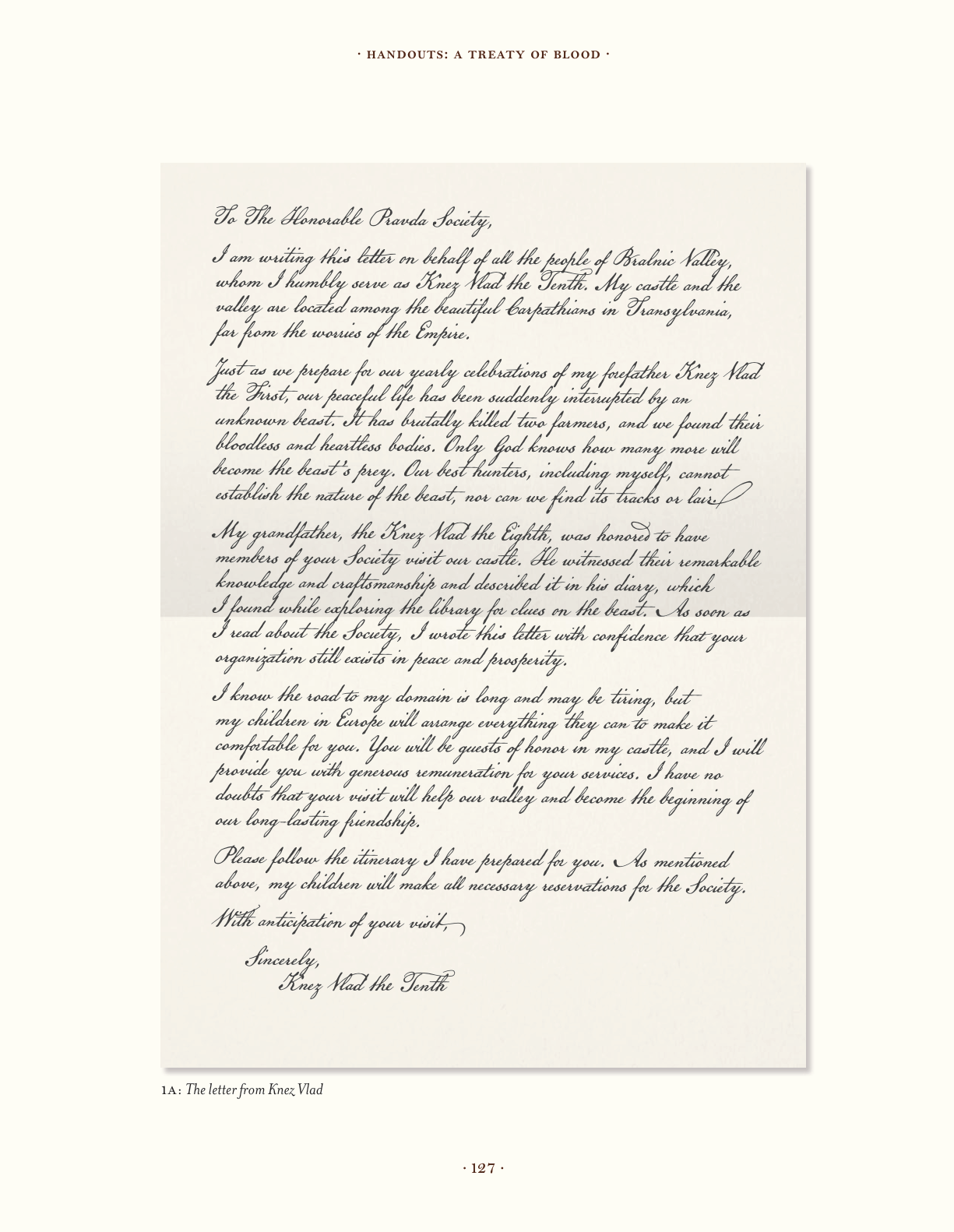
Knez Vlad becomes aware of the killings in the valley and has discovered the vârcolac’s absence from the dungeons. As he is not able to find the vârcolac and does not know that the creature is under Maria’s control, the knez takes a risk by writing a letter to the Society he encountered a few centuries ago (handout 1A on page 127, also available for download on the Free League website). The letter is sealed with a wax stamp showing a warrior killing a wolf-like beast. It is written in elegant handwriting on expensive French paper. To The Honorable Pravda Society, I am writing this letter on behalf of all the people of Bralnic Valley, whom I humbly serve as Knez Vlad the Tenth. My castle and the valley are located among the beautiful Carpathians in Transylvania, far from the worries of the Empire.
Just as we prepare for our yearly celebrations of my forefather Knez Vlad the First, our peaceful life has been suddenly interrupted by an unknown beast. It has brutally killed two farmers, and we found their bloodless and heartless bodies. Only God knows how many more will become the beast’s prey. Our best hunters, including myself, cannot establish the nature of the beast, nor can we find its tracks or lair.
My grandfather, the Knez Vlad the Eighth, was honored to have members of your Society visit our castle. He witnessed their remarkable knowledge and craftsmanship and described it in his diary, which I found while exploring the library for clues on the beast. As soon as I read about the Society, I wrote this letter with confidence that your organization still exists in peace and prosperity.
I know the road to my domain is long and may be tiring, but my children in Europe will arrange everything they can to make it comfortable for you. You will be guests of honor in my castle, and I will provide you with generous remuneration for your services. I have no doubts that your visit will help our valley and become the beginning of our long-lasting friendship.
Please follow the itinerary I have prepared for you. As mentioned above, my children will make all necessary reservations for the Society.
With anticipation of your visit, Sincerely, Knez Vlad the Tenth
Preparations
The letter includes train ticket for the first leg of the journey, from Prague to Temesvár via Vienna and Budapest. Before leaving Prague, the player characters can prepare for the journey by purchasing equipment (page 73 of the rulebook) or using Upgrades at Powder Gate (page 28 of this book). If they decide to look for some additional information, let each player make a LEARNING test. For each success rolled (in total), they gain one of the following clues:
- The valley is named after Bralnic Castle, built in the 14th century to protect an important trade route through the Carpathians. An earthquake caused a landslide in the 15th century, which closed the route and isolated the valley, leaving only one mountain road.
- The letter’s waxen seal refers to a story of a brave warrior killing a horrible beast and becoming the first Knez Vlad of the Bralnic Valley. After being severely wounded by the beast, the knez also defeated death and went on to rule and protect the valley.
- The paper on which the letter was written has watermarks of the French paper mill that made paper for monarchs, mainly Louis 14th, and was closed almost a century ago, at the start of the French Revolution.
- The Pravda Society did indeed visit the Bralnic Valley almost a century earlier, invited by Knez Vlad the Eighth to hunt down a rogue vampire. The vampire was eventually killed, along with one member of the Society – the young priest Karel Benes.
- This time of year, weather conditions in Transylvania are dangerous, with heavy snowfalls and low temperatures being common.
The Journey
Following the knez’s itinerary, the player characters depart from Prague by train, passing Vienna and Budapest before reaching Temesvár. There, they are met on the platform by a well-dressed young man, presenting himself as Lucian, son of Knez Vlad. He informs them that a carriage is prepared to take them to Brașov, the main town in Transylvania, the next morning. They may spend the night in a comfortable hotel, already paid for.
Brașov (Kronstadt) has a population of around 25,000 and is one of the biggest cities in Romania. Meanwhile, winter arrives in full strength, so the journey to Brașov takes almost a week. There, another young man greets the player characters, presenting himself as Darius, son of Knez Vlad. He informs them that another carriage will take them north along a small road to Bralnic Valley, far up in the Carpathian Mountains (not shown on the large map of Mythic Carpathia). This final leg of the journey takes two days.
It is late December, and roads are covered in snow, which makes traveling through the Carpathians very difficult. For each hour that passes, the snow becomes heavier, and any locals encountered are curious about the Pravda Society’s purpose, as they see no reason for outsiders to visit that isolated valley and the village located there.
You can play out the journey in detail or just handle it summarily, letting each player briefly describe what their character does. As usual, the characters can gain an Advantage during the journey (page 182 of the rulebook).
Arrival
Alone in a rickety carriage on a dangerous mountain road, the player characters travel through the Carpathians. The snowfall becomes heavier, before the coachman suddenly stops in the afternoon of the second day after setting out from Brașov. He declares that they have arrived and asks the passengers to disembark with their baggage, before he hurriedly turns the carriage around and leaves.
The player characters are alone at the gates to Bralnic Valley, between the ruins of two stone watchtowers that collapsed during the earthquake centuries ago. They rise above the road and are covered in snow. From there, the road splits in two. The right path goes down to the valley and the village, while the left goes up, leading to Bralnic Castle (page 81).
Cold & Wind
It is winter, and the frost is numbing. Each time a player character spends any significant length of time outside without very good winter clothing – including during their initial walk to the castle or the village – they must make a FORCE roll to resist the icy winds and snow. A character who fails suffers a physical Condition. The knez’s children can offer them sheepskin coats and boots that will protect them against the cold (page 84).
The Castle
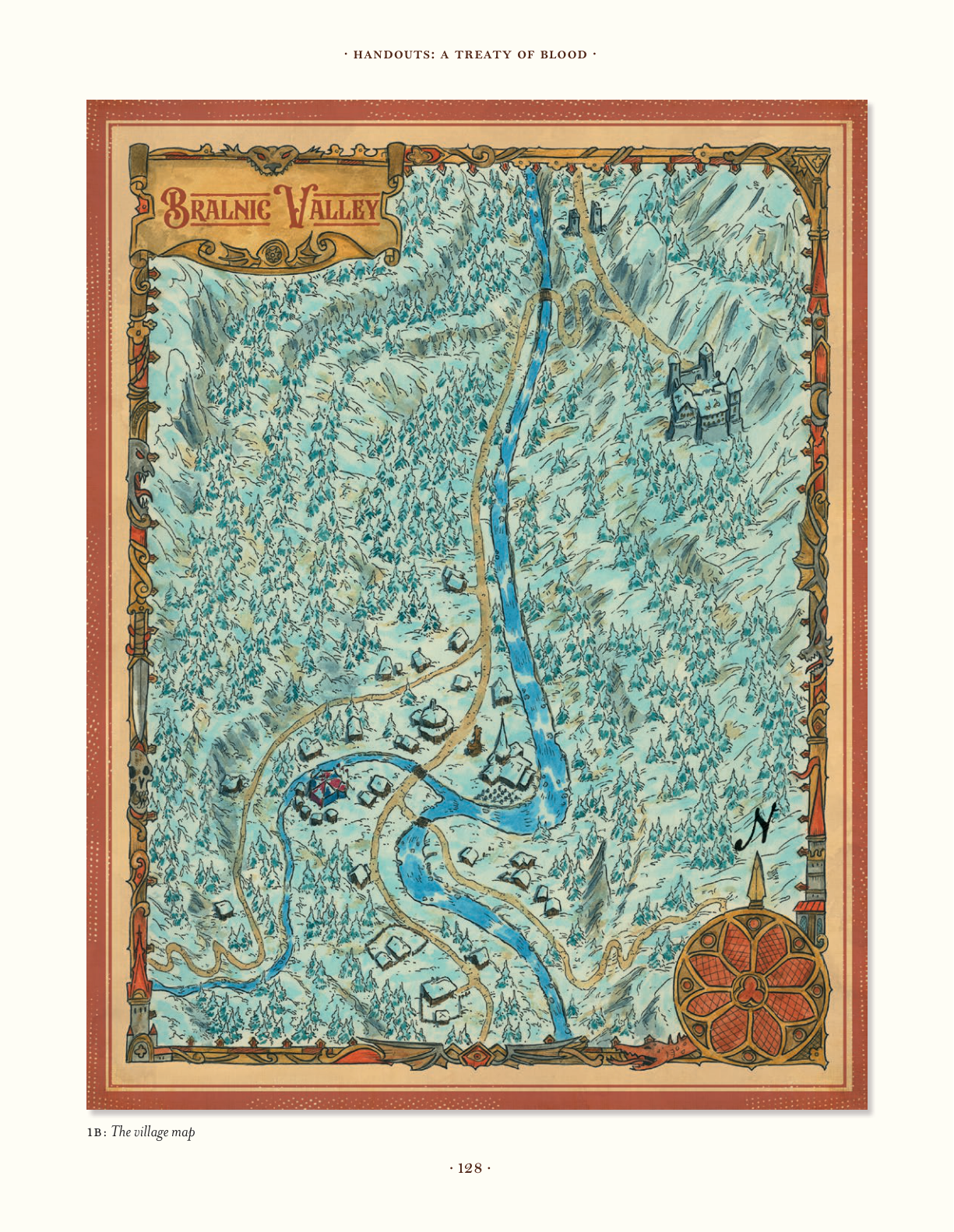
As the snowstorm lets up a little, the player characters see the castle looming like a mighty dark silhouette hanging over the valley. Down in the valley, they see the village with what looks like a church, a guesthouse, and a large tent in an open area. The valley is surrounded by mountains and forest on all sides. Give the players the player version of the village map (handout 1B on page 128, also available for download on the Free League website).
The Village
Even though the player characters are expected at the castle, and it would be wise to hide there from the storm, they are free to go to the village first if they choose. The road there takes twenty minutes to walk. For more about the village, see page 88.
Countdowns and Catastrophes
This mystery includes two countdowns. The main one is between the knez on one side and Eve and the villagers, instigated by Maria and the vârcolac, on the other. During that countdown, the villagers are slowly brought to the termination of their agreement with the knez and his defeat by the vârcolac and Eve. The second countdown indicates the growing power of the vârcolac, which results in it breaking free from Maria’s control.
The Villagers’ Countdown
At the beginning of the mystery, three villagers have been killed: two farmers on the edge of the village some weeks back and one hunter closer to Bralnic Castle, just a few days ago. This has influenced the mood of the villagers, who are feeling gloomy and distressed. Maria has been using her daughter to manipulate the villagers, making them hesitate and lose faith in their knez. 1. In the evening of the day when the player characters arrive, the traveling theater troupe (page
92) gives its first show, where they perform a
play depicting the Last Warrior defeating the beast.
This lifts the mood of the villagers and Eve, who
plays the Last Warrior, makes a speech about the
story and states that the people must be as courageous as the Last Warrior was, to fight against
the monster. 2. Spurred by Eve (page 94), the villagers decide
to go hunting for the beast. This will likely happen at a town meeting at The Last Warrior inn
(page 90) but can happen anywhere in the village. If the player characters are present, they may
try to dissuade the villagers, but their decision is
unchangeable, as they feel that they have been
doing nothing for too long. The player characters may also want to join the hunt, which they
are welcome to do.
During the hunt, two villagers are attacked
and killed by the vârcolac at Maria’s command.
The player characters cannot stop this, but they
may track the beast and hear the screams and confront the horrifying vârcolac in combat (see page
95 – and don’t forget its very high Fear value).
If defeated, the vârcolac disperses into gray mist,
but returns in a few hours. If the player characters
are Broken, the vârcolac leaves them and they will
be rescued by villagers who bring them to the Last
Warrior to treat their wounds.
After the battle, the player characters can track
the vârcolac towards Maria’s abandoned house
(page 93) with a VIGILANCE roll.
3. After the hunt and the death of the two hunters, they are brought to the church for burial and
another meeting is held – this time in the church.
Eve again agitates the villagers and asks them
why no one protects them from the beast. Why has
the knez failed his duty? This sparks an argument
between Eve and Father Iacob (page 90), who
pleads for patience. The villagers are torn but
eventually agree to send delegates to Knez Vlad
with a petition.
The tone of the message depends on who wins
the argument. If Father Iacob gets the upper
hand, it will be a humble petition, asking the
ruler for protection. If Eve is more convincing,
the message will be an ultimatum, demanding
action under threat of the treaty being broken.
If player characters are present and decide to
intervene, they can sway the villagers in one way
or the other with a successful INSPIRATION test. If
the player characters are absent or choose not to
interfere, you can make an opposed INSPIRATION
roll between Eve and Father Iacob, or simply
choose an outcome as desired. 4. Led by Eve, the villagers march to the castle after
dark, carrying torches. The knez comes out to
meet the delegation. The knez claims to have the
answer to the problem with the beast: the player
characters! They are experts at this sort of thing
and will soon thwart the beast, the knez claims.
The situation is tense, and the player characters
may need to roll for INSPIRATION or MANIPULATION
to intervene to avoid violence.
During the meeting, the knez sees Eve and
immediately realizes that she’s a dhampir – and his
daughter. If questioned by the player characters,
he may reveal this fact and tell them the story about
Maria – only leaving out that he killed her parents. 5. In the night, the celebrations start, and crowds of
people dressed in wolf and bear skins dance and
sing in the streets. The vârcolac, controlled by
Maria, sneaks through the crowds, looking for
the next victim. This leads directly to the Confrontation – see page 95.
The Villagers’ Catastrophe
If Eve breaks the treaty and the knez is killed and the vârcolac’s catastrophe (below) does not occur, the villagers cheer Eve and choose her as their new knez, signing a new treaty, already prepared by Maria. The villagers receive new freedoms, but Eve eventually dies and becomes a vampire.
Unless the family of the former knez, especially those abroad, can be convinced to support the new knez by learning of Vlad’s past crimes, the valley lacks the resources to maintain itself. Most people leave the valley to look for a better life, and only a few stay, living in a small community that can maintain itself but is destined to become extinct, leaving a hungry vampire alone.
The Vârcolac’s Countdown
At the beginning of the mystery, the vârcolac looks like a pale, skinny man with thick black hair and feral eyes. The vârcolac restores its powers bit by bit with each killed and drained victim, becoming more bestial, until it looks like a giant wolf. Maria’s spindle of yarn makes the vârcolac obedient and even stronger. Information about the vârcolac’s powers and how it is controlled can be found within the knez’s library (page 85), or even with a successful LEARNING check if the players are struggling to understand what they are dealing with. 1. The first three victims the vârcolac kills before the
beginning of the mystery restore its general powers,
making its appearance something between man
and wolf. At that stage, it can communicate and
express coherent thoughts. 2. The killing of two more hunters (step #2 in the
villagers’ countdown) grants it more power (giving
it to MIGHT) but affects its personality so that it
can express only simple thoughts that are barely
understandable amidst its roaring words. 3. The sixth killing restores almost all of its powers
(another to MIGHT), leaving no place for conscience and making it a bloodthirsty predator.
The Vârcolac’s Catastrophe
If the number of the vârcolac’s victims reaches seven, it becomes strong enough to break Maria’s control. If the thread that grants it more power remains intact, it uses its magic as a pathway to the moon and bites it. The white light changes to red as the blood from the vârcolac’s mouth spills on the heavenly body. The creature needs a few more bites to devour it and plunge Bralnic Valley into complete darkness.
After that, the beast returns to eat everyone in the valley. At this point it cannot be defeated in combat and the player characters must pass a STEALTH test to hide or an AGILITY test to run from the vârcolac. Multiple tests are allowed, but player characters receive one physical Condition for each failed test. Once a test succeeds, the player character is out of harm’s way but cannot return to the valley.
Locations (11)
Maps (1)

Inner Courtyard
The player characters enter here when they arrive. The gates are typically open. Tall walls surround the inner courtyard, with areas designated for chopping wood, butchering, and skinning. There are a few different entrances into the castle: the main doors – carved, wooden, three meters tall – and a few smaller entrances used by the knez’s “children” that lead to storage areas, the kitchen, and corridors within the castle. There is also a wooden door set into the mountainside, leading to a root cellar and the dungeon (page 87).
Challenges
- The Children: When the player characters arrive, they will be met by two of the knez’s “children,” Elena and Adrian (below). They welcome the guests, guide them to the other locations in the castle (except the knez’s chambers and the dungeon) and show them their quarters on the third floor. A third child, the sullen Mihai, works in the courtyard and watches the entrance to the dungeon (page 87).
- Exploring: Dinner will be served in the dining hall (page 84) in the evening, but the player characters have time to explore until then. As long as they don’t try to enter the knez’s chambers or the dungeon, they are allowed to roam the castle freely.
- The Village: The player characters are not prohibited from going to the village but are warned about the dangerous beast stalking the countryside. If they decide to go there, the family offers them warm sheepskin coats and boots, and asks them to return for dinner with the knez after sunset.
- Warm Clothes: The knez’s children can offer the player characters thick sheepskin coats and boots that will protect them against the biting cold outside (page 79).
- Home for Dinner: If the player characters choose to stay the night in the village, someone from the family finds them and invites them to dine with the knez, as it is a tradition that the knez dines with his guests on the first evening.
Clues
- Collars: If the player characters interact with the children, allow an INVESTIGATION roll to notice that they all wear high collars, hiding their necks from view. This is to hide the bite marks from the vampire.
Dining Hall
The dining hall on the second floor is much smaller than the grand hall and is currently used by the knez to dine with guests and with his family. The walls of the room are covered with gorgeous tapestries and carpets. A hidden door conceals stairs leading down to the kitchen.
The long wooden table is always set with porcelain dinnerware on a white silk tablecloth, with seats for sixteen guests. Two fireplaces and numerous candles provide just enough light for dinner and conversation but leave the corners of the ceiling shrouded in darkness. The player characters will be served food here and dine with the knez.
Challenges
- The Dinner: At dinner, the characters meet Knez Vlad and all six of his children residing in the castle in the dining hall. The knez enters the room in a bulky coat made from thick black fur. Underneath, he is wearing an elegant dark red suit similar to those prevalent in Prague and Vienna. He greets the player characters and invites them to eat. His children also wear fine suits and dresses and do not participate in the conversation unless asked to directly. The knez doesn’t eat food, but drinks what looks like dark red wine.
- The Vampire: The players will probably expect a vampire during this mystery, and their characters may well suspect that Knez Vlad is a vampire. However, the knez is only a threat to the player characters if they decide to fight him, as he only wants to stop the beast and restore the status quo. At the beginning of the mystery, the knez, remembering his previous encounter with the Society, is cautious and wants to know the player characters’ attitudes toward vaesen before revealing himself.
Clues
- The knez is open to questions and recalls events when prompted, pretending all the while that he is unaware of the nature of the beast. If asked, he shares the story of his “grandfather” working with the Society to stop the killings in the valley (page 76) – but he doesn’t reveal that the vampire was his own son, nor that the priest working with the Society was killed by one of their own members.
- The children (page 83) openly share that they were adopted by the knez as an obligation included in the treaty. See the sidebar The Knez’s “Children” for more information. OBSERVATION tests can reveal that Daniel and Alina seem uneasy talking about this.
- Bite Marks: All children have distinctive scars on their necks, marks left after the knez’s repeated feeding and healing of the wound. The children typically cover the wounds with high collars, but they may be spotted with an INVESTIGATION test. If confronted about this when the knez is not present, a MANIPULATION test will have the children admit the cause of the bite marks.
- Confronting the Knez: If the player characters reveal their suspicions to the knez about his vampiric nature, they need to make a MANIPULATION test (several attempts may be made at different points during the mystery). If successful, the knez acknowledges their suspicions. He tells the story of his battle with the vârcolac and how he was cursed with eternal life. He refers to his peaceful life, killing no one and protecting the valley. He argues that the valley is in danger, and they must work together to find the escaped vârcolac, who has somehow become more powerful than the knez now. He honestly needs their help, something that can be confirmed with an OBSERVATION roll.
The Grand Hall
From the inner courtyard, the main doors lead into the castle through the long, high-ceilinged central corridor to the grand hall. It is a spacious room with four cold fireplaces. Long ago, it hosted aristocratic celebrations with music and dances, but now it has been repurposed as storage. Only the artful carvings on the walls and ceiling hint at its forgotten glory.
Library
From the dining hall, stairs lead to an extensive library on the third floor. Numerous bookshelves create a labyrinth inside the room, leaving free passages along the walls. Only closed lamps are used here, protecting precious books and scrolls from fire.
Challenges
- Books: The knez has assembled an impressive collection of books, ranging from occult lore and folklore to science and philosophical papers, and will gladly allow the player characters to study here. You can let the players make LEARNING tests and give out one clue for each success rolled in total. Multiple attempts are allowed, but each roll takes a few hours of study. See Clues below. If you have access to the art book The Undead by Johan Egerkrans, the players may freely reference it. It describes the vârcolac and even features it on the front cover.
- Secret Door: A successful INVESTIGATION test reveals a secret door behind a bookshelf. The passage leads to the personal cabinet of the knez, where the player characters find letters and bills from different places in Europe sent by his children, reporting on successful deals and investments in factories, art, railways, and land.
From a quick skim of this material and a LEARNING roll, they realize that the valley is sustained by the knez's earnings abroad and would not survive without his support. Additionally, the knez's collection of wigs and makeup is stored here. The player characters may realize that the knez has pretended to be different knezes in the past.
Clues
- The Vârcolac: If the player characters look for information about the beast that was killed by Knez Vlad the First according to the legend, they find an ancient scroll portraying a wolf-like beast called a vârcolac. It is said to fall from the sky, kill people, and run on a beam of moonlight, trying to reach the moon with its bite.
- The Spindle: It is also said that a vârcolac becomes more powerful and more bestial for each person it kills. A vârcolac cannot be killed, but it can be imprisoned and even controlled by spinning a thread from its hair or fur on a spindle.
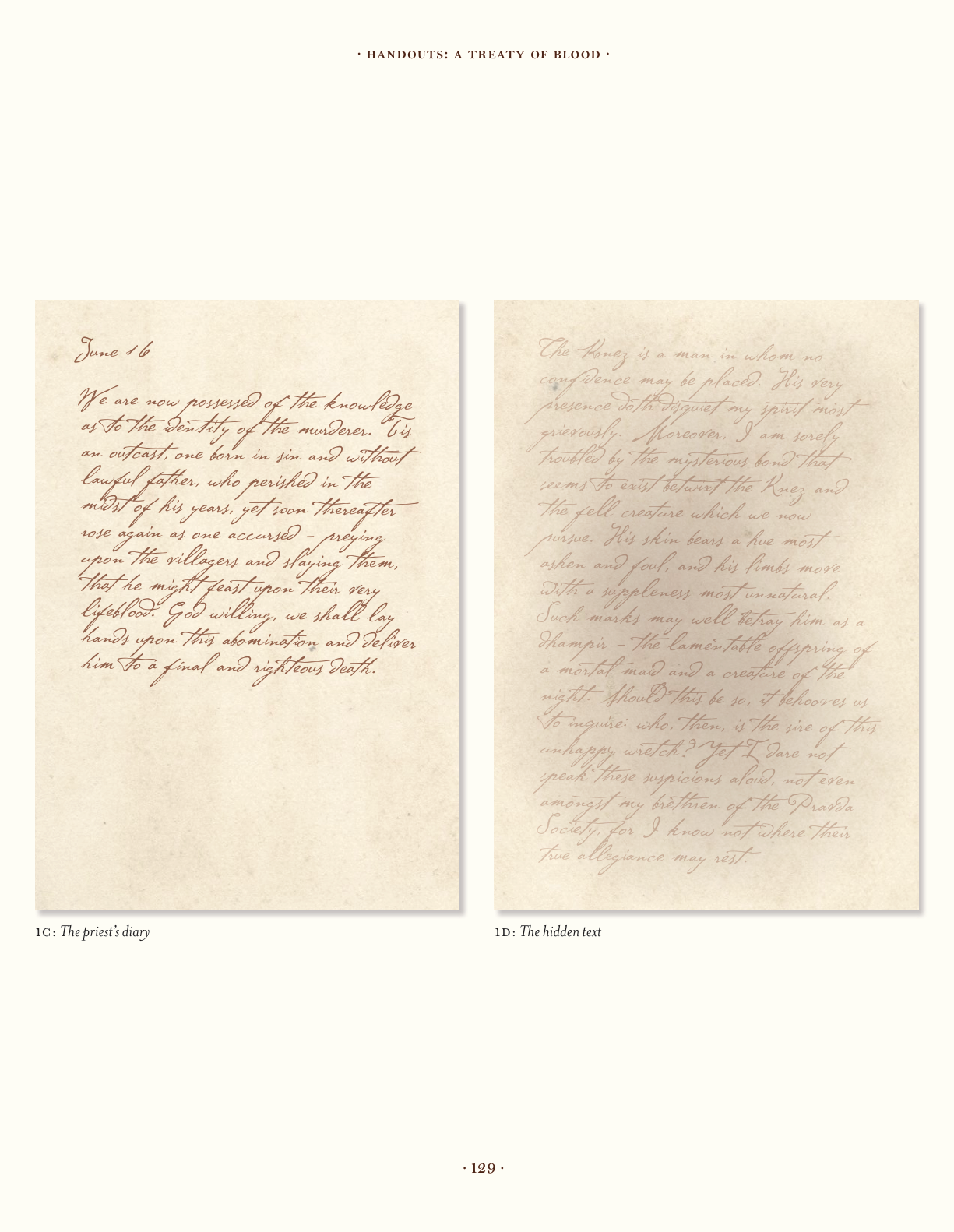
- The Priest's Diary: In the library, the player characters may also find an old diary written by Karel Benes, the priest who came here as a member of the Pravda Society almost a century ago (page 76). This may be found if the players look for information about this previous visit, or they may simply find it by chance. The priest describes the case they were working on – see handout 1C on page 129, also available for download on the Free League website.
- The Hidden Text: The rest of the pages of the priest's diary are empty. With a successful INVESTIGATION test, the player character finds hidden text written in invisible ink after heating it over fire – see handout 1D on page 129, also available for download on the Free League website.
- Confronting the Knez: If the player characters confront the knez with the priest's diary, he will admit that the vampire killed by the Society was his dhampir son. He did not reveal this initially because of the shame he feels over it. If asked about the priest, the knez says that he was sadly killed in an accident during a quarrel with the other Society members, and that he lies buried in the village. He claims he doesn't know what the quarrel was about. An OBSERVATION test can reveal that the knez is not telling the truth about this.
The Priest's Diary
June 16
We are now possessed of the knowledge as to the identity of the murderer. 'Tis an outcast, one born in sin and without lawful father, who perished in the midst of his years, yet soon thereafter rose again as one accursed – preying upon the villagers and slaying them, that he might feast upon their very lifeblood. God willing, we shall lay hands upon this abomination and deliver him to a final and righteous death.
The Hidden Text
The Knez is a man in whom no confidence may be placed. His very presence doth disquiet my spirit most grievously. Moreover, I am sorely troubled by the mysterious bond that seems to exist betwixt the Knez and the fell creature which we now pursue. His skin bears a hue most ashen and foul, and his limbs move with a suppleness most unnatural. Such marks may well betray him as a dhampir – the lamentable offspring of a mortal maid and a creature of the night. Should this be so, it behooves us to inquire: who, then, is the sire of this unhappy wretch? Yet I dare not speak these suspicions aloud, not even amongst my brethren of the Pravda Society, for I know not where their true allegiance may rest.
Living Quarters
On the second floor are rooms for the knez’s children, and the third floor holds rooms for guests. The player characters will be offered separate rooms with all necessary amenities. The fireplaces are already burning, heating the rooms. The carved wooden furniture, tapestries, and carpets create a cozier atmosphere than elsewhere in the castle.
However, after spending some time in silence, the player characters might hear the wind howling somewhere in the sealed corridors of the castle, and they may experience a constant feeling of being watched. During the night, the players may experience strange dreams and visions (page 81).
The Dungeon
A door in the mountainside in the inner courtyard leads to the dungeons. Behind the door is a root cellar with food stocks and a separate room for wine. At the back there is a solid wooden door, that has clearly been broken down from the inside.
Challenges
- Mihai, one of the children of the knez, always works in the courtyard and will take note of player characters going into the root cellar unless they sneak by rolling for STEALTH. If they are seen, he warns them against going into the dungeons below, stating that it is too dangerous as the old tunnels may collapse – an OBSERVATION roll will reveal this to be a lie. A MANIPULATION roll can convince Mihai to let them go in, but then he will accompany them and later tell the knez everything they found or said.
- The Dungeon: In the tunnels there are cells for prisoners and an old but well-kept armory. In one of the cells, the bars are broken, as if from the inside. The vârcolac was kept here before its escape.
Clues
- The Fur: If the player characters examine the cell with the broken bars, an INVESTIGATION roll will let them find a piece of thick black fur stuck to one of the bars.
- Star Marks: In addition, the walls and ceiling of the cell are carved with chaotic star-shaped marks. Another INVESTIGATION test reveals that the marks resemble the map of the night sky above the village. An additional success shows that the map reflects the positions of stars from more than five centuries ago.
- Bloodstains: A successful MEDICINE test gives away layer after layer of bloodstains on the stone floor, dating from different times. These were left after feeding the imprisoned vârcolac with cattle, but there is no apparent way to tell this.
- Confronting the Knez: If the player characters confront the knez with their finds in the dungeon, he will admit that the vârcolac was held there for centuries but recently escaped – and that this is probably the beast now on a killing spree in the valley. He claims he didn’t reveal this earlier as he was not sure. He can also give them general information about vârcolaci unless they already found it in the library (page 85).
The Knez’s Quarters
Also on the second floor, behind the children’s rooms, are the knez’s quarters. His room is dark and cold, with thick curtains drawn and a large wooden coffin placed in the center.
Challenges
- The children are always watching this area when the knez sleeps, and sneaking past them will require a STEALTH roll.
- The door to the knez’s quarters is always locked, and only the knez has the key. The lock can be picked with a STEALTH roll or broken down with FORCE – but the latter will automatically alert the children in the castle, who will come to his aid.
- The Coffin: The knez spends his days in the coffin but will awake if disturbed, to defend himself.
The Church
The orthodox church is an old wooden building on one side of the square in the middle of the village. There is a large statue of the "first" Knez Vlad defeating a wolf-like beast in the center of the main square facing the church, and one tall steeple in the front of the building. Out back is a small churchyard.
A warm, dim light shines from the small windows of the church. The church is in good condition, with benches set under the walls and a beautifully carved, gilded wooden iconostasis (a screen bearing icons) with embroidered hangings.
At all times of day, the priest Father Iacob and some parishioners are preparing it for the celebrations, wiping dust, polishing the gilt, and hanging red banners. The smell of hay strewn on the floor and burning incense greets everyone who enters. The light from small windows under the ceiling and the sea of shimmering candles make it feel warm and sacred but leave corners draped in shadows.
Challenges
- Father Iacob is busy organizing the work but kindly greets the player characters and gratefully accepts their help, answering questions while working. He's happy to answer their questions – see Clues below.
- The Churchyard: If the player characters explore the churchyard, they may notice footsteps in the snow leading to one grave. An INVESTIGATION roll reveals that the same person, with quite small feet, seems to have walked to this grave many times recently. For more, see Clues below.
- Mourners: After the death of the two hunters, their bodies are brought here for burial and many mourners gather here for a meeting about what to do next (see steps #2 and #3 in the villagers' countdown on page 79). Sad, sorrowful people in dark clothes look incongruous amidst these colorful decorations.
- The Confrontation: During the final Confrontation with the vârcolac (page 95), the villagers will hide here and ring the church bell to summon Knez Vlad.
Clues
- The Graves: The tombstone for the grave mentioned above has two names on it – Alexandru and Magdalena Weber (Maria's parents, see page 76). They both died on the same date, just over 40 years ago. Nearby, the player characters can also find an older grave of Karel Benes, the priest killed during the first visit from the Society (page 76).
- Exhumation: Father Iacob will not allow digging up any graves. Doing so anyway requires a FORCE roll. A MEDICINE roll reveals that the remains of Alexandru and Magdalena Weber have severe damage to the bones, which are broken and torn apart, while the skull of Karel Benes seems to have been bashed in.
- The Treaty: Inside the church, the player characters notice a stand with a treaty under glass close to the iconostasis. This is an old document written on rough paper, with many signatures, a wax seal displaying a man killing the beast, and what appears to be old bloodstains mixed with ink on the signature of Knez Vlad I. With a successful INVESTIGATION test, the player characters notice that the signatures of Knez Vlad I, who signed the treaty, and Knez Vlad X, who sent the letter to them, look too similar to be signed by different people.
- Father Iacob shares that fewer and fewer people have been coming to the service since the arrival of the Wallachia Mystique Extravaganza. He is disappointed that in such difficult times the villagers chose plays over God. He would not be surprised if God sent the beast as a punishment for their sins, the way it had happened a long time ago.
- Maria: If Father Iacob is asked about the grave of Alexandru and Magdalena Weber outside, he says he was only a boy when they died but recounts the sad tale of the couple being brutally murdered by a savage beast in their house. The previous knez managed to save their daughter Maria, who was brought to him in the castle as his wife. She later left the valley and has not been seen since. The Weber house still stands abandoned at the edge of town (page 93).
Celebrations
Every year on the day before Christmas, Bralnic Valley celebrates the beast's defeat, the signing of the treaty by Knez Vlad the First, and his miraculous recovery the next day. It is another element of religion twisted by the knez to sanctify his authority. This year, celebrations start the evening after the player characters' arrival at the village.
The valley's residents prepare for the celebration weeks in advance. They clean houses, build a fairground on the main square, and decorate everything with red ribbons that symbolize the blood spilled by the first knez while protecting them. They also make a giant scarecrow of the wolf-like beast out of hay and wooden sticks to burn at the end of celebrations.
Another essential element of the festival is the night beast dances. People of the valley choose the best pelts they have, usually those from wolves or bears, craft terrifying heads for them, and make beast costumes. They also twist red cords and bind them in tassels that they adorn with small bronze bells, to decorate their costumes with.
When the first star appears in the night sky, all the villagers dressed in beast costumes leave their homes singing and dancing, making as much noise with their bells as possible. This colorful and loud mass flows to the main square, where they celebrate, dance, eat, and drink all night. Thus, they are scaring evil spirits that come during the longest night to steal and eat the stars and the moon. The noise of bells, drums, and music must never stop so the spirits cannot sneak into the village during a moment of silence. People usually sing and show off their best dances on stage with families or groups of friends, participating in a few performances that night. When the first rays of the sun hit the peaks of the mountains, people bring out the beast-shaped scarecrow to the center of the square, just as the church bells start to ring.
The knez and his family, dressed in ancient ceremonial armor, descend from the castle to the village mounted on horses and carrying lit torches. While the cavalry moves to the main square, the villagers make as much noise as possible to greet the knez and his family. Still mounted, the knez makes three circles around the scarecrow and then sets it on fire. While it is burning, the villagers dance and celebrate the knez's victory. He dismounts and walks among people, greeting them and giving them presents.
Only after the flames consume the scarecrow do people remove their masks and see with whom they have been dancing all night. After the church bell rings for the last time that morning, Father Iacob (page 90) starts a service out in the open, in the light of the sunrise, celebrating the victory of Light over Darkness, praising the brave people of the valley and especially Knez Vlad, who defeated the beast. The knez remains present until the end of the service despite the daytime starting, since he is an old, well-fed vampire and can tolerate such minor inconveniences.
Throughout the mystery, the player characters may observe or even participate in preparations for the celebration. It is unlikely that celebrations will happen as planned because of the events in both countdowns and the Confrontation – see page 95.
The Tavern
The local tavern called “The Last Warrior” is a circular, well-insulated wooden building that stands opposite the church on the main square. It is named after the local legend who received the title of Knez Vlad for defeating the beast and protecting the valley. The tavern has one big, rounded hall, a kitchen on the opposite side of the entrance, and wooden stairs on the perimeter that lead to a few rooms for guests on the second floor.
The Last Warrior, with its big fireplace in the middle, delicious and nourishing food, and homemade drinks, is a favorite place for the villagers, especially hunters, who gather here to warm up and share rumors and stories from their hunts. Its keeper, Radu Harnicu, is also preparing for the celebration and decorating the tavern with tree branches and red ribbons under the ceiling. The kitchen works without breaks, preparing meals for the celebrations.
Challenges
- Villagers: Before the celebrations, many villagers are here preparing decorations and costumes, eating, and drinking, and their children are running everywhere. When the player characters enter, they are met with suspicion, especially if they are wearing the sheepskin coats loaned to them by the knez’s family. An INSPIRATION test is needed to win the trust of these people, who are upset with the death of their friends and irritated with their knez doing nothing about it.
- Town Meeting: After Eve’s speech against the knez on the first evening of the mystery, a town meeting is held here, where the villagers decide to go hunting for the beast. See step #2 in the villagers’ countdown (page 79) for more.
Clues
- The villagers preparing for the celebration twist red strands into cords and bind them into large tassels. Some people polish and repair small bronze bells that are later attached to those tassels. A successful LEARNING roll helps the player characters recall that in many cultures, bells or other implements that produce loud noises are used in rituals to protect from evil spirits.
- The Innkeeper: By talking with people at the tavern, the player characters can learn more about the innkeeper, Radu Harnicu. The actual owner of this place is his wife Lidia, one of the knez's adopted "daughters," who spends most of the time in the kitchen preparing for the celebration.
- Split Sympathies: With a successful OBSERVATION test, the player characters may notice that Radu tries not to choose a side in the conflict between the villagers and the knez's family, because he is married to one of the knez's adopted children but also understands and sympathizes with the villagers.
- The Strange Sighting: Radu is quite busy but if the player characters win his trust (MANIPULATION test), he's willing to talk to them. He recalls a strange scene he witnessed as he was returning home a few nights ago. He saw two figures: a tall one in a bulky coat made of thick black fur, and a smaller one who he thinks might have been "Mother Maria" from the traveling theater (page 92). They were entering an abandoned house at the edge of the village. Actually, Radu saw Maria meeting with the vârcolac but mistook the creature for a man in a coat. If asked about the house, he can tell them where it is but doesn't know who lived there – Father Iacob (previous page) should know more, however.
The Wallachia Mystique Extravaganza
The knez invited this wandering theater to cheer the people of the valley, as it was in nearby Brașov and could arrive quickly. This was part of Maria’s plan (page 76). The theater travels in five beautiful vardos, which serve as a home for the six troupe members. They arrived in the valley a few days ago, and in the time since then a hunter has become the vârcolac’s third victim.
The theater is set up in an open area on the outskirts of the village with a big, colorful tent and a stage inside. The troupe have also decorated the area with festoons, flags, and placards from their former performances all around Europe.
Challenges
- The Troupe: The theater is open to everyone and performs in the evenings. During the day, the troupe is busy preparing for their performances, maintaining their tent, and decorating the area, and some villagers occasionally pass nearby to look at and talk to the guests. The troupe is happy to interact with the player characters – see Clues for more.
- Mother Maria is interested in the player characters, especially if they are dressed in sheepskin coats from the castle, as the Society may become an obstacle to her plan. To learn more about them, she invites them to her vardo, offering to tell their fortunes and at the same time asking them questions about their current case. Maria is an occultist who has the talent Medium, but does not require a dice roll to tell the parts of the player character’s backstory or hint at their dark secret. While talking with Mother Maria, during her fortune telling or on other occasions, the player characters may take an OBSERVATION test to understand that she is worried about their presence and that she is hiding something. However, she will not reveal the truth until the final Confrontation (page 95).
- The Vardos: If the player characters decide to sneak into any of the vardos, the best time to do so is during the plays, while the troupe and visitors are inside the tent. However, they must pass a STEALTH test to be unnoticed and to open closed doors.
- The Show: On the first evening after the player characters arrive, the Extravaganza gives its performance about the Last Warrior. After the show, Eve makes a speech to encourage people to be brave, and hunt down the beast – see step #1 in the villagers’ countdown (page 79).
Clues
- The Troupe: Anyone from the Extravaganza can tell that the knez invited them when they were in Brașov. Upon arrival, they were invited to the castle for dinner, but Mother Maria said no and told the troupe to avoid that place. They are unhappy with this decision since sleeping in a wooden wagon in the winter is not very comfortable. A successful INSPIRATION or MANIPULATION test persuades the troupe to share their worries. When Maria became the director, she led their troupe to different places, pursuing her own unknown interests and disappearing for long periods upon each arrival in a new city. It appeared to the troupe members as if she had some plan of her own rather than focusing on the theater, resulting in the loss of profits and lower morale.
- Octavian: If player characters talk to Octavian and win his trust (INSPIRATION), he tells them how Maria joined the Extravaganza. Forty years ago, the troupe had been invited to this valley to entertain people. On the night before they were to leave, a terrified young woman asked them to take her out of the valley. The former director could not refuse as they all heard rumors that the woman’s family had been killed in their home by a bear. A few months after departing the valley, the woman, Maria, gave birth to a strange child with gray skin and black hair. This was Eve. Her mother Maria was vigilant, constantly looking over her shoulder as if someone was after her. She went to libraries wherever they stayed and read many occult books. After she became the troupe’s director, she changed the former name of the troupe – “The Carpathian Wandering Theatre” – to its current title and led them through Europe, from Sweden to Spain and Greece.
- Eve: Player characters who meet Eve notice that her skin is not covered in gray makeup but is actually gray and looks like it is covered in dirt. With a successful OBSERVATION test, they understand that she is sick and trying to hide it. She occasionally coughs, and her muscles contract as if she is in pain. If asked, she answers that she was born with a rare skin condition, and because of that, her mother was forced to leave her home, despite being with a newborn child.
- Maria’s Vardo: If the player characters manage to sneak into Mother Maria’s vardo, they find many occult books about the undead. The marked paragraphs and pages describe cases of children born from an undead parent. Despite their supernatural talents, they are destined to die in their thirties or forties. Further search requires an INVESTIGATION test to find a hidden box under the floor. The box contains an old but fine silk napkin with the initials “KV IX” and a simple wooden spindle with rough black thread wrapped around it.
The Abandoned House
The house is located on the outskirts of the village, close to the forest that cascades from the mountains. It is a small wooden building on a stone foundation, with just a main room and a side room inside. There is also a root cellar with a separate door from the outside.
Maria’s family lived here, and no one took over the place after her parents’ death. Since Maria left, this deserted house has been slowly collapsing – the door is leaning inside and the roof leaks, although some things remain of its former owners.
After Maria recently returned to the valley, she uses this place as a hideout for the vârcolac.
Challenges
- Footprints: The house was abandoned a long time ago, but the player characters may notice indistinct snowy footprints on the stairs that disappear inside. An INVESTIGATION test reveals that the footprints are from a small person.
- The Cellar: The vârcolac’s hideout is in an empty root cellar underneath the house. The beast is likely not here when the player characters arrive – but it can be if you want it to. It will immediately attack if confronted. If combat ensues, use the guidelines in step #3 of the villagers’ countdown (page 79).
- Someone Comes: When the player characters visit the house, Maria and/or the vârcolac may return. You can use this to create a tense scene. The player characters may attempt to hide (STEALTH test) or confront whoever is coming.
Clues
- Inscriptions: Anyone examining the main room will notice old carvings in the ceiling. A LEARNING test will reveal the inscription in Romanian: “Knez Vlad IX built this house for Alexandru Weber, his wife Magdalena, and their daughter Maria. God bless them for a long and happy life.”
- Love Letters: If the player characters examine the main room, an INVESTIGATION test lets them also find a bundle of love letters in the fireplace, partly burned. It’s still possible to make out that the love letters are addressed to Maria and signed by Knez Vlad IX. They will recognize that the handwriting on the love letters from the ninth knez and the script on the invitation they received from the tenth knez are identical.
- The Spinning Wheel: The door to the side room is skewed and twisted with age. The player characters can force it open and see that it leads to a sewing workroom. Some equipment is left, including a spinning wheel. Apart from a missing spindle, the wheel is still functional and seems to have been recently repaired and used.
- Black Fur: Player characters who pass a VIGILANCE test notice a piece of thick black fur caught on an iron nail in the door frame to the root cellar. It looks as if it was torn free not long ago.
Cast
The Knez’s “children” p.83
“It is an honor to join Knez Vlad’s family. Our father is not perfect, but we will do everything to repay his kindness.”
Under the treaty, the knez must adopt a youngster from the village every few years. The person may be an orphan, but it is also seen as an honor for parents to give their child to the knez. In return, the knez sees to the children’s education and well-being. The knez’s family lives in the castle and visits the village only on business. Most of the children accept this fact without question, but there are exceptions (see below).
After a few years in the castle, the children may choose to stay in the castle, move back to the village, or be sent to Europe by the knez. There are ten adult children of the knez scattered throughout Europe and nine more living in the village, including the priest and his sister-in-law, who owns the Last Warrior.
Mihai: A severe and moody hunter with messy black hair. When he came of age, he decided to stay in the castle. He is competitive and proud of his hunting skills.
- STEALTH 3, RANGED COMBAT 3, CLOSE COMBAT 2
Elena: A calm and kind young woman who currently organizes most of the work in the castle. She has curly blonde hair and green eyes.
- FORCE 2, AGILITY 1, VIGILANCE 2
Adrian: An open and cheerful young man interested in history and science. He wants to study in Europe but for now must help in the castle.
- LEARNING 2, MANIPULATION 2, MEDICINE 1
Constantina: A bright and loud ginger young lady who usually helps Elena and has a collection of postage stamps from the letters Knez Vlad receives.
- AGILITY 2, MANIPULATION 2, INVESTIGATION 1
Daniel: A shy and sneaky youngster who likes to roam the castle and explore it. He has a bandage on his hand, which he broke when he slipped on the stairs. Daniel misses his own family and secretly wishes to leave the castle. An INSPIRATION test can reveal this.
- STEALTH 2, AGILITY 2, VIGILANCE 1
Alina: An observant and straightforward girl with piercing brown eyes. She has a tiny pet mouse that she carries with her everywhere. Like Daniel, Alina recently settled in the castle. She misses her parents and feels unhappy, but fears to speak out.
- MANIPULATION 1, OBSERVATION 2, INSPIRATION 1
All have the following characteristics:
- Physique 2, Precision 2, Logic 2, Empathy 2
- Mental Toughness 2, Physical Toughness 2
Father Iacob p.90
“God sends us these difficult trials to remind us that we should be grateful and not take anything for granted.”
Father Iacob is a thick-set man in his forties with a long, pointy black beard, black priest robes, a black Romanian skufia (clerical cap) on his head, and a silver crescent on his chest. He looks calm and wise, as is often required for a priest, but he is depressed because of the killings. He believes that the traveling theater has brought more unrest than joy. His deep and powerful voice sounds impressive during the church service.
Iacob belongs to the knez’s family – he lived in the castle in his youth, was sent to a European seminary, and then replaced the former priest in the village. Because of this, Father Iacob is loyal to the knez and believes in him and in the treaty as much as he believes in God. He often refers to the knez and the treaty during his sermons, sharing his faith with the villagers.
If Father Iacob learns of the knez’s past crimes against Maria and her parents, he will be bitterly disappointed and demand that the knez be banished from the valley forever.
Hunters p.91
“We should hunt prey, not bloodthirsty beasts. The knez must protect us, as did his ancestors. If we must kill the beast ourselves, why then must we have the knez lording it over us?”
These folk are from the valley and their job is to hunt animals for their skin and meat. Like everyone in the village, they grew up believing that the knez protects them from all dangers. After the horrible murders of their friends, they feel afraid and angry. Eve’s speeches make them question the role of the knez and their own power in that relationship.
Radu Harnicu p.91
“I do not want to believe that the knez ignores us, but the villagers have already lost their relatives and are starting to lose their hope.”
Radu is an energetic, loud man in his mid-thirties. He has curly blonde hair, blue eyes, and a kind smile. Because of a lifetime of hard work, he is well-built and confidently moves through the tavern, serving tables with food and drinks.
Radu married the knez’s daughter, Lidia, and Knez Vlad had The Last Warrior built as a gift for their wedding. Shy and quiet, Lidia prefers cooking with her mother-in-law, leaving Radu to care for the tavern guests. He is loyal to his wife and their job but also understands those he grew up with. At the beginning of these terrible events, he appears to be stuck between both sides, so he currently chooses to take neither.
Theater Members p.92
Currently, the Wallachia Mystique Extravaganza consists of six members:
Mother Maria: Director and fortune teller. See more on page 94.
Eve: Acrobat and the director’s daughter and right hand. See more on page 94.
Bianca: Juggler and knife swallower, she is a tanned woman in her thirties, with black hair and big brown eyes. She is married to Dragomir.
- AGILITY 2, RANGED COMBAT 3, MANIPULATION 2
Dragomir: Fire breather, cheerful and calm. Husband to Bianca, he is a tall, skinny man in his thirties, with short red hair.
- FORCE 1, AGILITY 1, INSPIRATION 3, OBSERVATION 2
Gabriel: A bald, muscular strongman in his fifties with a black pointed mustache – silent and serious.
- FORCE 3, CLOSE COMBAT 2, RANGED COMBAT 2, VIGILANCE 1
Octavian: A 70-year-old magician with long white hair and a pointy beard. Despite his age, he shows no sign of weakness and may be seen walking outside in a nightgown only.
- FORCE 1, STEALTH 3, MANIPULATION 2, OBSERVATION 1
All have the following characteristics:
- Physique 3, Precision 2, Logic 1, Empathy 3
- Mental Toughness 2, Physical Toughness 3
Mother Maria p.94
“An ancient evil is cunning and insidious, like the Serpent in Heaven. One should be cautious before it is too late to do anything.”
Mother Maria is in her sixties. Despite her hair being gray and her body looking fragile, her eyes glow, and her voice is powerful. She has the posture of an artiste, graceful and mysterious. Maria wears colorful clothes, which make her look extravagant and impressive.
She has had a challenging life full of misfortunes. Fleeing from Bralnic Valley after discovering the knez’s vampiric nature and the things he had done to her family, she left everything she loved behind. But soon, she gave birth to a gray-skinned child, Eve. Nothing was more important than her love for her daughter, and her new friends from the theater troupe supported her. Seeking out occult lore from all over Europe took years, but she found explanations for the true nature of her daughter, the knez, and the creature sealed beneath Bralnic Castle.
Unfortunately, Maria discovered that her Eve was going to die in the near future and was destined to turn into a vampire. She realized that there was no safe place for her daughter after such a transformation, except for the place she came from. Maria came up with a plan to guarantee her daughter’s safety in her unlife and to exact revenge for her parents’ death and the knez’s cruel lies, no matter the cost.
Maria told Eve about the knez and claimed that she had a prophetic vision of Eve freeing people from his vampiric tyranny. She did not, however, reveal that Knez Vlad is Eve’s father.
Handouts (9)
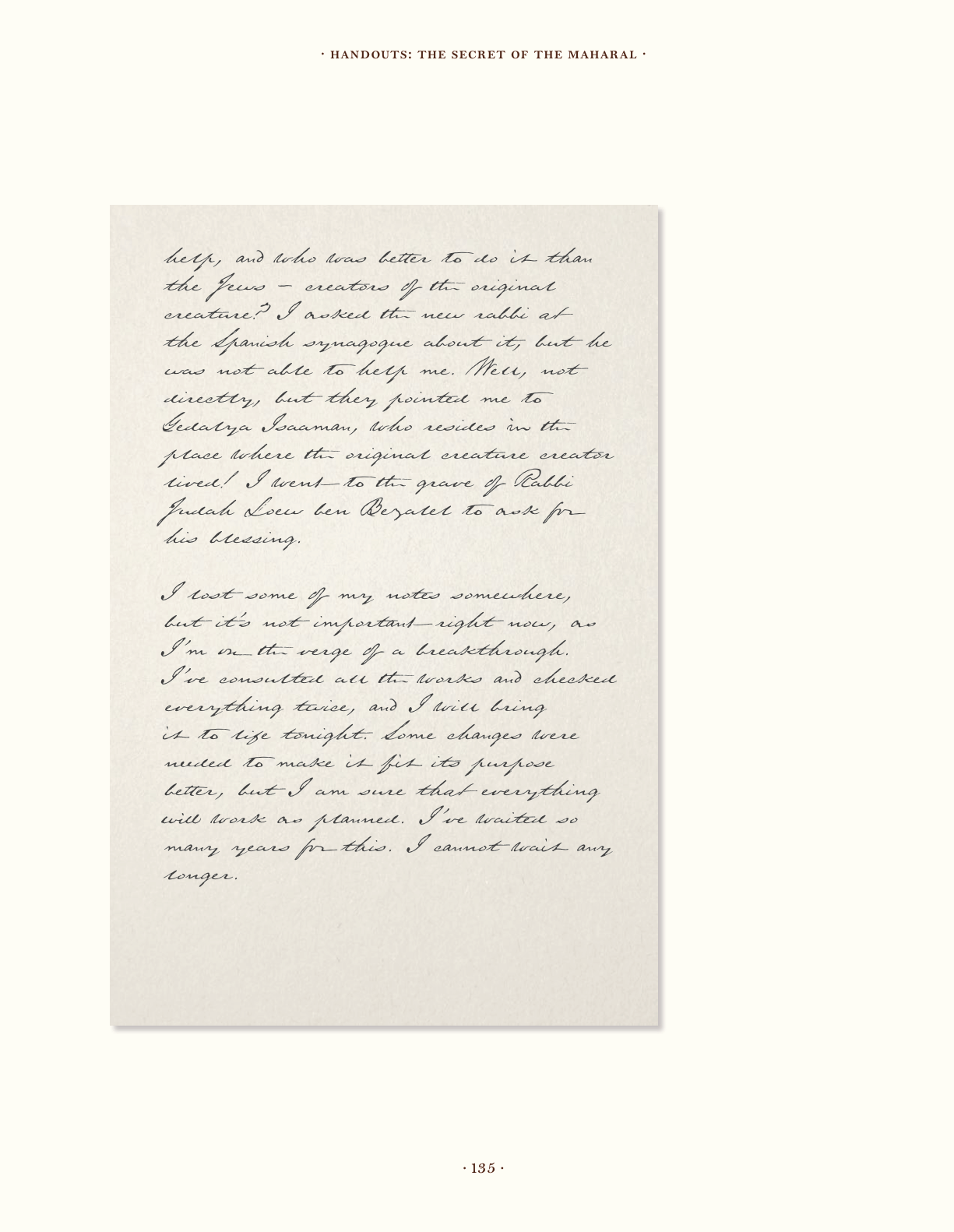
Handouts print at the back of VAE MC covering all of its mysteries — click to reveal one to the players.
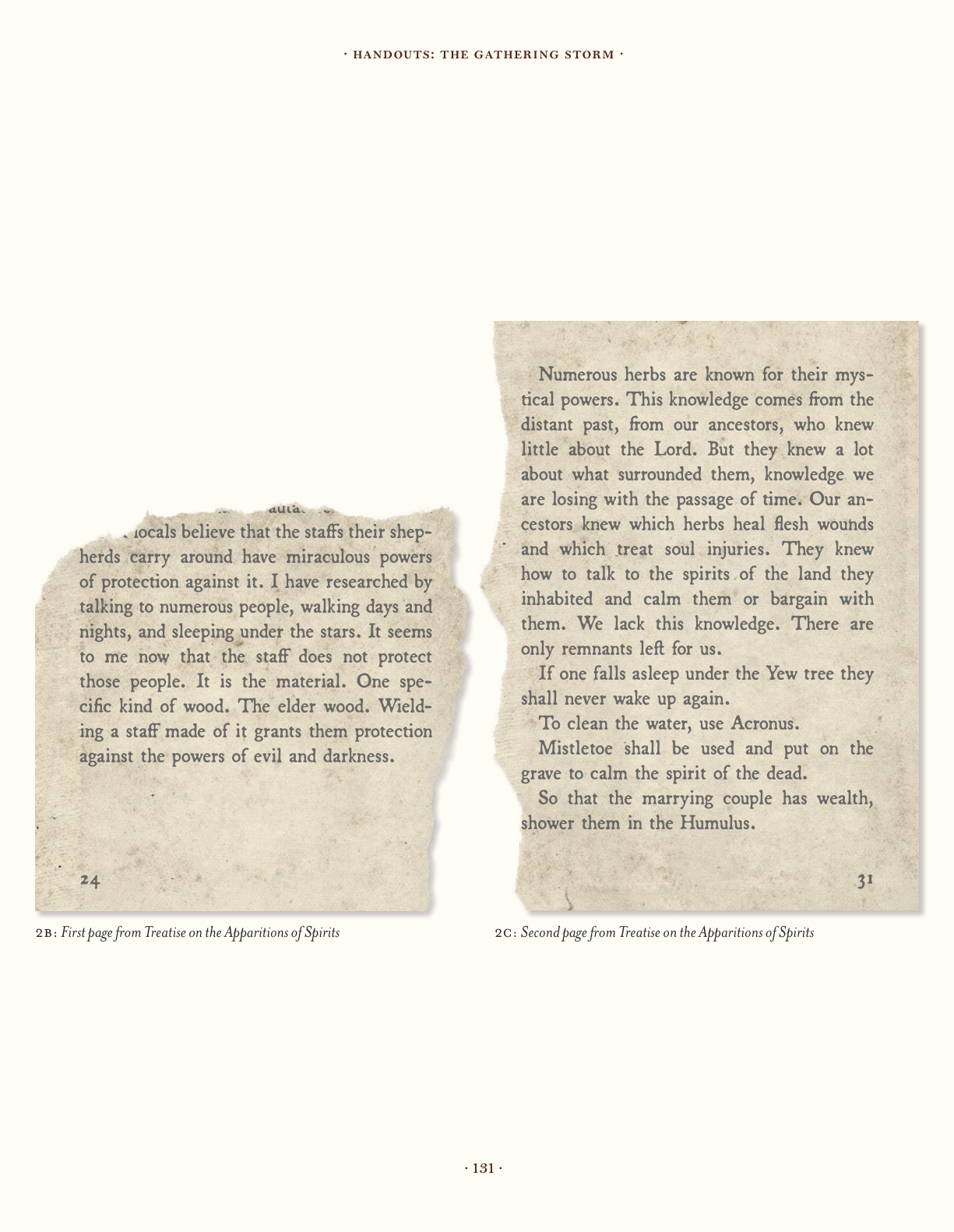
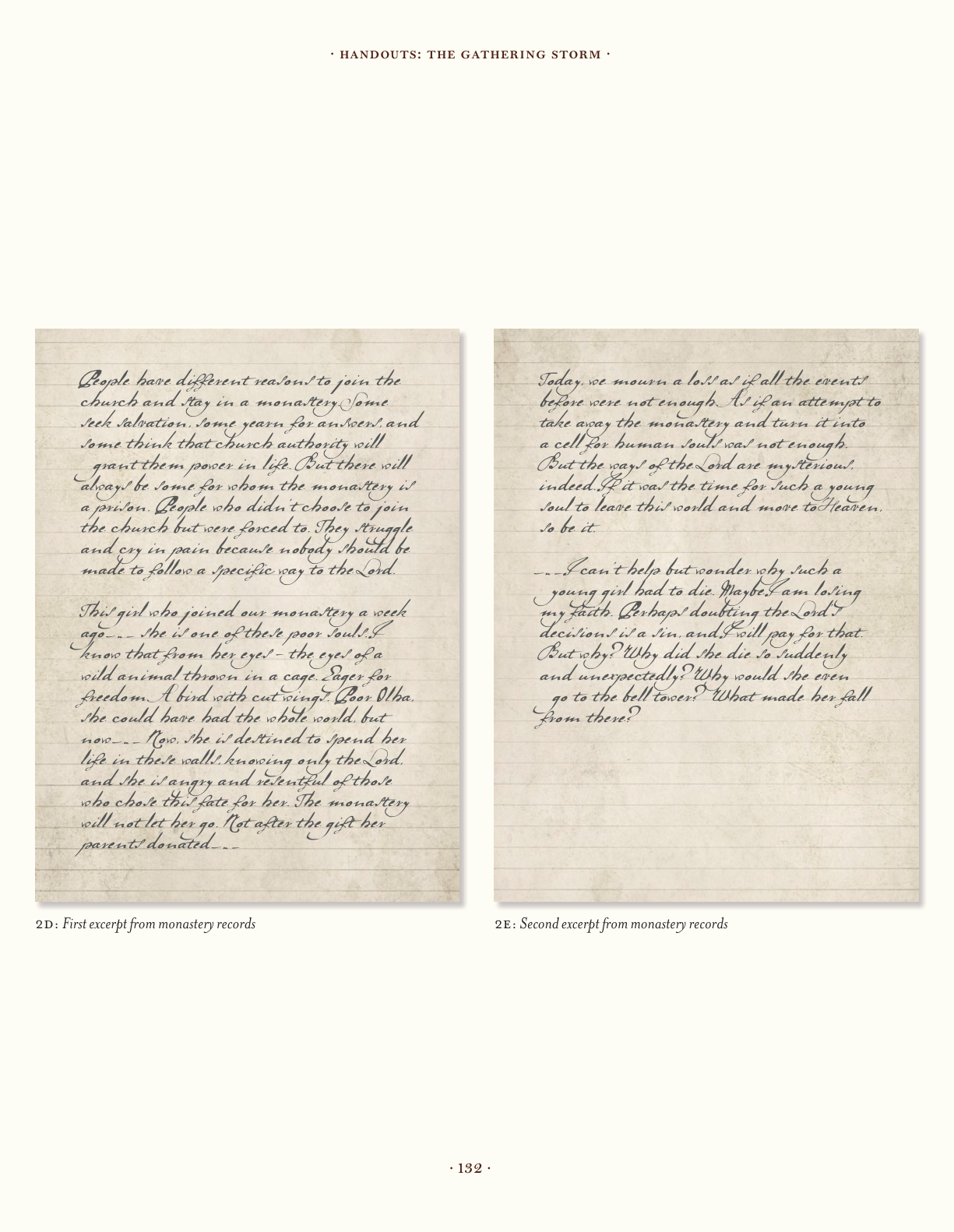
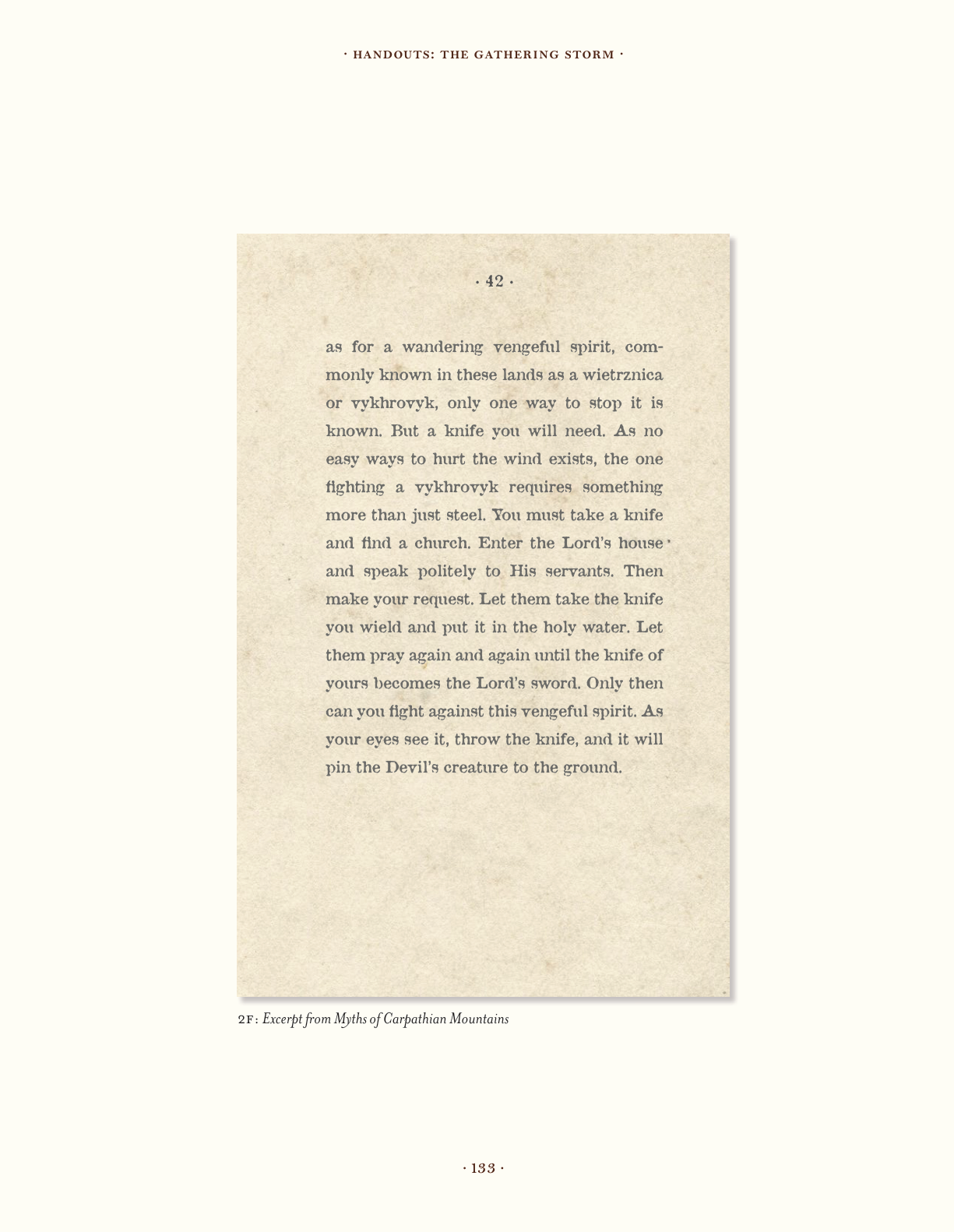
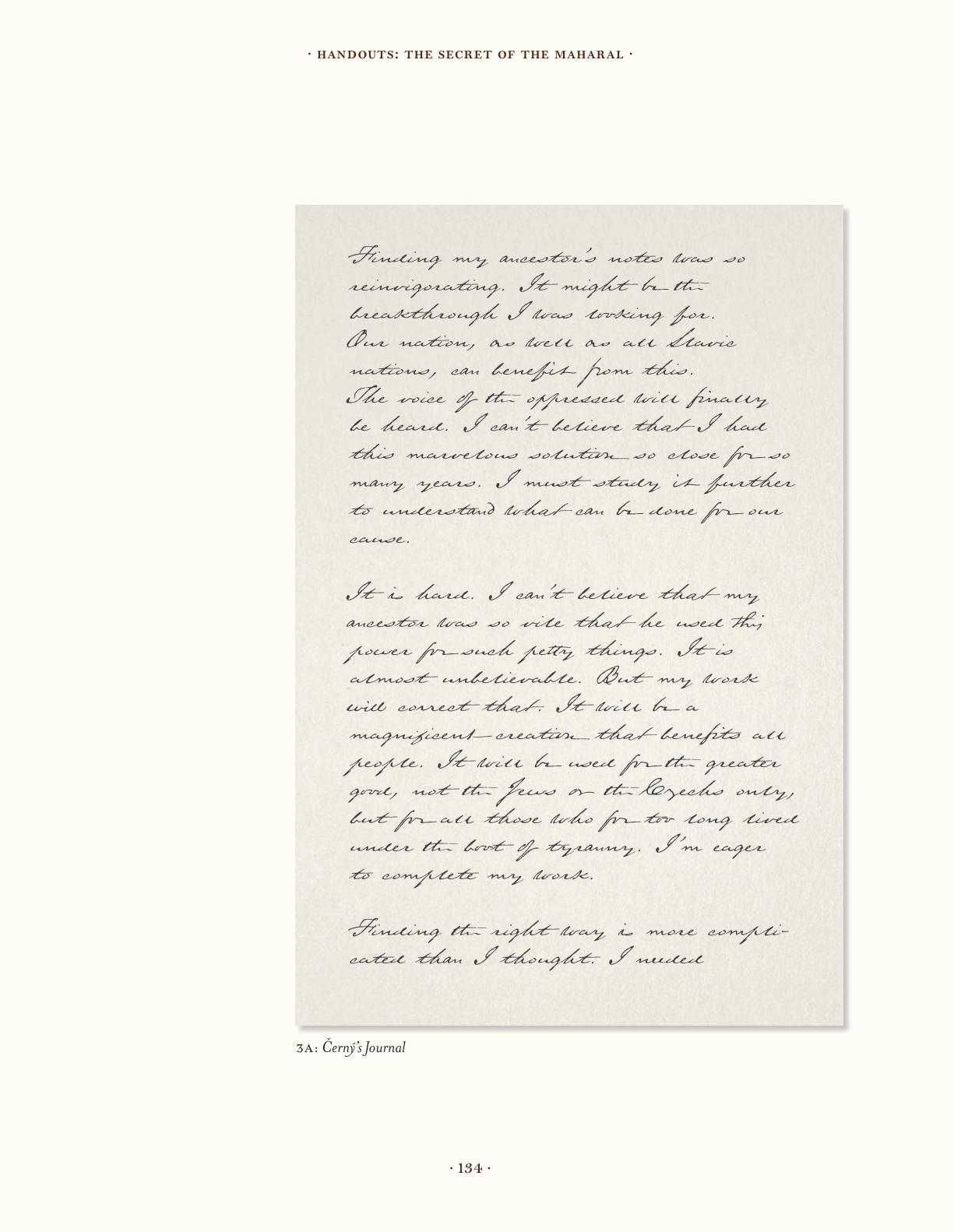
Confrontation
p.95The final Confrontation of this mystery will likely start in the village. As the celebrations start in the evening, the day after the player characters arrive, crowds of people dressed in wolf and bear skins dance and sing in the streets.
The Vârcolac’s Attack
The vârcolac, controlled by Maria who is skulking nearby with her spindle, sneaks through the crowds, looking for the next victim. If the player characters have confronted Maria or if she otherwise has concluded that they are a threat to her plan, the vârcolac will be looking for them. Otherwise, it attacks someone close to the knez’s family who is respected in the village, such as Radu Harnicu (page 91). See the sidebar Fighting the Vârcolac below.
Fighting the Vârcolac
Vârcolaci and their stats are described on page 63. Its strength has been increased by Maria’s yarn spindle (MIGHT , for a total of 10), which helped it escape from the castle’s dungeons.
When confronting the vârcolac, people with the Sight (like the player characters) may make an OBSERVATION test to spot a very thin, magical thread stretching from the beast’s back to Maria’s yarn spindle, wherever she is, that gives her control of the vârcolac.
Cutting the thread requires a CLOSE COMBAT attack with a bladed weapon. Doing so will reduce the vârcolac’s MIGHT by 1 but also turn it loose. For dramatic purposes, we recommend that you don’t let the player characters see the thread until the final Confrontation (page 95).
It’s also possible to take the spindle from Maria with an opposed FORCE test, or without a roll if Maria is Broken – this must happen in the same round of combat, or the vârcolac will go free. A player character with the spindle cannot fully control the beast as this requires years of study, but with a slow action and an INSPIRATION test they may slow the beast down and eliminate one full upcoming turn for the beast for each success rolled.
The Vârcolac
“I… am… hungry…”
The beast in this mystery is one of the first vârcolaci, believed to have been sent by God to punish people for their sins. It is an ancient being that spent centuries under the Carpathian Mountains and was freed by an earthquake. Weakened, it hunted in the nearest village to satisfy its hunger but encountered the local knez and his warriors. The vârcolac killed everyone except for the knez’s champion, who lured it into the dungeons and sealed it there. The champion was mortally wounded in the process, but despite that, he was chosen to become the new knez. He died shortly after and turned into a vampire. Now immortal, the new knez tried to kill the vârcolac by different means with his new powers but failed each time.
The vârcolac tried to escape a few times, driven by its eternal hunger and desire to devour heavenly bodies. The first time was when it offered the knez assistance to win Maria’s favor. The knez freed the vârcolac, who then killed Maria’s parents, but the vârcolac was not strong enough to escape the knez and was sealed back into the dungeons. The next time it made an escape attempt was when Maria found it in the dungeon cell. It told her about the knez’s original plan and promised to get revenge for her if she set it free. Shocked, Maria refused but agreed to take a piece of its fur with her when she left the valley.
At the beginning of the mystery, the vârcolac looks like a creature between a man and a wolf and can communicate coherently. The vârcolac’s appearance and power depend on its hunger. The more it eats, the stronger it becomes, but at the same time it becomes more bestial and incoherent. See the vârcolac’s countdown (page 80) for more information. As the vârcolac kills, the thread to Maria’s spindle tightens more and more and will eventually break, setting the beast free.
When the villagers realize that the beast is among them, panic ensues. Some villagers take refuge in the church and ring the church bells to alert the knez of the threat. If the player characters are not in the village during the celebrations but up at the castle, they will be alerted by this sound and can follow the knez down (below).
The attack can play out in many ways. It can happen in the streets or inside the church.
- Maria stays close, controlling the beast with her spindle. If the player characters spot her and realize that she controls the vârcolac, they may attack her or try to take the spindle from her. If confronted, she may admit that she controls the beast but claims that her actions are justified to get revenge on the knez, revealing the truth of his past crimes.
- Eve initially stays back, letting the player characters deal with the vârcolac, and helping villagers take shelter in the church. If they attack Maria, Eve will furiously attack them and defend her mother. However, if told the truth about the beast, Maria and the knez, she may be reasoned with (MANIPULATION test). After the initial attack, the vârcolac leaves to attack again later during the night. This also happens if the beast is Broken by the player characters.
The Knez Arrives
Soon after the initial attack by the vârcolac, the knez arrives on horseback, accompanied by his six “children” residing in the castle. The knez is dressed like a warrior of old, with a metal cuirass protecting his heart.
Unless the knez arrives in the middle of the attack, he is met by the villagers led by Eve, accusing him of failing in his duties and endangering his people. This meeting can take place in the town square or inside the church.
- Eve encourages the villagers to renounce the treaty and denounce the knez. Her resolve in this may strengthen or falter if the truth about the knez, her mother, and the vârcolac is revealed to her.
- The knez is angered and challenges Eve to a duel, knowing that Eve is his dhampir daughter (see step #4 in the villagers’ countdown on page 79) and knows that she will arise as a vampire if killed. The fight starts.
- Maria commands the vârcolac to help Eve. If the duel takes place inside the church, the vârcolac storms in, attacking the knez. If the player characters still haven’t realized that Maria controls the vârcolac with her spindle, they should get another chance now.
- Mihai and Father Iacob try to protect their adoptive father but are no match for the vârcolac and quickly die at its claws.
- The vârcolac then jumps on the knez, crushing his cuirass and letting Eve pierce the knez’s heart with an aspen stick. Controlled by Maria, the vârcolac will attack the player characters if they support the knez. Maria commands the vârcolac to bend its knee and bow before her, which it does with a mighty furious roar. See the countdowns (page 79) during the fight, as this may lead to the Catastrophes. The player characters can completely change the course of events above. You will need to let the NPCs react to the player characters’ actions. They might for example:
- Fight and even kill Maria and/or Eve during the initial attack by the vârcolac. If this happens, the knez will arrive after the fight, in time for the vârcolac’s second attack.
- Reveal Maria’s plan and try to convince the villagers (and possibly even Eve) to keep the treaty with the knez (INSPIRATION roll modified for any relevant evidence presented). This will make Maria furious, and she will reveal herself to recount her story about what the knez did to her parents, and then command the vârcolac to attack them, and the knez.
- Reveal the story about what the knez did to Maria and her parents, turning the villagers against the knez (INSPIRATION roll). The knez admits what he has done – and even to being a vampire – but pleads with the villagers to accept his remorse. The actions and evidence presented by the player characters will determine how the villagers – and Eve – react. The knez may then give up and leave the valley for good or defy the villagers and challenge Eve as per above. This can lead to a fight between the player characters and the knez.
- Intervene to protect the knez (and his children) against the vârcolac. This may prevent the catastrophe, but without the support of the beast, Eve loses the duel. The knez disarms her and intends to kill her, knowing that she will return as a vampire and hoping she will join him in the castle. Again, the player characters can interfere by words or force.
- Try to make peace between the knez and Eve. This is difficult but not impossible (MANIPULATION roll with a −2 modifier and bonuses for relevant evidence and information, such as revealing that Eve is a dhampir destined for unlife). Eve may accept a peace with her vampire father despite his crimes, but this will be all but impossible for Maria to accept, demanding that the knez must be killed or banished from the valley.
The Vârcolac
If the vârcolac is Broken during the Confrontation, it’s only temporarily banished and will return later the same night. However, if no longer under the control of Maria’s yarn spindle, and if the beast is Broken a second time, it will disappear into the night.
Eve
Eve is a key character in the finale of this mystery. During the Confrontation (or even earlier), she will likely learn the truth not only about her own nature, but also about her father the knez and his murder of her grandparents. She will naturally be hostile toward him but realizing she will soon become a vampire herself, she may accept a pact with him and an unlife in the castle by his side. Her reactions depend on the actions of the knez, Maria and the player characters during the final Confrontation.
Aftermath
p.98The aftermath of this mystery determines the future of the village and the people living in the valley. Since it includes many elements that player characters may have influenced during the mystery, it may have different outcomes based on their actions. Feel free to come up with other versions of the aftermath if the ones presented below do not fit your circumstances.
The Knez Triumphant
If the player characters supported the knez and helped him thwart Maria’s plan, nothing changes for the people in the valley. They continue to live their lives, supported by the knez, but remain isolated from the rest of the world. No longer under Maria’s control, the vârcolac is weakened and will eventually be captured again by Mihai and the knez and returned to the dungeon under the castle.
If Eve was killed, she arises again the next night as a vampire. She may accept the knez’s offer to stay with him or leave the valley swearing revenge, depending on what has happened and the actions of the player characters.
The Knez Defeated
If the player characters supported Eve to kill or banish the knez, the village starts to live freely. Soon, Eve turns into a vampire and slowly adopts the role of knez in the castle. If the past crimes of the knez were revealed, the villagers and even the knez’s adopted children support her, and the village flourishes for generations to come. The is the best possible outcome of the mystery.
If the crimes of the knez were not brought to light, the children of the knez will not support Eve. Without this support, especially from the children outside the valley, many villagers come upon hard times and leave the valley. Soon the village is a ghost town, leaving the hungry vampire alone in her castle.
The Vârcolac Breaks Free
If the vârcolac became strong enough to break the bond (see the vârcolac’s Countdown, page 80), it leaps into the sky and devours the moon, a mystic act that nonetheless seems to have a physical manifestation. The moon is restored in a few days from the crumbs left in the sky, but all of Europe, shocked and confused, is abuzz about the strange lunar eclipse that happened without any preconditions. Meanwhile, the vârcolac continues to hunt in the Carpathian Mountains, giving the Society another chance to meet and hopefully defeat it.
Going Home
If the player characters survive, they return to the Society headquarters with or without rewards. They can use their remuneration from the bank account created by the knez’s family at their discretion. They also receive an appropriate number of experience points.
A Treaty of Blood - Bralnic Castle
p.81The locations in this mystery are divided between those inside Bralnic Castle and those down in the village (page 88).
Bralnic Castle was built five centuries ago to protect a trade route through the Southern Carpathians and was named after the valley where it stands. The castle was damaged after an earthquake in the 15th century and lost its purpose after the trade route collapsed. After the vârcolac was defeated and sealed within the dungeon, Knez Vlad has resided in the castle for around four centuries.
The castle itself was built in Romanesque style as a fortification with massive walls and small windows. After the earthquake, it underwent a few reconstructions, including those the knez made to adapt the castle to his unlife. Some rooms were hidden, corridors redirected, and secret passages were created that only those who lived there could navigate easily. Only the knez knew all of the castle’s secrets.
Six of the knez’s adopted “children” (page 83) maintain the building and protect the knez in the daytime. Despite its cold stone appearance, the castle feels safe from the harsh winter outside. The walls in the rooms are covered with old tapestries, and the floors with carpets. Although it might look cozy and safe at first sight, staying there longer becomes anxiety-inducing, with the wind howling in sealed corridors and the constant feeling of someone’s presence.
Following are some key locations the player characters might visit while in Bralnic Castle. Feel free to add other locations your player characters would like to explore, keeping in mind the history of the castle, its atmosphere, and common sense. There is no map of the castle as it has many rooms, and most are empty or of no importance to the mystery.
Dreams & Visions
The old walls of the castle have witnessed many rituals and are suffused with the vampire’s magic. At your discretion, while staying at the castle, player characters may have dreams or see visions of the annual village celebrations (page 89). They can be used to add more details to the mystery, direct or mislead characters, strengthen the atmosphere, or remind the player characters about the countdowns.
Try to make the dreams vague or twisted to keep the player characters intrigued and to build atmosphere – you may use scenes of beasts leaving houses or the knez leading torch-bearing cavalry descending rapidly from the castle towards the village, for example.
A Treaty of Blood - The Village
p.88In the center of the village square stands a bronze monument of a warrior killing a wolf-like beast, similar to the image on the wax stamp of Knez Vlad’s letter. On one side of the square is an Orthodox wooden church with a tall bell tower, and on the other side is a large circular guesthouse, with a chimney in the middle of the roof.
On the outskirts of the village, the player characters notice a large, colorful tent with five vardos (wooden, horse-drawn wagons) behind it. The knez has invited the wandering theater to the valley to perform during the upcoming annual celebrations of signing the treaty by Knez Vlad the First, and his miraculous recovery the next day.