VAE MBI
Content warning — Violence, Child Death, Mutilation
This mystery for Vaesen takes place in the rural west of England, where the old ways died hard and echoes of the pagan past are all around. It can equally well be set in Scandinavia, where there are similar traditions of hags and trollwives and of miracle-working saints.
While the cause of the mystery is not difficult to determine, the characters will find themselves faced with a powerful foe who is not at all easy to stop.
Prelude
p.84This first section describes the background of the mystery and the conflicts on which it is based. There is an invitation to kick off the session, then the text proceeds to describe the journey to the fishing hamlet Gloucester and Brancomb. The section concludes with a countdown of events which you as the Gamemaster will initiate at some appropriate time during the mystery – and a catastrophe that describes what happens if the player characters do not take action or fail in their efforts. But first we will look back at the events leading up to the mystery.
Background
The western English county of Gloucestershire, like those around it, is rustic and comparatively back- ward. It is a place little changed since the Middle Ages, where the remains of prehistoric stone- work dot the landscape. Burial mounds are asso- ciated with the fairies, while stone circles and lone standing stones are frequently given the names of legendary witches and hags.
One such stone is Old Meg, a tall and weath- ered lump of rock some two meters tall, that stands on a gorse-covered hillside overlooking the broad valley of the river Annon near the market town of Annonsbury. According to local legend, a nearby cave – called Old Meg’s Holt – was the lair of a dangerous pagan witch who terrorized the area in the 7th cen- tury before being defeated by the missionary Saint Birinus, who is known locally as St. Birren. Unable to resist the power of the saint, she turned to stone and has stood above the cave ever since.
Modern science disputes the legend, of course, and Old Meg has been recorded in many archaeologi- cal surveys of the area as a standing stone of Neolithic date, similar to many across the west of England and nearby Wales.
All was quiet until a month ago, when a plough- boy by the name of Billy Winchcombe broke the heart of young Daisy Thomas by squiring Jenny Pearce to the May Fair at the village of Brancomb. Daisy left the fair in tears of rage and humiliation, climbing the hillside and somehow finding herself beside Old Meg’s cave. Daisy slipped and fell out- side the cave, hitting her head on the stone. Her blood freed the ancient hag from her imprison- ment: she hungrily tore Daisy apart before setting out on a path of destruction across the countryside. Three days later, Daisy’s distraught father found his daughter’s mangled body just inside the mouth of the cave. A murder hunt was launched, and Billy Winchcombe was arrested on suspicion of killing his former sweetheart.
In the days that followed, the area was engulfed by unseasonal cold, and experienced the latest frost on record. Sheep were found mutilated and par- tially eaten. A late traveler was thrown into the River Annon from the Shaftington bridge, and lingers near death in the Annonsbury cottage hospital. Two chil- dren, out picking flowers for the church’s St. Birren’ Day display, ran from a “wicked, ugly lady” in the gathering dusk.
Edgar Longby, the curate of the church of St. Birren at Brancomb, has a keen interest in local folklore and archaeology, and while a student at Cambridge he corresponded with a member of the Society on the common elements of Anglo-Saxon and Scandinavian folklore. His morning walk took him past the cave, and he had intended to lay a posy of wildflowers at the spot where the unfortunate girl’s body was found. It was he who first noticed that the stone was missing. Reminded of the legend of Old Meg, he renewed his correspondence with his fellow folklorist (one of the Player Characters).
Conflicts
The main conflict in this mystery is that between tradition and reason. It is embodied in the char- acter of Edgar Longby the curate, who sees all the signs of a legendary monster awaking but whose rea- son and education tell him that there must be some mundane explanation. As sheltered and backward as Annonsbury seems to the sophisticated eyes of vis- itors from London or Uppsala, it is still the nine- teenth century, and even in this remote area most people scoff at superstition. Even those who retell the legends only half believe them.
The secondary conflict is between the authori- ties in Annonsbury and the villagers of Brancomb. The law, led by Inspector Banks of the Gloucester Constabulary, regards the case as open and shut: at some time after the fair, Billy Winchcombe met Daisy Thomas near the cave. The two quarreled, and he killed her. The fact that almost everyone in Brancomb will swear to having seen Billy in and around the vil- lage during the three days between Daisy’s disappear- ance and the discovery of her body is a mere inconve- nience. Banks is convinced that he has his man, and that in time Billy will be persuaded to confess. As their young neighbor sits in the cells at Annonsbury’s police station, the people of Brancomb are growing increasingly restless – not least because the authori- ties are taking no interest in the dead sheep and other strange occurrences.
In the Mythic North
Other Mysteries for Vaesen are set mainly in the Mythic North, and you may decide that a long journey to rural England, with linguistic and other difficulties, is too much for the player char- acters. In that case, the setting may be changed to a rural area of southern Scandinavia, far from any city, where old superstitions linger and outsiders are regarded with suspicion. Many such areas have Neolithic standing stones, some with legends similar to the tale of Old Meg. Just change the names to appropriate Scandinavian counterparts, and you’re all set!
A Very British Mystery
Since this Mystery is set in England, you may prefer to play it with British investiga- tors. The Society is a worldwide organization with branches across Europe. It has a major base in London, and it is quite possible that a smaller group operates out of the nearby city of Bristol.
British characters will face fewer cultural and linguistic difficulties than their Swedish counterparts, but there will still be some. Londoners will find the local Gloucestershire dialect nearly impenetrable, requiring a simple LEARNING test to understand what a Brancomb villager is saying, even though they are suppos- edly speaking the same language. In addition, anyone from outside Brancomb – even visitors from Bristol – will be regarded as an outsider, and face penalties to Empathy tests (see the box headed “Furriners”) though these penalties will be less severe than those faced by non-English characters.
Invitation
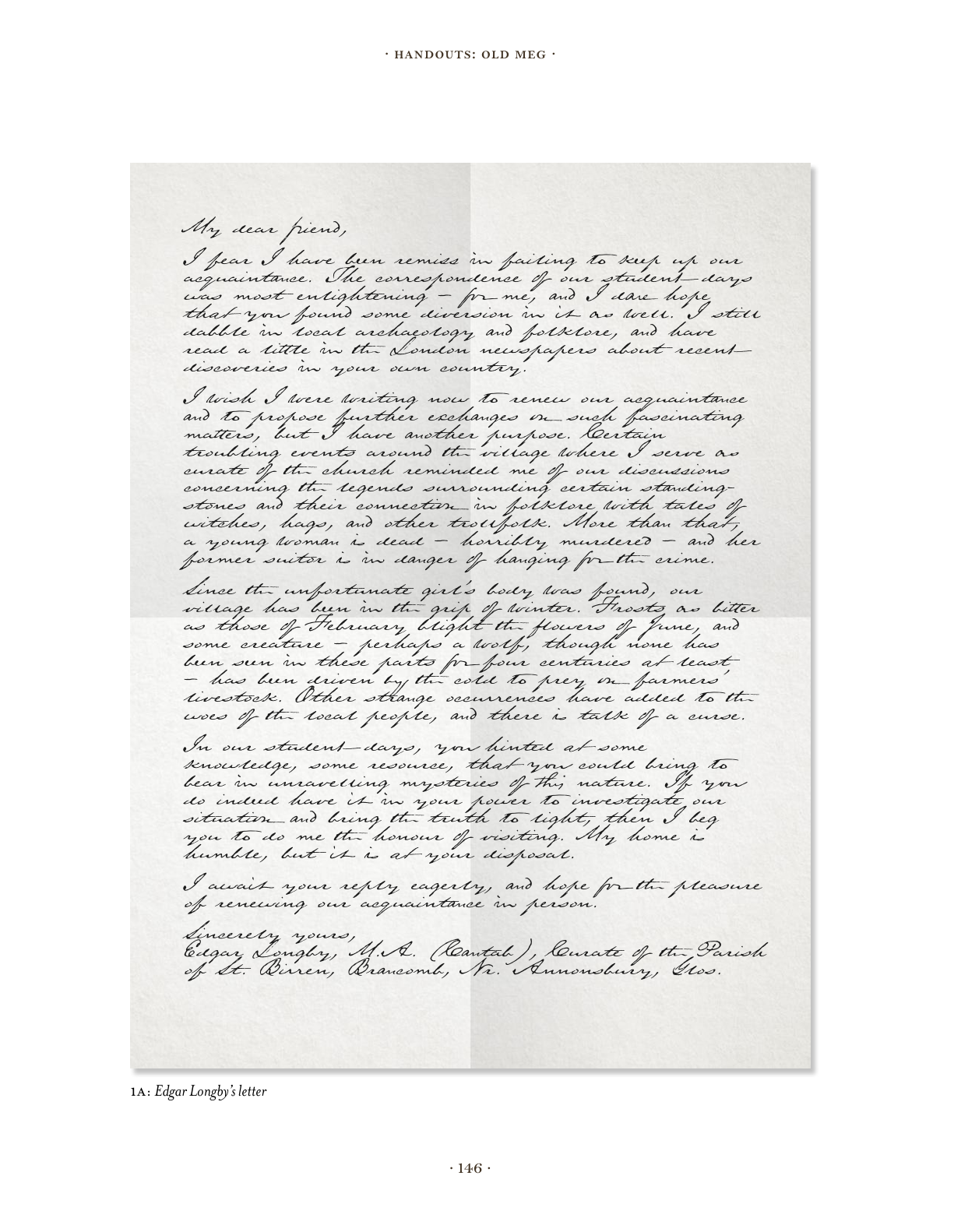
In early June, a letter arrives, addressed to Longby’s former correspondent (Handout 1A). It reads as follows: My dear friend, I fear I have been remiss in failing to keep up our acquaintance. The correspondence of our student days was most enlightening – for me, and I dare hope that you found some diversion in it as well. I still dabble in local archaeology and folklore, and have read a little in the London newspapers about recent discoveries in your own country.
I wish I were writing now to renew our acquaintance and to pro- pose further exchanges on such fascinating matters, but I have another purpose. Certain troubling events around the village where I serve as curate of the church reminded me of our discussions concerning the legends surrounding certain standing-stones and their connection in folklore with tales of witches, hags, and other trollfolk. More than that, a young woman is dead – horribly murdered – and her former suitor is in danger of hanging for the crime.
Since the unfortunate girl’s body was found, our village has been in the grip of winter. Frosts as bitter as those of February blight the flowers of June, and some creature – perhaps a wolf, though none has been seen in these parts for four centuries at least – has been driven by the cold to prey on farmers’ livestock. Other strange occurrences have added to the woes of the local people, and there is talk of a curse.
In our student days, you hinted at some knowledge, some resource, that you could bring to bear in unravelling mysteries of this nature. If you do indeed have it in your power to investigate our situation and bring the truth to light, then I beg you to do me the honour of visiting. My home is humble, but it is at your disposal.
I await your reply eagerly, and hope for the pleasure of renewing our acquaintance in person. Sincerely yours, Edgar Longby, M.A. (Cantab), Curate of the Parish of St. Birren, Brancomb, Nr. Annonsbury, Glos.
Preparations
As usual, the characters can prepare for the journey at their headquarters and thereby gain an Advantage.
Player characters who go looking for informa- tion about Annonsbury and Brancomb in Uppsala will not find much, as both places are relatively small and unimportant. Annonsbury can be found on maps or in county directories as a small to medium sized market town with an unremarkable history. Brancomb is barely a spot on the map. The River Annon flows out of the surrounding hills, through Brancomb, and on through Annonsbury, eventu- ally flowing into the Slimbridge marshes that adjoin the River Severn.
A successful LEARNING test allows a character to recall that hags are common in folklore, and the names of local hags are sometimes given to standing stones and other prehistoric remains.
The Journey
The journey to Brancomb from London involves a train to Bristol, and another train toward Gloucester, stopping at the small town of Annonsbury. Longby will meet them there, having engaged a private coach to take them and their luggage the final mile and a half to Brancomb. Player characters coming from Upsala will have to travel to Gothenburg and then take a ship to London or Bristol.
As the track winds upward toward Brancomb through the wooded hills, the player characters have about half an hour to talk with Longby and gain the following information:
- A local girl named Daisy Thomas was found dead near the entrance to a cave in the hills. Her body was horrifically mutilated, as if by a wild animal.
- A local youth named Billy Winchcombe has been arrested for Daisy’s murder. He is said to have been her beau. Three days before her body was found, Daisy fled from Annonsbury’s May Fair in visible distress after seeing Winchcombe in the company of another local girl. When she did not come home that evening a search party was organized.
- In the weeks since the girl’s body was found, there have been sheep mutilations and attacks on night travelers in the area. The local people are afraid, and there are rumors of a ghost, or a curse.
Arrival
Brancomb is a tiny village nestled in a fold of the hills. There is an inn, a church, the vicarage where Longby resides, a water mill beside the stone bridge over the River Annon, and not much else. If asked, Longby will explain that most of his parishioners farm sheep in the surrounding hills and go to Annonsbury for its market and other services.
Just before they enter the village, Longby points to a hill behind the church. Known locally as Meg’s Mount, it is the site of the cave near which the girl’s body was found.
The coach stops at the door of the vicarage, where three guest rooms have been prepared for the player characters. The rooms are not large, and can accommodate two people each. The village inn, the Shepherd’s Rest, has two more rooms, and if more accommodations are necessary Longby will offer to put the player characters up at the inn at his own expense.
It is getting dark by the time the player characters reach Brancomb, and Longby offers them dinner at the vicarage. They are probably exhausted after their journey, and Longby suggests that they begin their investigation in the morning.
Important People in the Mystery
- EDGAR LONGBY: The curate of the parish, and an acquaintance of the player characters. He introduces them to the mystery, and can provide introductions to the locals.
- TOM PAWSEY: A local farmer and poacher.
- OLD GAFFER INGHAM: A fount of local lore.
- INSPECTOR ROBERT BANKS: A level-headed police officer who is certain that he got his man.
- DOCTOR CUTHBERT MELLORS: The local phy- sician, who is perplexed by the evidence.
Furriners
The following is completely optional, and is recommended only for players who enjoy a challenge when interacting with NPCs. The Gamemaster should feel free to adjust the difficulty levels given below, or disregard this whole box, according to the preferences of the gaming group. The people of rural Gloucestershire speak a thick dialect that can be difficult even for native English speakers to understand. They are distrustful of outsiders (which means, any- one born more than a mile from the center of the village), and doubly distrustful of foreign- ers – or “furriners,” as they call them. Even Longby, who has served the parish for almost five years, is regarded as an outsider, and the locals watch what they say in his presence. Longby will accompany the player characters as much as he can, making introductions and acting as interpreter. He speaks no Swedish, but he is familiar enough with the local dialect to render it into a better form of English.
This can be handled in several ways, depending on how much of a challenge you want to present to the players.
The easiest option is to require a simple LEARNING test whenever a player character tries to talk to a new NPC. The thick local dia- lect may impose a penalty on the test if desired. The severity of the penalty is at the GM’s dis- cretion. If Longby is present, he can “translate” the local dialect into his own, more educated form of English. At the GM’s option, this may reduce the penalty or even remove the need for a LEARNING test altogether.
In addition, all Empathy tests are made with a penalty (again, at the GM’s discretion) because the player characters are outsiders, and “furriners” to boot. This penalty may be reduced or even removed when Longby is pres- ent, since the locals respect him.
Countdown
p.90- 1. A distraught mother rushes into the village, screaming that her child was taken from the house during the previous night. The window above the child’s bed was torn from its frame and the child pulled out through it. The villagers organize an armed search party and invite the player charac- ters to join them. Their response to the invitation will result in further Empathy modifiers. A suc- cessful search leads to the discovery of the child’s body, which is as badly mutilated as Daisy’s corpse.
- 2. A brawl breaks out in the Shepherd’s Rest one evening when members of the Winchcombe and Thomas families meet. Each blames the other for the situation, and harsh words are exchanged about the dead girl and the imprisoned youth. Bystanders intervene before things get out of hand and the Winchcombes return to their farm in a foul mood.
- 3. Four men, the father and brothers of Billy Winchcombe, come down into the village from their hill farm, armed with shotguns and agricul- tural implements. They ask Longby to come with them to Annonsbury to get Billy out of jail, and are ready to drag him there by force if necessary – and to free the young man by force if they have to. **Catastrophe** After weeks of roaming the surrounding countryside killing sheep and attacking lone travelers, Old Meg comes into the village one dark and moonless night. Seeing light and hearing sounds of merriment com- ing from the Shepherd’s Rest, she bursts inside and lays about her in a blind fury, attacking whomever is nearest to her until she is stopped or forced to flee. The locals now know who is to blame for the attacks of the last several weeks, and probably for the death of young Daisy Thomas. Those who saw Daisy’s body will attest that her wounds were very similar to those left by this monster. The villagers arm themselves and begin to patrol the outskirts, looking for any trace of the monster. Remembering the legend of Saint Birren, they implore Longby to cast the hag out as the saint had done, or at the very least to send for “some clever, holy feller vrum Lunnun or Cambridge or such, as can do it iff’n the curate b’aint able his- self.” A full-blown monster hunt ensues, which the Annonsbury police ascribe to mass hysteria or bad drink. Determined to restore the Queen’s peace on their territory, they swear in temporary constables to swell their numbers and descend on the village in force, demanding the surrender of all weapons and imposing a dusk to dawn curfew. This results in a riot, and if the spiral is left unchecked reinforce- ments from Gloucester may be called in, backed up by troops from the city if necessary. If worse comes to worst, the whole village might be destroyed, and the villagers imprisoned or sent to the penal colony in Australia. Meanwhile, the hag will continue to stalk the night. **A Parallel Countdown** Even as the hag wanders the countryside causing more and more destruction, tensions are growing within the community; first between the Thomas and Winchcombe families and then between the people of Brancombe and the Police at Annonsbury. Events will unfold as follows unless the player char- acters step in. 1. Brawls break out between the younger Thomas and Winchcombe men whenever they meet. An early example is given in the description of the Shepherd’s Rest below, but the encounters esca- late and drag in other villagers. 2. As the sheep killings and other phenomena con- tinue, even the Thomases agree Daisy was killed by whatever is killing the sheep, and the two families reconcile. Representations are made to Constable Moore and then to the police at Annonsbury, but they fall on deaf ears. As far as the police are concerned, the murderer has been caught and there is no reason to re-open the investigation. 3. Frustrated and angry, villagers from Brancombe go to Annonsbury in increasing numbers, more determined each time to see Billy set free. **Catastrophe** A riot breaks out at Annonsbury as Brancombe folk try to force their way into the police station to free Billy. Violence is met with violence, and although the Annonsbury Police do not carry guns, heads are cracked and bones are broken. When order is restored, more villagers are in jail and facing trial. ### Signs and Portents Old Meg’s trail is marked by cold weather and frost damage, as noted above. Optionally the Gamemaster may wish to add some more enchantment effects to stoke up the fear and tension. Here are some examples: feel free to use whichever will work best in the campaign, or to devise others. - Water and other liquids inexplicably freeze in their vessels, even indoors. - Stored food – even food kept indoors – blackens and rots as if from extreme cold. - Animals suddenly become terrified, strug- gling against halters and kicking barn doors in an effort to tear themselves away and escape. - In addition to the frost damage in the hag’s path, localized patches of snow and hail- stones are found, drifting several feet deep. - The wind carries unholy words in an unknown language – the hag’s prayers to ancient gods. While no one living can understand their meaning, something about their sound strikes fear into all who hear them. - All NPCs, and perhaps some player char- acters, suffer from nightmares, screaming in their sleep and waking up drenched in sweat amid a tangle of sheets. **Countdown** ### Creating Atmosphere The mystery surrounds the village with a con- stant menace. Read the following text or con- vey the same information to the players as the opportunity arises. Brancomb is a village under siege, even if the enemy is unknown and unseen. Everyone is braced for more killings, but no one knows when or where they might take place. When they do, people speculate about where the killer might strike next, and whether it is a wild animal or something more frightening. It is the uncertainty, more than anything else, that wears on everyone’s nerves. You can see it in faces and hear it in voices. There is no talk of anything else in the village, and raised voices turn to blows all too easily, especially in the Shepherd’s Rest. There is also bitterness and a sense of betrayal. With Billy Winchcombe arrested, the police are taking no further interest in the matter, even though everyone but Daisy’s family admits that the evidence against him is flimsy. Are these fresh killings the work of the same hand? If so, they suggest that Billy is as innocent as he and his family maintain. But Annonsbury seems like another world, and the police there dismiss the people of Brancomb as ignorant yokels. Meanwhile, everyone waits. Where will the next killing be, and when? What is causing the strange blight of the crops nearby? And how long will it be before another human life is lost?
Locations (8)
The following locations are marked on the maps of Brancomb and Annonsbury. The most important of them are the vicarage, the Shepherd’s Rest, Old Meg’s Holt, and the Annonsbury Police Station. If the characters wish to investigate other locations, you are free to improvise, but it is perfectly alright to sim- ply explain that the place in question is not part of the mystery and that there is nothing for them there.
The Monster’s Path
If the player characters collect enough informa- tion about the locations of the various attacks and the areas affected by the strange and unseasonable frosts, a successful LEARNING test will enable then to trace the monster’s path on a map. It starts at the Thomas farm, just below the hill where the cave is located, and contin- ues across the neighboring Winchcombe farm, followed by a couple of others. Although the path is not straight enough to predict exactly where the creature will strike next, it does indi- cate a general route which is heading toward the river – and might end at the village itself.
Maps (3)


The Vicarage
The vicarage is a boxy, two-story building with white- washed walls and a slate roof. On the lower floor are Longby’s office/library, a front parlor, and a kitchen and scullery. Upstairs are four bedrooms, one of which is used by Longby. Behind the house is a yard with a well and an outhouse.
Challenges
The vicarage will be the characters’ base of operations. Here are some suggestions for events and challenges.
- Longby has an extensive library, which contains some useful information (see “Clues” below). However, it is not well organized (for anyone except Longby, who can put his hand on any book almost immediately), and any player character trying to use it for research must make a success- ful INVESTIGATION test to find each clue given below.
- Mary Hopper, a widow from the village, comes in to cook and clean for Longby and his guests. At first she will be as reticent as her neighbors, but given a successful MANIPULATION test (and some encouragement from Longby, if needed), she may warm to the player characters after a day or two, and be able to answer questions. Through her association with the educated curate, her rustic accent has softened somewhat, making her a little easier to understand than the other villagers. She can offer information on the people of the village (usually with the caveat “you didn’t hear this from me, mind”) as set out below.
- Mrs. Hopper is an inveterate gossip, and enjoys the attention of curious neighbors eager to pump her for information about Longby and his visitors. She overhears a great deal, and will actively try to eavesdrop on any conversation that sounds interesting. If the player characters wish to prevent her from overhearing, everyone involved in a conversation must make a STEALTH test. Alternatively, they may switch to Swedish or some other language that she does not understand. Longby does not understand Swedish, and Mrs. Hoppers will be offended if she thinks the player characters are trying to stop her from snooping. This will add one level of difficulty to all Empathy tests while talking to her until her hurt feelings can be soothed.
Clues
- The legend of Saint Birren and Old Meg is recounted very briefly in The History and Traditions of Gloucestershire. While converting the pagan Anglo-Saxons of the area, the saint battled the evil witch and turned her to stone by the power of his prayers. The book says no more on the matter, although the player characters may hear a more complete telling of the legend from Old Gaffer Ingham at The Shepherd’s Rest – if they can understand him.
- The Monuments and Antiquities of Gloucestershire, an archaeological survey of the county published about 20 years ago, includes a map of the cave and its surroundings with the location of the standing stone marked. The stone is described as “…a single standing stone, about the height of a man, typical of those found in upland areas across England and Scotland and generally ascribed to the Neolithic era. No trace was found of any circle or other arrangement of stones, of which the stone might formerly have been a part.”
- Longby is compiling notes for a parish history that he intends to write, and among his documents are some maps of the area. These will help the player characters see where attacks have taken place, gaining a bonus to LEARNING or INVESTIGATION rolls when the player characters are looking for a pattern or route that the creature is following: see “The Monster’s Path” below.
- Mrs. Hopper can tell the player characters that Daisy and Billy were a devoted couple. Everyone in the village expected that Billy would ask Daisy’s father for her hand the following spring, when he had made a little money from selling a small flock of sheep that his father had given him. She has no idea why Billy chose to go to the May fair with Jenny Pearce. It was rumored after the fact that the two had fallen out, but no one knows why. If the GM wants to muddy the waters, Mrs. Hopper might invent any details that she does not know.
The Shepherd’s Rest
The village pub is built of the golden local limestone with a roof of stone shingles. There is a tap-room on the ground floor, with accommodation for the inn- keeper and his family behind. The beer cellar is cut into the rock below the tap-room, with a barrel-hatch set into the floor behind the bar and a set of stairs leading up to the family’s suite of rooms.
Upstairs there are four rooms: two are available as guest rooms, and the other two have been given over to storage since the village rarely sees any visi- tors. The storage rooms are piled high with miscel- laneous junk: at the GM’s option, a careful search of them may turn up some item that the player char- acters can use.
The beer in the Shepherd’s Rest is typical of the area. Served at cellar temperature (which is only slightly below the temperature of the tap-room), it is mid-brown in color. Swedish characters will find it denser and a little sweeter than the beers they know from home. Also available is cider, which is cloudy and wickedly strong: about 10–12% alcohol. The inn has no wine (“no call fer furrin drinks ere’round ’ere”) and the only spirits consist of a half-empty bottle of Scotch whiskey and a quarter-full bottle of brandy. Neither has been opened in living memory, and no one knows what condition they are in.
The food in the inn is simple but hearty. Meat pies are sold on their own during the day, cold or heated. In the evening they are served hot as a meal with mashed potatoes, gravy, and boiled vegetables. The other option is the “ploughman’s lunch,” which consists of a lump of local, Cheddar-style cheese, a lump of rough, gray-brown bread, home-made pickle, and fresh butter, accompanied by an apple or other fruit according to the season.
Challenges
The inn provides the player characters’ best opportu- nity to interact with the locals. They will be reluctant to talk to “furriners” at first, but Longby will try to help break the ice, and translate if necessary.
- Edward Moore, a constable from Annonsbury, enters the inn looking for Longby and his guests. He is more curious than anything else, but wants to know who the foreigners are and what their business is. A successful MANIPULATION or INSPIRATION test will soothe his concerns – not that he can express what they are, exactly, but some of the locals shoot him dirty looks and mutter under their breath. This provides an opportunity for the player characters to learn of the resent- ment that is building in the village following Billy Winchcombe’s arrest.
- Two of the Winchcombe brothers, Tom and Martin, are in the inn, drinking heavily. They argue with Albert Bradley, the innkeeper, when he suggests that they go home and sleep it off, becom- ing loud and troublesome. Just at that moment, Daisy’s father, Fred Thomas, comes into the inn. He is red-eyed, unshaven, and disheveled, clearly broken by the loss of his daughter and the shock of finding her mutilated body. The Winchcombe brothers turn on him angrily, accusing him of reporting Billy to the police and causing his arrest. Threats and accusations fly, along with slurs on the characters of both young people. A fight seems inevitable unless the player characters try to stop it. If they intervene, they will earn the gratitude of one side and the enmity of the other, and this will be reflected in further adjustments to any Empathy tests they make in dealing with them.
- Tom Pawsey, a local poacher, brings a sack full of rabbits to Albert the innkeeper. While he is well known in the village, he will try to avoid strang- ers, in case they are in league with the law or the local gamekeepers. Gaining his trust requires a difficult MANIPULATION test.
- Inquiring about the legend of St. Birren and Old Meg will see the player characters being referred to Old Gaffer Ingham, the oldest inhabitant for miles around. Whenever the Shepherd’s Rest is open, he can be found in his chair at the back corner of the tap-room, smoking a clay pipe and nursing a tankard of ale.
Clues
There is a great deal of information to be gained at the inn:
- Fred Thomas breaks down if questioned about the state of his daughter’s body, and any player char- acter who is so insensitive as to ask him about it will have a hard time in future dealings with the locals. He was not alone, though, and both of the two men who were with him – Rob Watledge and Edwin Horsley – are regulars at the Shepherd’s Rest. Either one can describe the state of the body (“Torn apart, it were – ’orrible sight. An’ ’ard it be to say it, but I reckon not all of ’er were there. Some parts was ate, iff’n you ask me. I’d swear on the Bible no ’oomin done that – t’were an animal for sure. Bin centuries sin’ a wooluf bin seen hereabouts, but ’ard to think what else could’a done such mischief”), though they will be careful not to speak of it in the presence of the grieving father.
- All of the villagers knew Daisy, and most will describe her as a pleasant, honest, and decent young woman. If coaxed further, one or two might volunteer more (“She were moonish, if ye take my meanin’ – full of old tales and such. She loved hearin’ of the… good neighbors, is what we call ’em here – you know, I’m sure – and the like. She’d ’a bin ’ung fer a witch in the old days, but there were no ’arm in ’er, just what eddicated folk might call an overactive imagination”). Further successes will reveal that she often walked alone in the hills, and was fascinated with the legend of Old Meg.
- Likewise, everyone knows Billy, and no one can believe that he would be capable of such a violent crime. He could be high-spirited at times, like any youth, but there was never any malice in him and he was noted for his even temper. It is said that he adored Daisy, and according to one rumor Jenny was a cousin visiting from out of town – no one can quite say where – and Billy was doing his duty as a family member by showing her around the fair. It is said that he was visibly distressed when he saw Daisy run off.
- Tom Pawsey knows the surrounding countryside well, and for a couple of shillings he will guide the player characters to the cave and any surrounding farms if they can win his trust. He can supply the same information on the sheep attacks as anyone at the Winchcombe or Thomas farms. If he can be persuaded to accompany the characters to a kill site, or to the cave, he will admit that he has never seen tracks like those the characters find there. He knows every kind of animal that lives in the area, and these tracks belong to none of them. If the characters have not already realized that the tracks are human-like but for their long claws Tom will give them this information, confessing that he has never seen the like before.
- Old Gaffer Ingham can tell a more detailed version of the legend. His account adds the details that Old Meg was not a mortal witch but some kind of monster; that the Anglo-Saxons (whom he calls “the old-time folk”) used to leave offerings of livestock by her cave – and sometimes condemned criminals – to propitiate her; that St. Birren vanquished her with a cudgel he had blessed; that her “old-time” name was Mog and some say she was a sister to Morgan le Fay of King Arthur’s time; and that she can’t be killed, only driven back into her stone form. This is a major clue, letting the player characters know that a blessed weapon is required to defeat the hag.
- If the characters ask, Old Gaffer Ingham might also reveal that he had been talking to Daisy about the legend of Old Meg, and that she had been fascinated by it. She confided in him once that she went up to the cave from time to time to think, and that she felt a connection to the witch of legend. “No monster in her mind, she said – more a woman who wouldn’t bend the knee to men, she thought. She ’ad some right modern ideas in that direction, did young Daisy.” This clue established a link between Daisy and the cave, making it likely that she was there of her own free will when she met her death.
- General gossip in the inn tells of unseasonable frosts. They are later than any frost in memory, and seem very localized. An extra success (or a kindly GM) adds that these are the same areas where sheep have been found dead. This is a clue about the hag’s path, and if the player characters have already been to the cave or to the site of any sheep kill they will have seen the effects for themselves. Old Gaffer Ingham or some other local can recall that the legend of Old Meg includes the words “winter comes behind her.”
- Some farmers have found sheep savaged to death by some large wild creature. They are torn apart, with meat ripped from their carcasses and bones smashed. The largest local predators are foxes, and they are not capable of such destruction. An extra success (or a kindly GM) adds that the ground around them shows signs of a severe and unseasonable frost.
The Thomas Farm
The Thomas farm sits at the foot of the hill below Old Meg’s Holt. It consists of a small stone farmhouse, a timber barn on a stone foundation, and a fenced sheepfold, all surrounded by a low stone wall. The farmhouse is little bigger than a cottage. The family is headed by Fred Thomas. His wife Emma died two years ago, leaving him and Daisy alone. Also on the farm are two hired hands, Rob Watledge and Edwin Horsley. Both are in their early twenties.
Challenges
- Nothing can be done here unless the player char- acters have gained the trust of those on the farm. They have one opportunity to do this in the Shepherd’s Rest (see above). If they supported Fred Thomas, no test is necessary. If they stepped in on the Winchcombe side, all Empathy tests at the Thomas farm will be one step more difficult than usual. Otherwise, an MANIPULATION test must be made as normal.
Clues
- Fred is beside himself with grief, and hardly knows what to make of his daughter’s fate. Between sobs, he will say that he liked Billy, and would not have believed him capable of such a brutal attack. On the other hand, the police told him that Billy is their only suspect.
- A guide from the farm will be needed to lead the player characters to the site of a sheep mutilation on Thomas land. The attack took place several days ago, and the carcass has been burned on the spot. If asked why, anyone from the farm will explain that the dead sheep could not have been left there for fear of encouraging foxes and other pests. Also, since no one knows what killed it, there is the risk of disease to be considered. Examining the site will require an INVESTIGATION test, because there is a great deal of disturbance including the ash and blackening of the fire and the prints of farmers’ boots all around. However, a successful test will reveal one or two anomalous tracks. They look like the prints of bare human feet, but are slightly distorted. Any extra successes will allow a character to characterize the distortions as com- ing from unusually long toes with claw-like nails. If the player characters have already seen tracks at the cave or at the site of another sheep kill, they find these tracks are identical.
- The area around the attack site shows an unusual and localized blackening of the grass and other vegetation. Any extra successes will lead to the further conclusion that the blackening looks like frost damage. The blackening is not restricted to the attack site, but continues away from it in two directions, in a swathe about six feet (2 m) wide. Following the trail will lead to the discovery of more footprints, and allow a character to deter- mine that the creature that left the footprints was moving more or less away from the hill and the Thomas farm.
The Cave
Old Meg’s Holt is a small cave in the side of a crag overlooking the Thomas farm. Its roof varies from about 6 feet/2 meters to 3 feet/1 meter high; it is about 24 feet/8 meters deep and 12 feet/4 meters wide. The floor consists of compacted dirt. The cave itself is empty, and the floor does not seem to have been disturbed recently.
Challenges
- A normal INVESTIGATION test can be made inside the cave if any character wishes to search for clues there, but nothing will be found.
- Outside the cave, a normal INVESTIGATION test will allow a character to find the place where the stone once stood, and to examine the area around it.
Clues
- Outside the cave mouth is what looks like a freshly-dug hole, about 3 feet/1 meter in diame- ter and 18 inches/50 cm deep. The soil around it is churned up, and a few footprints may be found. Most are the prints of bare feet with long, clawed toes, like those at the attack sites on the Thomas and Winchcombe farms. A few, mostly at the edge of the disturbed area, were made by Fred Thomas and his companions when they came upon Daisy’s body. If the player characters have already found clues about the standing stone and the legend of Old Meg, they will realize that the stone is miss- ing, and they may begin to wonder how a prehis- toric standing stone weighing at least four tons can simply disappear.
- Close by the hole is a patch of dark soil, sur- rounded by many boot-prints. A MEDICINE test is required to identify the stain positively as blood, but anyone local will confirm that this is the spot where Daisy’s body was found.
The Winchcombe Farm
The Winchcombe farm sits across the river from the Thomas farm, and is very similar. The family is headed by David and Matilda Winchcombe. Also on the farm are their sons Tom and Martin, both in their late teens, and their daughter Anne, who is twelve.
Challenges
- Nothing can be done here unless the player char- acters have gained the trust of the Winchcombe family. They have one opportunity to do this in the Shepherd’s Rest (see above). If they supported the Winchcombe brothers, no Empathy test is necessary. Otherwise, an Empathy test must be made as normal.
- The heads of the family, David and Matilda Winchcombe, flatly deny all accusations against Billy, and expect the rest of the family to do the same. While they are present, no one will vol- unteer any information. Instead, they simply back up everything their parents say. A further Empathy test – and some ingenuity – will be required to get one of the younger Winchcombes alone and persuade him or her. Anne will be the hardest to talk to privately, since the rest of the family are very suspicious of any stranger’s intentions toward her.
Clues
- A guide from the farm can lead the player characters to the site of a sheep killing on Winchcombe land. The site is just as described above for the Thomas farm, including the blackening of the grass.
- Talking to the Winchcombes about the sheep attack will reveal that it took place the night after the attack on the Thomas family’s sheep.
- If any character succeeds in talking to Anne Winchcombe alone, a further Empathy test is required to persuade her to open up. She will confirm that Billy and Daisy were a loving couple, with dreams of marrying in a year or two. They will also confirm that Jenny Pearce is a distant cousin, and that Billy was eager to smooth over the misunderstanding with Daisy.
- A guide from the farm will be able to lead the characters to the site where a sheep was killed. The clues there are identical to those found on the Thomas farm (see above).
Annonsbury Police Station
Annonsbury police station stands close to the center of the small town, with the post office on one side and a bank on the other. All three buildings are made of the local yellow sandstone, which has weathered to a pale gray. Inside, the characters find a wooden counter manned by Sergeant Jack Worrell, who asks their business. Inside are various small offices and a narrow corridor with cells on either side: six in total.
Challenges
- Getting to visit Billy Winchcombe requires some work. The sergeant will refer the visitors to Detective Inspector Robert Banks, who is in charge of the case. A, challenging MANIPULATION test is required before Moore will deign to speak to the characters. If they met Constable Edward Moore in the Shepherd’s Rest, he can shift the dif- ficulty of the test by one step in either direction, depending on whether they made a good or bad impression on him. One step easier than normal is an automatic success.
- Inspector Banks is reluctant to discuss the case, especially with a group of outsiders who have no official standing. He has already seen off a couple of journalists who were sniffing around for details of the grisly murder. If the characters present him with everything they have found, they must make a difficult Empathy test before he will tell them anything. If this test is failed, Banks will decide that they are interfering amateur detectives and order them out of the police station, calling sev- eral large policemen to enforce his command if necessary. If the characters make any mention of the supernatural, the difficulty of the test rises from difficult to impossible.
- In addition to Worell and Banks, there may be three to five constables in the police station at any time. Successful MANIPULATION tests may elicit some basic information from them. However, they are all reluctant to tell outsiders too much, for fear of getting into trouble with Banks. Therefore, each successive MANIPULATION test is one level more dif- ficult than the one before.
Clues
- Billy Winchcombe is sitting in one of the cells awaiting trial. This will be at least a week away, as Inspector Banks is still collecting evidence and preparing his case. Once Billy is convinced that the characters believe in his innocence, he will tell them that he and Daisy were in love and planned to marry, that Jenny was a visiting cousin and Daisy misunderstood the situation, and that plenty of people saw him at the fair that afternoon. The characters will probably have heard all this information before from people in the village.
- Everyone at the police station is aware of the case, and can tell the characters a few things: that a date for Billy’s trial has not yet been set; that the inves- tigation is being led by Inspector Banks; and that Daisy’s body was examined by Doctor Mellors, a local physician.
Annonsbury Public Library
This gothic-revival red-brick building stands not far from the police station in the center of Annonsbury.
Challenges
- The player characters can consult the local his- tory collection, and find the clues below. The Gamemaster may require a successful LEARNING test if desired.
Clues
- An early volume of the annual transactions of the local historical and archaeological society includes some notes reprinted from the works of the antiquarian William Stukely, who visited the area in 1721. Stukeley mentions a cave known locally as “Old Meg’s Holt” and notes that the name “Old Meg” refers to “an antient Standing Stone nearby, which local Tradition holds to be the body of a terrible Witch, turn’d to Stone by the intervention of a Saint in the Saxon age, who was engaged in converting the local Population.” This is a clue that something supernatural is at work.
Doctor Mellors
Doctor Mellors maintains a surgery in a large house on the edge of the town. He lives on the upper floor of the building.
Challenges
- Like Inspector Banks, Doctor Mellors will be hard to talk to. He will refuse to see the player char- acters unless one of them is a physician. Failing that they can convince him that their interest in the case is legitimate and respectable by making a successful MANIPULATION test.
Clues
- Daisy’s body has been buried and is not available for examination, but Dr. Mellors can be per- suaded to let the characters see the notes from his post mortem examination, as well as a copy of the report that he sent to Inspector Banks. His con- clusion was that Daisy was attacked by a large and vicious animal, possibly a bear. The only problem with this theory is that bears are thought to have been hunted to extinction in the Middle Ages. None the less, Mellors insists that the wounds on Daisy’s body were caused by a powerful creature with long claws. He also found that several inter- nal organs were missing, apparently eaten.
- If the characters win his confidence, Mellors will express his frustration with the Annonsbury police. He is especially frustrated with Inspector Banks, who dismissed his theories about a dangerous
Cast
Edgar Longby p.87
“It is all most peculiar.”
Longby is a small and studious man of 27, but looks a decade older. This is partly because of his quiet and serious demeanor, and partly the result of a deliberate effort to seem mature and worthy of the respect of his parishioners. His sandy hair is always neatly brushed, and his blue eyes are watery and pale behind his wire-framed glasses. He wears a dark suit with the dog-collar of a clergyman.
He feels a strong sense of duty, but lacks self-confidence, especially in social situa- tions. However, he will back the player char- acters fully in their efforts to solve the mys- tery that threatens his parish – though he will much prefer a scientific explanation to a supernatural one. There is also rising tension between the villag- ers of Brancomb and the police at Annonsbury, where Winchcombe is being held. The locals are convinced that he could not have committed the murder, but the police refuse to listen.
Typical Villager p.93
The following game statistics can be used for any NPC who does not have an individual entry in this section.
Mary Hopper p.94
“Now, you didn’t hear this from me, mind.”
A stout and bustling widow in her early fif- ties, Mrs. Hopper (no one but her late hus- band called her Mary within living memory) “does” for the curate, handling all cooking, cleaning, and laundry at the vicarage. Her family is scattered, sons moved to Bristol and Gloucester in search of factory work and daughters married into families in neigh- boring farms and villages. She lives all alone in a small cottage in Brancomb, but her access to the curate – and now, her potential information on his strange visitors – gives her considerable status.
Albert Bradley p.96
“I reckon you’ve ’ad enough, boyo. I’d go home and sleep it off if I were you.”
Bradley is a tall, broad man in his early fifties, with a jolly, round face framed by mutton-chop whiskers. He runs the Shepherd’s Rest with a firm but jovial hand, but he keeps a shotgun under the bar in case of trouble.
Constable Edward Moore p.96
“I’m not supposed to tell.”
Moore is tall, slender, and dark, aged about twenty. He is a junior member of the Annonsbury police, a little lacking in self-confidence but determined to do his duty – and to avoid the wrath of Inspector Banks as much as possible.
Tom and Martin Winchcombe p.97
“It ain’t right, that’s all. We won’t stand for it!”
Tall and rangy with tangled blond hair and blue eyes, Tom and Martin are clearly broth- ers. They are stronger than their slim build would suggest, thanks to a lifetime spent on the farm. Convinced that their cause is just, they will stand up to anyone and apologize to no one.
Tom Pawsey p.97
“I might know summat. What’s it worth to yer?”
Tom is small and slender, with dark eyes and a tangled mop of black hair. His eyes have a watchful quality about them, and he has the disconcerting ability to leave a room with- out anyone seeing him go. His voice is soft but clear, but he speaks only when he must.
Old Gaffer Ingham p.98
“This was afore you were born, but I ’member it clear enough.”
The Gaffer is the village’s oldest living inhab- itant, though no one – not even the Gaffer himself – knows his true age. He can talk with authority on almost everything concerning the village, its history, and its folklore, as long as the drink keeps flowing. When he does not know the answer to a question he is likely to make something up, and it will always sound convincing.
Fred Thomas p.99
“I just want my little girl back. She never done no ’arm to nobody!”
Fred is in his late forties, with dark, curly hair starting to go gray at the temples and a straggly mustache. He is strong like all farm- ers, but is starting to go soft around the mid- dle. Daisy’s death has completely broken him, leaving him distracted and prone to breaking down in tears at the slightest stress.
Inspector Robert Banks p.102
“This is police matter, and everything is well in hand. Good day to you.”
On the surface, the stocky, red-haired Banks is a plain-spoken and confident leader. Underneath, he is horrified by the ferocity of Daisy’s murder and feels pressure to close the case as quickly as possible. This makes him resistant to any suggestion that does not fit with his theory that Billy Winchcombe is the killer.
Sergeant Jack Worrell p.102
“The Inspector’s busy with a murder. What’s your business?”
Worrell is a tall and well-built man in his early fifties, with pale hair turning gray and pale blue eyes. He has an open face and an honest demeanor, but has learned that Inspector Banks does not take kindly to interruptions, or to casual inquirers.
If the player characters have not yet realized that blessed weapons are needed to defeat the hag, they can find a box of notes at the back of a shelf, com- prising an incomplete work on the life of Saint Birinus by 18th-century clergyman. The section describing his encounter with the witch quotes a 13th-century manuscript the author uncovered – he does not say where – which reads “He blessed hys staff and laved it in holy water, dedicating it in ye Almighty’s Name to the task ahead.”
Doctor Cuthbert Mellors p.103
“The injuries are unlike any I have seen.”
Mellors is tall and dapper, with a neat gray mustache and gold-rimmed glasses. He is educated and cultured, and a keen observer of people. He is precise by nature, and does not like to have his time wasted. He can also be a snob, looking down on his less educated neighbors as coarse and common yokels. animal on the loose and maintained the Billy Winchcombe somehow caused the horrific inju- ries, perhaps with some kind of agricultural imple- ment. Mellors turns red in the face and splutters with rage when he describes the Inspector’s theory.
Handouts (4)
Handouts print at the back of VAE MBI covering all of its mysteries — click to reveal one to the players.
Confrontation
p.104The final showdown will probably take place on the outskirts of Brancomb, as Old Meg continues her path toward the village. If the characters are able to trace her course and intercept her, it may take place near one of the outlying farms. Otherwise, she will reach the village at some point, as described under “Countdown and Catastrophe” above.
The Hag Appears
When the characters encounter Old Meg, the hag comes striding out of the mist, holding her gnarled staff in one hand. Her pace never varies, and she exhibits no sign of fear or aggression. She is as relent- less and uncaring as winter itself – until she strikes at a victim, which she can do with surprising speed.
Blessed Weapons
By the time the player characters confront the hag, they should have picked up at least one clue that lets them know that they require blessed weapons to defeat her. As an ordained minister of the Church of England, Longby has the ability to bless any weapons, although he has never done it before and he needs the assistance of a book from his library. Blessed weap- ons should be part of the player characters’ prepa- rations for a confrontation, taking place once they have seen her path in the pattern of sheep kills and other incidents and before they set out to do battle. If things turn out differently and the player characters find themselves surprised in the vicarage, Longby can still bless their weapons as long as he is uninjured. Blessing a weapon requires holy water and a short prayer, taking about five minutes per weapon. In the case of firearms, the ammunition must be blessed rather than the gun itself. Five minutes suffices for blessing whatever ammunition one character has.
Create an Atmosphere
Old Meg only moves by night. During the day, she finds a place to rest, turning into a standing stone with a thorn-bush (her staff) nearby. When she is on the move, she is surrounded by a zone of cold half a mile (800 meters) in diameter. Within this zone, low-hanging clouds hide the moon, creat- ing near-total darkness. The temperature hovers around freezing, and frost blankets everything.
The hag’s approach is heralded by plummet- ing temperatures and sudden clouds. Frost builds up on windows, and the air grows unnaturally still. Sounds echo and lights seem dimmer than usual. A freezing mist springs up from the ground, leaving a silvery coating on everything it touches.
Defeating Old Meg
If she is forced into a Broken condition, the hag sinks into the ground and escapes. She can be forced back into the form of a standing stone by defeating her using any kind of blessed weapon, just as St. Birren did. Longby knows how to bless a weapon in theory, although he has never actually done so. Alternatively, a priest character can perform the blessing. Rules for blessing are found on page 52 of the Vaesen rulebook.
Aftermath
p.105The outcome of this Mystery will affect Brancomb and its surroundings deeply, according to how the characters manage things.
- If Old Meg is forced back into stone form, the characters – and those villagers who know the truth – face a choice. They can leave her in stone form, as St. Birren did, and hope no one else rediscovers the old rhyme that wakes her. They can research magical or spiritual means to keep her confined within the stone. They can devise some way to move her to a safer location – the bottom of the sea, perhaps – without arousing too much curiosity. They can try to break the stone up and scatter the pieces as widely as they can: this might kill the hag, or it might free her from the stone to defend herself.
- If the characters are defeated, Brancomb and its surrounding area develop an evil reputation. An eternal winter grips the area as people and live- stock are killed almost nightly. Eventually the authorities in London send someone to inves- tigate, and the government becomes involved, sending experts and troops to hunt for the sup- posed “wild beast” that is responsible for the destruction.
- Regardless of the outcome of the climactic battle, the fate of Billy Winchcombe still hangs in the balance. The best chance of securing his release is to engage a capable and respected barrister from London, and make a convincing case that Daisy was killed by a wild animal of some kind. Doctor Mellors will willingly testify in support of this theory, and it should be possible to secure Billy’s release. The Winchcombe family will forever be grateful for this, and the Thomas family can be persuaded to accept it, but Inspector Banks will never forgive the damage to his reputation. Any locals who have learned the truth of the matter will willingly go along with the characters as they promote the wild animal theory, since they know that the authorities would never accept the truth. After everything is settled, the characters can return home and receive experience points for their part in resolving the Mystery. Page 25 of the Vaesen rulebook has guidelines for awarding experience.