VAE CMN · City of My Nightmares
Content warning — Violence, Gore, Murder, Mutilation, Transformation, Mental Health, Drug Use, Disease
Also in this campaign
Drug Use, Disease
This mystery brings the player characters to Stockholm and the Town Between the Bridges – today known as the Old Town – where a series of gruesome murders have taken place. The characters are contacted by August T. Lysander, one of the richest businessmen in the town and an old friend of the Society, who asks for help in solving the murders as he suspects a vaesen is responsible. The mystery is a race against time where the characters must uncover the killer before more bloody victims are found in the autumn darkness.
Prelude
p.10This first section describes the background of the mystery and the conflicts on which it is based. It concludes with a countdown of events which you as Gamemaster will initiate at some appropriate time during the mystery and a catastrophe that describes what happens if the player characters do not take action or fail in their efforts. But first we will look back at the events leading up to the mystery.
Background
In recent months, several brutal murders have taken place in the alleys of the royal capital. The victims have been known criminals and the police have assumed their deaths to be the result of an underworld dispute.
However, the latest murder undermines this theory – the victim was Sverker von Essen, one of the country’s most famous opera singers. A month before the start of the mystery he was found dead with his throat ripped out behind Saint James’s Church near the Royal Opera. The investigator in charge of the case is Police Commissioner John Gabriel Utterson, who despite his best efforts is unable to find any trace of the killer.
The investigation has ground to halt, and increasingly critical voices are heard from Stockholm’s cultural elite. The newly established police force is mocked in the press for being even less successful in maintaining order than the old abolished City Watch (see sidebar on page 13).
Late one evening at the Masonic Lodge, Utterson unburdens himself to the charismatic cork magnate August T. Lysander. Lysander suggests that Utterson bring in special investigators from outside the force. He tells him that he knows of a society specializing in solving difficult murders and other mysteries. The hour is late and after some hesitation, Utterson accepts the offer.
Lysander genuinely wants to help his Masonic brother, but also sees an opportunity to contact the Society’s latest members – the player characters – and see what they are made of. It so happens that Lysander needs their help to solve his own problems – see page 6 for more information about this.
The Coroner
Coroner Ester Volk works in a tiled autopsy room at Utterson’s police station. Born in Ostrobothnia in what is now Finland, but was then the eastern province of Sweden, she showed an early interest in medicine and trained as a doctor at the Collegium Medicum in the city. She received her military training at Karlberg and served in the war against the Russian Empire.
Ester is haunted by the trauma of a bloody battle in which the Swedish army was heavily defeated. She has fragmentary memories of the panic that ensued when the Tsar’s forces broke through the Swedish lines and captured their camp. Soldiers stormed into the medical tent. The battle was brief and Ester was knocked to the ground.
She only remembers flashes of what happened next. The silence and darkness of the night once the Russians had moved on. The open, unseeing eyes of the dead in the moonlight. A large wolf-like creature with strangely human eyes coming towards her. Then only darkness.
Ester woke up days later in the freezing tent, surprised to have survived. The journey back to Stockholm took several weeks. Her wounds had healed, and she felt different, stronger. Now and then a sudden rage welled up inside her. She had always been an even-keeled woman, but now she found it difficult to control her temper.
On the first full moon after the battle, Ester woke up in a pasture with the taste of fresh blood in her mouth. Next to her lay a dead horse with its throat torn out. She remembered her grandmother’s tales of shapeshifters. Werewolves. In old documents at the National Archives in Stockholm, she found stories describing ancient cures for the curse she now bears.
Ester Volk left the military and started working with the police as a coroner to continue her research. The pay was not great but other people’s aversion to the morgue allowed her to work undisturbed. For years she has worked tirelessly in her laboratory to produce an elixir that can prevent her transformation.
The Scent of a Killer
What Ester did not realize was that the elixir was beginning to blur the line between her human and wolf forms. The doctor developed a heightened sense of smell and started picking up the scent of the killers whose victims ended up on her autopsy table. In her bestial form, the werewolf remembered these scents and hunted down the perpetrators.
Several times over the past few months, Ester has woken up in the gutter at dawn with torn clothes and the taste of blood in her mouth, and she has begun to suspect that the maimed bodies she now encounters on her autopsy table are actually her own doing.
The police initially took little notice of these slain killers, but after the murder of Sverker von Essen, the wave of homicides has struck fear into the city’s inhabitants. The tenor fell prey to the beast after murdering the Opera’s conductor, Mortimer Cronstedt, at the Golden Peace tavern by poisoning his turtle soup.
Pressure is now mounting on Ester Volk, who is finding it increasingly difficult to control the werewolf. She has caught the scent of more villains who will soon die at the fangs of the beast – organist Friedrich Baum of Saint Gertrude’s Church, who has strangled several pauper girls, and barber surgeon Jens Svärdh, who has performed a series of revolting surgical experiments on the city’s poor.
All the while, the political temperature in the capital is rising. Inspired by the revolutions on the continent, insurgents are gathering to overthrow the royal family and declare a republic. Commissioner Utterson has his work cut out for him, to say the least, and needs all the help he can get from the Society.
Conflicts
The primary conflict of this mystery is between Police Commissioner John Gabriel Utterson and the murderer, Coroner Ester Volk. Utterson wants to stop the killer before more victims are found in the alleys. He is not a superstitious man, but he has seen enough in his years in office to firmly believe that people can be monsters. Now it seems a serial killer is on the loose in the Town Between the Bridges, and he wants to catch the culprit at all costs.
The secondary conflict is an internal one between Ester Volk and the werewolf she is turning into. She has been trying to control her bloodlust with the help of elixirs she has created through a combination of scientific research and occultism. For years she managed to contain her transformation by drinking the elixirs or locking herself in the cellar beneath her apartment building whenever the moon is full. But now Ester is losing control.
Invitation
This mystery begins in Upsala, at the city’s mental asylum. The player characters have received a message addressed to them at Castle Gyllencreutz from Linnea Elfeklint (page 83 of the rulebook) who wishes to see them immediately. Read or play out the following: It is an autumn evening and the trees along the boulevards of Upsala are lit by an almost full moon. Inside the asylum, Linnea greets you in a common room. A few other patients are sitting around reading books. The autumn winds beat against the window, and the crackling fire of a large ceramic stove fills the room with heat.
Linnea’s clothes are freshly washed, and her white hair pulled back into a neat bun. Her eyes look clearer than usual and in her gnarled hands she holds a letter.
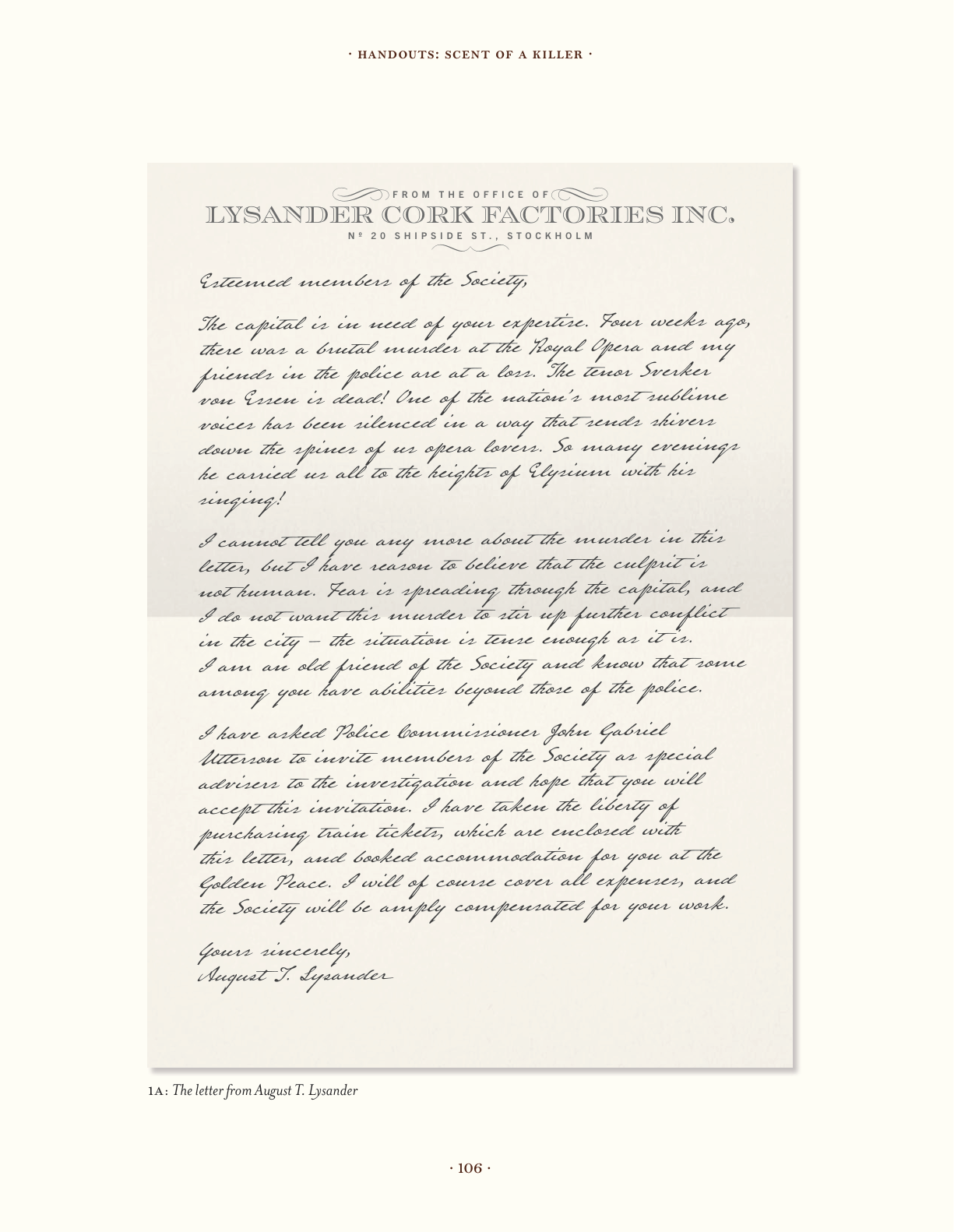
“Thank you for coming. I’ve received a letter from an old friend. The industrialist August T. Lysander in Stockholm is a patron of the Society who has made substantial donations to us in the past. He lacks the Sight but is well aware of our work and how important it is. I’ve not heard from him in decades. Now it is he who needs our help.” Linnea hands over the letter (included as handout 1A on page 106 and available for download on the Free League website) and lets the characters read it: Esteemed members of the Society, The capital is in need of your expertise. Four weeks ago, there was a brutal murder at the Royal Opera and my friends in the police are at a loss. The tenor Sverker von Essen is dead! One of the nation’s most sublime voices has been silenced in a way that sends shivers down the spines of us opera lovers. So many evenings he carried us all to the heights of Elysium with his singing!
I cannot tell you any more about the murder in this letter, but I have reason to believe that the culprit is not human. Fear is spreading through the capital, and I do not want this murder to stir up further conflict in the city – the situation is tense enough as it is. I am an old friend of the Society and know that some among you have abilities beyond those of the police.
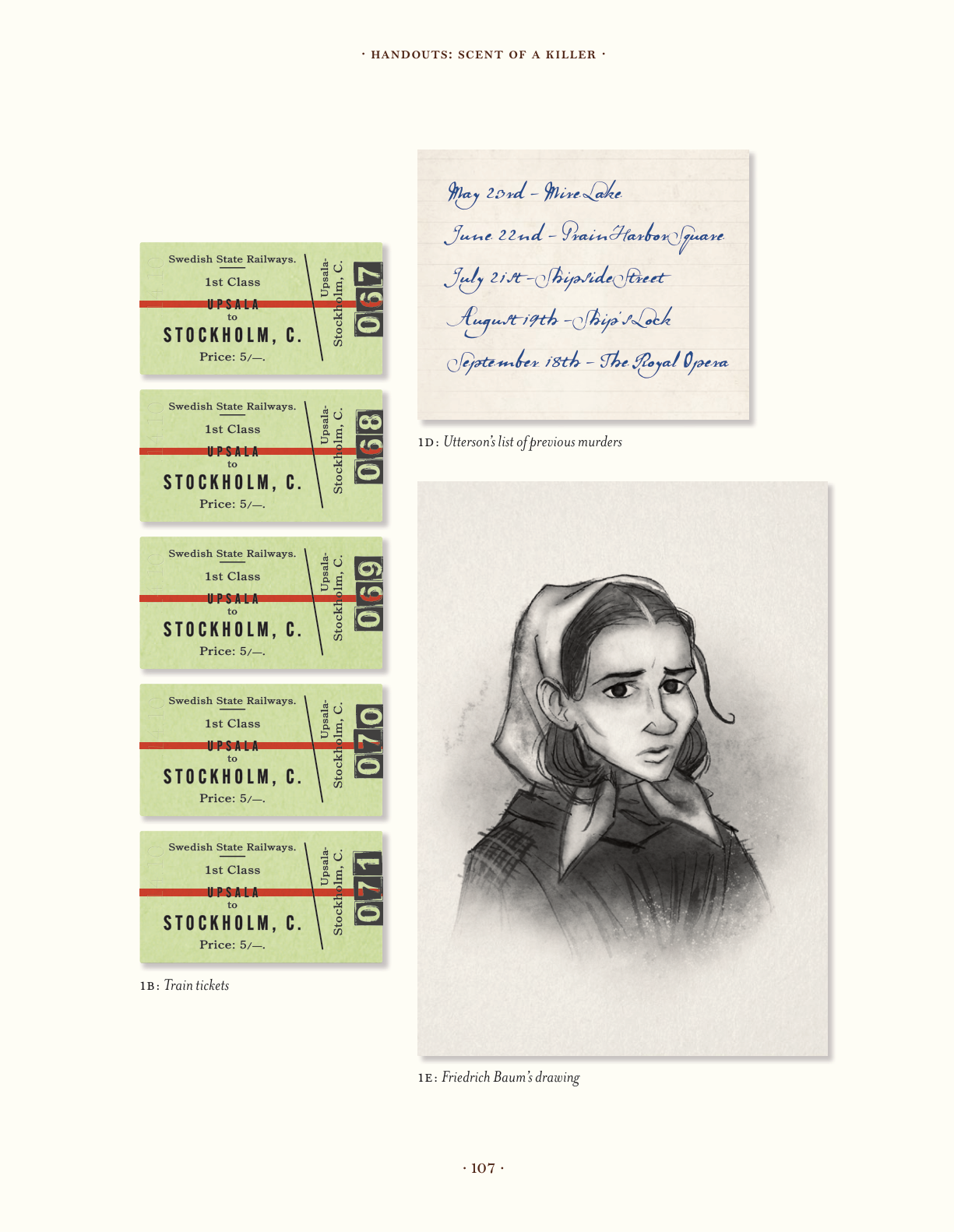
I have asked Police Commissioner John Gabriel Utterson to invite members of the Society as special advisers to the investigation and hope that you will accept this invitation. I have taken the liberty of purchasing train tickets, which are enclosed with this letter, and booked accommodation for you at the Golden Peace. I will of course cover all expenses, and the Society will be amply compensated for your work. Yours sincerely, August T. Lysander The train tickets are valid for the next day’s morning departure and included as handout 1B on page 107 and available for download on the Free League website.
Preparations
As usual, the player characters can prepare for the journey in Upsala by purchasing equipment (page 73 of the rulebook) or using Upgrades at Castle Gyllencreutz (page 89 of the rulebook). They can look for information about Lysander and, with a successful LEARNING roll, find out about his career as a businessman and that he is a member of the Freemasons as well as several spiritualist societies in Stockholm (peripheral clue). They find no information about the murders beyond what is written in the newspapers (see The Journey below).
The Journey
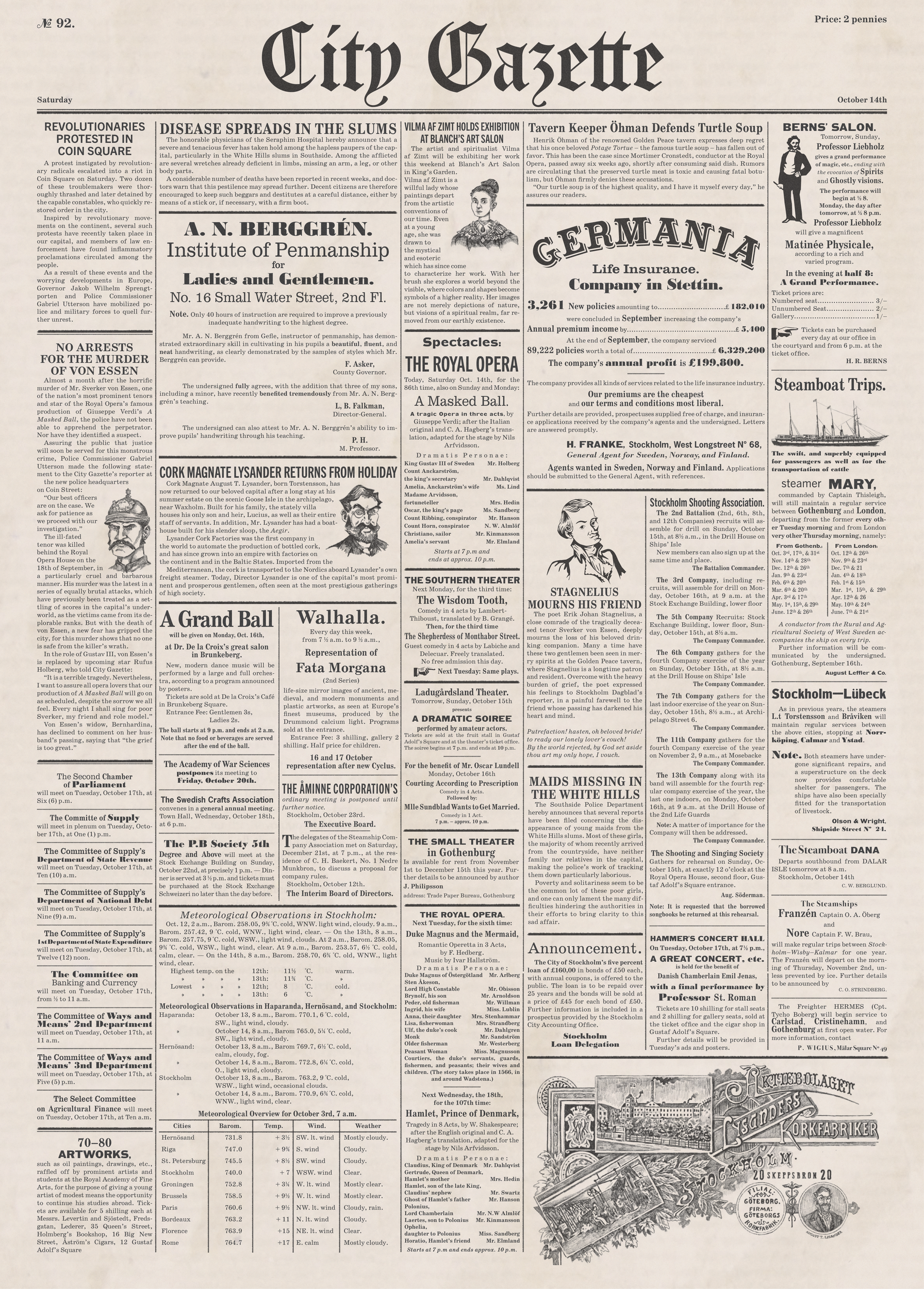
The player characters will likely take the newly opened steam train from Upsala Central Station to Stockholm. During the journey they receive today’s issue of the City Gazette – see handout 1C included as a separate print in this book, and available for download on the Free League website. The newspaper contains many stories of interest to the players. The articles about von Essen’s murder are a central clue. As usual the characters can gain an Advantage during the journey (page 182 of the rulebook).
Arrival
The train arrives at Stockholm’s grand, newly constructed Central Station. The capital is bustling with activity, in stark contrast to the stillness of Upsala. The street outside is crowded with travelers, servants, day laborers, and beggars, as well as carriages and cattle.
Just as the player characters are contemplating how to proceed, a shiny black coach stops in front of them . A skinny man with a top hat sits in the coachman’s seat. The door opens and an elegantly dressed man with a well-groomed beard peeks out. Show the players the portraits of Karl-Axel Trygg and August T. Lysander on pages 53 and 6 (also available for download on the Free League website).
“Welcome to the capital! I wanted to take this opportunity to meet you in person. Hop in, my valet Trygg will take you anywhere you want to go. To the police headquarters, perhaps, or to the Golden Peace to freshen up from the journey?”
Show the players the large map of the city and point out the police headquarters and the Golden Peace (see the GM map on page 17). If they want to go somewhere else, that is perfectly alright.
The characters can talk to August Lysander on the way to their next stop. He knows nothing more about the murders than what he has read in the newspaper, although he suspects vaesen to be involved due to the bestial nature of the killings. He can also tell them about himself but does not reveal anything that is not public knowledge. August has no role in this mystery except as a quest giver. He spends most of his time at his office (see Lysander Cork Factories Inc., page 25). Karl-Axel Trygg also has no further role in this mystery but is introduced here as he returns later in the campaign.
The Police
At the time of this mystery, the Stockholm Police Department has recently been reorganized. The capital’s previous law enforcement organization, the City Watch, had failed to curb the riots that raged a few years earlier. Crimes remained unsolved and thefts increased dramatically. The press openly criticized the City Watch, claiming that its officials were themselves committing criminal acts.
In response to this criticism, a new civilian police force was established. Stockholm was divided into three districts, each with its own police station: Northside, Southside, and the Town Between the Bridges.
To become a police officer, a recruit needs to be at least 5 feet 7 inches tall, 24–35 years old, and literate. It also requires “sound judgment”, a calm disposition, good health, and a strong physique. A new uniform has been introduced for the police force, consisting of a top hat and a double-breasted long coat, and officers are armed with a truncheon and saber.
Countdown and Catastrophe
During the mystery the conflicts will escalate step by step. The following events can be used to up the pace when necessary and push the players toward the final confrontation. Each step of the Countdown takes place during the hours of darkness. If the game is progressing quickly, multiple phases can occur on the same evening or night.
Countdown
1. Friedrich Baum, organist at Saint Gertrude’s Church, is found brutally murdered. The characters can be drawn there by screams or fetched by Utterson’s constables. The murder was committed by Volk in werewolf form. See the section Saint Gertrude’s Church on page 32.
2. Field Surgeon Jens Svärdh is brutally attacked at the statue of Saint George and the Dragon. Again, the characters can be drawn there by screams or fetched by police constables. Svärdh survives the attack, which is witnessed by his wife, and is taken to the Seraphim Hospital. Once again it is Volk who is behind the attack, which leads to Svärdh contracting lycanthropy and turning into a werewolf. He flees the hospital and begins to prowl the alleys of Stockholm. See the section Saint George and the Dragon on page 33.
3. A fire watcher in the Town Between the Bridges is attacked and viciously killed by Jens Svärdh in werewolf form. The characters can witness the attack or be drawn there by the desperate screams of the fire watcher. Under a magnificent full moon, the werewolf bares its teeth and growls. The characters can fight or try to escape. However, the werewolf is interrupted by a distant howl. It howls back at the full moon and runs away. The characters can go after it – make an AGILITY roll opposed by the werewolf’s BODY CONTROL (for stats, see page 160 of the rulebook). If the characters win, they manage to follow the werewolf for a while, in the direction of Ester Volk’s home (page 35), before it disappears into the shadows. The characters cannot confront the werewolf at this point – that will have to wait until the Confrontation. After this event, Ester Volk concludes that her curse cannot be controlled and must be stopped at all costs. She does not return to her workplace but locks herself in her cellar.
Catastrophe
If the player characters fail to stop Svärdh, the werewolf unleashes a bloodbath in the alleys. Unlike Volk, Svärdh kills indiscriminately. Panic breaks out and the police struggle to control the angry and terrified residents. If Volk is alive, her killing continues as well. The police pursue the werewolves but fail to catch them, and the murders keep piling up. A few months later, Svärdh’s body is found in Haga Park with his heart torn out.
Locations (11)
This mystery allows the player characters to move freely through Stockholm, but only places that are relevant to the investigation are described below. All locations are marked on the maps on page 14 and below. Note that two of them – Saint Gertrude’s Church and Saint George and the Dragon – only become part of the mystery once steps 1 and 2 of the Countdown have occurred. Until then, there is no reason to visit those places.
If the characters want to visit a location that is not described below, you will either need to improvise or simply tell the players that there is nothing of interest there. Make sure that the game does not grind to a halt because the players do not know where to go next. Use the Countdown, or Utterson, to drive the plot forward.
Dreams and Visions
The player characters could suffer visions and nightmares during their stay in Stockholm, triggered by the gruesome events. The dreams show images of Stockholm at night. The dreamer is chasing someone and feels a strong sense of hunger, blood, rage, and thirst for vengeance. Do not describe a werewolf too clearly in the dream. One tip is to weave creatures from the character’s trauma or people from their dark secret into the dream, to make it more personal. A typical nightmare has Fear value 1.
Central and Peripheral Clues
The clues the player characters can find are either central or peripheral to the plot. Central clues are vital for solving the mystery; peripheral clues are not, but provide additional information that may be useful. The players do not need to be handed central clues on a silver platter, but there are several ways for the characters to discover them during the adventure. Central clues are marked with the symbol in the text.
Maps (8)


Police Headquarters
The newly built police headquarters is located in the northern part of the Town Between the Bridges, overlooking the Stream of Stockholm. The sturdy stone building has four floors and, in addition to offices for the police force, houses a detention center complete with a hundred cells and a morgue where Ester Volk works. The third floor is where Commissioner Utterson has his office. All visitors must report to the doorman before they are escorted through the narrow corridors and the throng of victims, thieves, constables, vagrants, detectives, and judges.
Challenges
- Commissioner Utterson is in his office during the day. He greets the player characters courteously and tells them what he knows, although he is not sure what the Society can contribute to his investigation. A MANIPULATION roll makes him reveal more about his suspicions.
- Coroner Ester Volk is usually at the morgue during the day. She willingly answers questions about her work, but under no circumstances does she reveal her suspicions that she herself may be the killer (see Background).
Initial Clues
- The Murders: Utterson confirms that the city has been struck by a series of grisly murders, of which opera singer Sverker von Essen appears to be the latest victim. He was found in the street behind the Opera on September 18th after a performance of the opera A Masked Ball. All victims have been torn apart, as if by some wild beast. Everyone before von Essen was a criminal, and Utterson assumed at the time that they were killed in some underworld dispute.
- The Feud: Utterson has no suspects. There was rumored to be bad blood between von Essen and another singer at the Opera, Rufus Holberg, but the latter had an alibi – he was at Bern’s Salons with several colleagues – and Utterson found no evidence against him.
- The Widow: If the characters ask about von Essen’s widow, the police commissioner says she has already been interviewed and offered no useful information. They can have her address on Knight Street if they wish to speak to her.
- Previous Attacks: Utterson has a list of times and locations of the murders – see handout 1D on page 107, also available for download on the Free League website. No names are listed – the police didn’t bother as all of the victims were criminals. Perceptive players may notice that a month passed between each murder. At the National Archives (page 31) – or by consulting a calendar – the characters can learn that all murders occurred around the time of a full moon.
- Insider? If pressed (MANIPULATION), Utterson admits that he suspects someone in the justice system may be guilty, as the victims were all criminals. In fact, Sverker von Essen was a suspect in the death of conductor Mortimer Cronstedt a few weeks before his own demise. Cronstedt, who also worked at the Opera, died after eating turtle soup at the Golden Peace (page 22). There were rumors of a feud between von Essen and Cronstedt, but no evidence could be found.
- Unrest: As if the murders were not enough for Utterson to deal with, the streets are rife with insurgents seeking to overthrow the royal family, inspired by the revolutions on the continent. The new police force must prove that it can maintain law and order – people must not be allowed to take the law into their own hands.
- The Sickness: If the characters ask about the disease spreading through the slums, Utterson or Ester Volk can inform them that several people in the While Hills slums in Southside have died of severe infections in recent weeks. They had all had an arm or leg amputated and some of them had had the lost limb replaced by a body part from a corpse. The police’s interrogations have led nowhere, as mistrust is high in the slums.
- The Woman: On the characters’ first visit, Coroner Volk has the corpse of a young woman on her slab, covered by a cloth. The woman was found in the Stream the day before, seemingly strangled. Volk sighs that the murder of von Essen gets lots of attention while no one cares about the poor who are losing their lives every day in Stockholm. Several girls from the White Hills slums have recently gone missing, and Volk believes that this may be one of them. No one has asked about her.
- The Wounds: As for Sverker von Essen, Volk says his throat was slashed with great force and that he died from extensive blood loss. She has nothing more to say. Perhaps it was a wild dog?
- The Conductor: If asked about Mortimer Cronstedt, the conductor at the Opera, Volk says he was found dead six weeks ago at the Golden Peace, face down in a bowl of turtle soup. Volk examined the body and concluded that he had been poisoned, but found no evidence of who or what might be responsible.
- The Society: If Volk learns that the Society has an interest in the supernatural, she becomes very curious, asking all kinds of questions about ways to appease or deal with vaesen. She also tells them about the National Archives on Knights’ Isle (page 31), which has a special Esoteric section on vaesen and other supernatural matters, and recommends that they go there for information.
- Smells: If the characters pass a VIGILANCE roll, they notice that Volk’s keen sense of smell seems to bother her in her work. Perfumes and fragrant herbs can be seen on shelves in the morgue.
Clues After Step 1 of the Countdown
- The Organist: Volk is now examining the maimed body of the murdered Friedrich Baum. The victim’s abdomen has been savagely slashed, exposing his intestines. His chest has been torn open and the heart removed. The modus operandi is similar to the murder of Sverker von Essen, although the singer’s heart was not missing.
- A Loner: Volk can also reveal that she is familiar with Friedrich Baum, as she regularly visits Saint Gertrude’s Church. The organist was a recluse who lived in a room in the church’s parish house.
- Arm Wound: Volk has a fresh wound on her forearm, sustained when she jumped out of the window of Saint Gertrude’s Church in werewolf form (page 32). The wound is bandaged and hidden under her clothes, and Volk does not show it to the characters unless they pressure her (MANIPULATION).
- The Notebook: If presented with Baum’s notebook, both Utterson and Volk recognize a young woman in the pictures – she was recently found dead in the Stream and was autopsied during the characters’ first visit to Volk. They do not know who she is but suspect that she is a poor girl from the White Hills slums, since no one has reported her missing.
Clues After Step 2 of the Countdown
- The Surgeon: Utterson explains that the victim of the attack, field surgeon Jens Svärdh, was himself the subject of a criminal investigation a few years ago. He was suspected of having engaged in experimental surgery during the war, attempting to replace amputated and torn-off body parts with limbs from fresh corpses. The ability to replace lost limbs would not only be a major scientific advance, but would also make it easier for the military and the city’s factory owners to get injured soldiers and employees back to work. Only those involved in the investigation knew of these suspicions, which never led to prosecution. If Utterson has not already expressed his suspicions about the attacker working within the justice system, he does now. In response to a direct question, he admits that Doctor Volk was involved in the Svärdh investigation. If asked directly, Volk admits that she participated in the Svärdh investigation but has nothing further to add.
Previous Murders
- May 23rd – Mire Lake
- June 22nd – Grain Harbor Square
- July 21st – Shipside Street
- August 19th – Ship’s Lock
- September 18th – The Royal Opera Neither Utterson nor Volk have any more useful information about the killings that occurred before the murder of Sverker von Essen – because the victims were criminals themselves, there was no investigation. If the player characters visit the crime scenes in search of information, they get no answers from the locals – no one wants to be seen talking openly to strangers about what is assumed to have been a settling of scores in the underworld.
Clues After Step 3 of the Countdown
- Volk Missing: Utterson says that Ester Volk has not turned up for work. He can give the player characters her home address on Charity Street if they ask for it. If the characters still do not suspect Volk, Utterson can voice such suspicions.
The Golden Peace
The tavern and hotel of the Golden Peace is located in a centuries-old stone building on East Longstreet, a stone’s throw from the main water pump in Iron Square. The Tavern: The ground floor and basement of the building houses the old tavern, commonly known as the Peace Cellar. Its clientele includes aristocrats and customs officials from Shipside Street as well as poets and composers. The dining room with windows facing East Longstreet is hung with beautiful lamps. Ceramic stoves and tealights provide a lovely warmth in the autumn chill. Guests are sitting in armchairs and at tables set with white tablecloths. The Hotel: A crooked wooden staircase leads to the second floor which holds a number of simple guest rooms. Here August Lysander has booked accommodation for the player characters in separate little rooms, drafty but clean. The ceiling is painted with medieval patterns that are visible between the thick rafters.
Challenges
- Stagnelius: The famous poet Erik Johan Stagnelius is usually seated at his regular table in the dining room. Characters who pass a LEARNING roll recognize him immediately, otherwise the tavern keeper or other guests can tell them who he is.
- The Bottle: With a successful VIGILANCE roll, the characters can see Stagnelius occasionally taking a small, brown glass bottle out of his pocket and pouring a few drops into his coffee. Stagnelius is in a bad mood, but characters who pass a MANIPULATION roll ( if they praise his poetry) can chat with him and gain more clues about the murder victim Sverker von Essen, whom he knew well.
- The Tavern Keeper: In the dining room is tavern keeper Henrik Öhman, who is devastated by composer Mortimer Cronstedt’s death from poisoning at the dining table six weeks ago. Now no one dares to eat his signature dish, turtle soup, as rumors circulate that the preserved meat is poisonous and causes deadly botulism. If the characters get on his good side (MANIPULATION roll with if they praise his cooking), they can gain several useful clues.
A Shadow in the Night
In order to ramp up the pace and suspense of the adventure, you can give the player characters a glimpse of the werewolf. Have them make a VIGILANCE roll – those who succeed feel like they are being watched and notice a dark and menacing shadow in an alley. If they go after it, they can make an AGILITY roll to catch a glimpse of a shaggy creature. However, they cannot confront the werewolf during such encounters, so use them sparingly.
Clues
- The Feud: The emotional Stagnelius says he was a close friend of the late Sverker von Essen, “who was a true artist and always smelled pleasantly of lavender.” He claims the singer had a feud with Mortimer Cronstedt, conductor of the Opera, and that von Essen’s eyes sometimes went dark when he talked about Cronstedt’s plans for the spring repertoire. In response to a direct question, Stagnelius admits that von Essen was at the tavern the night Cronstedt dropped dead in his turtle soup.
- Laudanum: If the characters ask Stagnelius about his bottle of drops, he explains that he takes laudanum for his nerves. Anyone who passes a MEDICINE roll knows that laudanum is deadly in high doses (which Volk can confirm). If the characters ask Stagnelius if von Essen may have taken some of his laudanum, it takes a successful MANIPULATION roll for him to admit that this is the case. On failure, Stagnelius angrily accuses them of “smearing his dead friend.”
The Mutilated Beggar
At some point in the beginning of the mystery, a dirty beggar comes up to the player characters and asks for money. His right hand looks nasty – it is all pale and smells terribly. Given the rumors of disease in the slums (see the City Gazette newspaper), the encounter may frighten the characters.
If they give the man a coin or two (cost level 1) and take the time to speak with him, he tells them that a well-dressed gentleman offered him money to cut off his hand and replace it with another. He does not know the man’s name.
This event can occur anywhere in the city. The characters can even run into the same man multiple times.
Lysander Cork Factories Inc.
August Lysander’s company has a mansion on Shipside Street with a magnificent view of the Stream and the ships that are anchored there. The building dates from the 17th century and has a large, ornate door decorated with mermaids holding gas lamps. A beautiful marble staircase and gilded sconces can be seen inside the door. Lysander has had the palace renovated with the latest technology and built an iron-grate elevator from the ground floor all the way up to his office at the top.
Challenges
- Guards: The office is well guarded. There is always a man posted inside the door, armed with knuckledusters and a pistol, and another three are constantly on duty in the building. But if the characters come knocking during the day, they are let in and shown to the top floor office where Lysander receives them.
Clues
- Guidance: August Lysander is curious about the player characters’ investigation and has lots of questions. He has no concrete clues to offer them during this mystery, but can provide hints if they get stuck, as he is very knowledgeable about vaesen.
- The Snuff Box: During the visit, the player characters may notice that Lysander has a gilded snuff box in his waistcoat pocket. A sharp-eyed player character (roll for VIGILANCE) may see that it is decorated with the monogram “CL.” Under no circumstances does Lysander let the player characters know what is in the snuff box. It plays no role in this mystery, but becomes important later in the campaign.
Sverker Von Essen’s Residence
The opera star Sverker von Essen had a grand apartment on Knight Street in the norteast part of the city, and his grieving widow Bernhardina still lives there.
Challenges
- The Valet: If the player characters knock on the door, a dignified valet opens it. He firmly states that Mrs. von Essen is in mourning and must not be disturbed, but he can be persuaded with MANIPULATION or a handsome bribe (cost level 2).
- The Widow: Bernhardina von Essen greets them in the parlor, which is decorated with statues, chandeliers, and tapestries. She is a beautiful middle-aged woman dressed in all black and a mourning veil. The room smells strongly of lavender. The widow sobs and says that she has already told the police everything she knows, but the characters can make her talk with a successful INSPIRATION or MANIPULATION roll.
Clues
- The Feud: The widow was not present at the time of her husband’s murder and has no idea what happened. She can confirm that Sverker von Essen had a feud with his rival at the Opera, Rufus Holberg (page 30), whom she calls “that silly little upstart.” That conductor Cronstedt before his death had intended to replace von Essen with Holberg for the leading role is news to Bernhardina, who finds it highly unlikely. “No one could match my Sverker’s God-given voice.” She dismisses any suggestions or allegations that her husband was involved in Cronstedt’s death as “gossip and malicious slander.”
- Lavender: If asked about the lavender scent, Bernhardina explains that “it was my Sverker’s favorite perfume. The smell of it makes me feel his presence.”
The White Hill Slums
“The stench was still there, of course, and as the sun and the heat rose it would grow stronger, becoming unbearable for those who weren’t used to it. The stench of poverty, of dirt and garbage, of latrines and decay. The city’s stench, the stench of a city.” – P. A. Fogelström, The Children of the Weavers The area known as White Hills in Southside, on the outskirts of the city, is the largest slum in Stockholm. The city’s population has more than tripled in recent decades, and the shanty towns of White Hills are home to all those who have come to the capital in search of work. People live in cramped conditions, often lodging with other families. Rumors, diseases, and fires spread quickly in these parts.
The player characters may come here to find out more about the disease in the slums or the mutilated individuals they have encountered or heard about, or to seek information about the dead young woman depicted in the notebook of the murdered organist Friedrich Baum (see step 1 of the Countdown and page 32). The smell of food, outhouses, and people hit them as they arrive.
Challenges
- Urchins: A crowd of dirty, giggling children surround the player characters. One of the children may try to steal something from them (it takes a VIGILANCE roll to notice the attempt, which otherwise costs the characters one point of Capital). If the characters show the children the drawing of the young woman and pass a MANIPULATION roll (or give them money equivalent to cost level 1), they point to an old, dilapidated mansion at Demolition Alley, saying “ask Mrs. Grankvist.”
- The Laundry Lady: Lillemor Grankvist runs a small laundry in one of the run-down annexes of the mansion. She is a feisty 45-year-old woman with three snotty children clinging to her legs. Filling a large wooden tub with hot water, Mrs. Grankvist complains that her maid has not been home for a week and that she owes her rent. If the characters pass a MANIPULATION roll or pay the maid’s rent (cost level 2), Lillemor tells them what she knows (see Clues).
- The Dying Man: If the characters ask around about the disease in the slums, the children (or Lillemor) can point them towards one of the shacks in the shantytown. The dark room is buzzing with flies and stinks of rotten flesh. The characters must pass a FORCE roll not to vomit and suffer a physical condition. The victim is Johan Petterson who is dying of gangrene. His right leg has been amputated at the knee and another, formerly belonging to someone else, has been sewn in its place. The operation was clearly unsuccessful. His lower leg has gone black, and an infection has spread around the knee and up his thigh. His breathing is erratic and his eyes feverish. The poor man tells them everything he knows (see Clues). He dies shortly afterwards unless the characters treat him with MEDICINE (–3 to the roll) and then take him to the Seraphim Hospital.
- Body Snatchers: The player characters see some shady-looking types (equal in number to themselves) in an alley. The men are carrying something heavy, which they then throw into a covered cart. With a successful VIGILANCE roll the characters realize it is a human body. If the characters approach, the men pull knives, first threatening them and then attacking if the characters do not back down. If defeated and questioned (OBSERVATION roll), the men can reveal some interesting information (see Clues). If the characters lose, they are left in the gutter.
- The Surgeon: If step 2 of the Countdown has not yet occurred, the characters can encounter barber surgeon Jens Svärdh in the White Hills. He stands out from the dirty surroundings with his white shirt and black doctor’s bag as he hurries across the street and into a coach. If the characters stop him, he introduces himself as a doctor and explains that he has come to the slums to help the sick. He is currently studying the new disease, as it would be fatal for the city if it were to spread from the slums. A successful OBSERVATION roll reveals that Svärdh is lying. If the characters have encountered the mutilated beggar (page 24) and are now beginning to suspect Svärdh, he snaps at them before leaving in his coach. If they try to stop him, Svärdh defends himself, helped by the coachman and some goons (body snatchers) hiding inside the coach (as many as the player characters, in addition to Svärdh himself). If the characters are defeated, Svärdh leaves them in the gutter. If Svärdh’s henchmen are defeated, he surrenders, and the characters can arrest him – see the sidebar Svärdh Arrested? Make sure that Svärdh is not killed at this point.
- Note: The encounters with the body snatchers and Svärdh should not take place during the same visit to the White Hills. Choose the encounter that seems most appropriate. The second encounter can occur if the characters stay for a long time or return to the White Hills later on.
Clues
- The Missing Woman: If the player characters show her the picture of the dead woman, Lillemor Grankvist can confirm that it is her missing maid and that her name is Bodil Larsdotter. She is a 19-year-old orphan who recently moved here from Smolandia. Bodil lived in one of the sheds in her backyard. Lillemor has no idea what happened to her, but knows that she sometimes went to the Town Between the Bridges to sell bread to the dockworkers of Shipside Street.
- The Church: Lillemor also mentions that Bodil was a “God-fearing girl” who often went to church, usually Saint Gertrude’s. If Lillemor learns that Bodil is dead, she shrugs. “I’m sorry to hear that. But there are more poor girls coming in from the country every day, so I guess I’ll hire a new maid.”
- The Offer: The dying Johan Petterson can tell the characters that a man offered him a lot of money to take part in his important research. Johan was scared but the money was equivalent to several years’ salary and with it he could support his family in Smolandia. He knows he does not have much time left but regrets nothing. He asks the characters to send the money (5 points of Capital) to his family farm outside Vimmerby.
Svärdh Arrested?
It is possible that the player characters will arrest Jens Svärdh in the White Hills and take him to the police station. However, he is released after a few hours as the evidence against him is purely circumstantial – there is no hard proof that he has committed any crime. Svärdh must be free when step 2 of the Countdown occurs.
The Royal Opera
The Royal Opera was founded by King Gustav III in the late 18th century, inspired by French architecture. Its facade on Gustav Adolf’s Square has four columns, and the auditorium and foyer are decorated in white and gold.
Gustav III was murdered in this building during a masked ball, and at the time of this mystery the Opera is putting on Giuseppe Verdi’s A Masked Ball which depicts this very assassination. Superstar Jenny Lind plays Amelia, while the role of Gustav III was played by master tenor Sverker von Essen. Since his death, up-and-comer Rufus Holberg has quite literally taken up the mantle.
Challenges
- Getting In: Following the murder of von Essen, security around the Opera has been tightened and the player characters are not allowed in during the day. However, A Masked Ball is performed several nights a week. A ticket has cost level 3. The characters can also try to bluff their way in (MANIPULATION) or sneak inside (STEALTH), but if they fail, they are brusquely ejected by security guards (stats as dockworkers on page 166 of the rulebook).
- Holberg: The characters can mingle with the guests during the intermission. In the foyer they see Rufus Holberg with a glass of champagne, surrounded by admirers. He is wearing his 18th-century stage costume, with intense green eyes under an extravagant hat, but has temporarily removed his mask. If the characters approach Holberg with good manners and just the right amount of flattery (MANIPULATION roll with a bonus for the character’s Resources), Holberg has time to exchange a few words (see Clues).
Clues
- The Feud: Rufus Holberg is happy to talk about Sverker von Essen, who “always smelled so nicely of lavender.” He claims to be deeply saddened by the death of his rival, but adds that conductor Mortimer Cronstedt was tired of von Essen’s prima donna antics and wanted Holberg to take over the role of Gustav III. “He felt that my lyric tenor and acting talent would do the role more justice than von Essen’s heroic tenor.”
- The Argument: Holberg says von Essen was furious when he learned that he was to be replaced, and that everyone at the Opera could hear the argument that broke out between him and Cronstedt. When the conductor was found drowned in his turtle soup at the Golden Peace, the performances continued with von Essen in the lead role. A few weeks later von Essen was found dead as well. “A sad story, but at least it had a happy ending. I’m here, aren’t I?”
- Alibi: If the characters ask where Holberg was on the night of von Essen’s death, he says that he too participated in the performance, as part of the chorus, and then went over to Bern’s Salons with a group of colleagues and enjoyed himself until the early hours of the morning.
The National Archives
The National Archives has been collecting records, documents, books, and other items of particular importance to the kingdom for hundreds of years. It is one of the nation’s oldest government authorities, dating back to the 13th century. The impressive stone building on Knights’ Isle is newly constructed and built on a cast iron frame to reduce the risk of fire.
The floors rest on iron beams and are supported by slender cast iron columns. A spiral book chute runs through the entire stairwell. Light shines in through beautiful leaded windows. The bookcases are also made of iron and the doors of sheet metal. The National Archives is not open to the public.
Challenges
- The Archivist: Sitting behind the reception desk is archivist Sigrid Holgersdotter, an ancient woman with round glasses and a stern face. Her gray hair is pulled back in a tight bun. To be admitted, the player characters must explain that they are working for the police commissioner and either pass a MANIPULATION roll or make a “donation to the organization” (cost level 2). If the characters ask for writings on vaesen and the like, Sigrid refers them to the Esoteric Section two floors up.
- The Esoteric Section: Here, there are reading areas with leather armchairs, large potted plants on pedestals, and statues between the bookcases. Here the characters can seek useful information about werewolves, if they have begun to suspect that such a creature is behind the murders. Each character looking for information makes a LEARNING roll and gains a clue (below) for each six rolled. The players may also consult the Vaesen art book if they have access to it. If the characters fail to find any clues here, they can learn the most important information from Volk herself during the Confrontation (page 35).
- The Silver Knife: The Esoteric Section contains not only writings, but also historical artifacts. In a glass case the characters can find a long, curved silver knife from Transylvania. An inscription reads “Silver knife from Transylvania, for use against supernatural beings, gifted by Count Konstantin Konstantinovich of Jamburg.” Sigrid will not let the characters borrow the knife, but they can rent it (cost level 3) or try to steal it with STEALTH. If they get caught, Sigrid kicks them out.
Clues
- Transformation: Werewolves are affected by the phases of the moon. Most werewolves transform on the night of a full moon or the nights immediately preceding or following it. Some werewolves can also transform during the day if they experience strong emotions.
- Killing a Werewolf: A werewolf can only be killed with a silver weapon or by another werewolf.
- The True Name: A werewolf in wolf form turns back into a human if someone close to it calls it by its true name. However, this method only lifts the curse temporarily – the person transforms again at the next full moon.
- Curing the Curse: It is said that a werewolf who tears out and devours the unborn child of a pregnant woman is permanently cured of the curse.
- Calendars: The National Archives has astronomical charts and calendars that let the characters know that the brutal murders all occurred near the full moon (page 18). No roll is required to realize this.
Back to the National Archives
In a later adventure in this book, the player characters will have the opportunity to revisit the National Archives and uncover even deeper mysteries in the bowels of the building. It is therefore important that the National Archives is not destroyed or significantly altered in this mystery.
Saint Gertrude’s Church
This church, also known as the German Church, is one of the tallest buildings in Stockholm. It got its current look in the 17th century but dates back to the 1300s. The church is dedicated to Saint Gertrude, the patron saint of sailors. Next to the church is a small parish house.
The player characters have no reason to come here until after step 1 of the Countdown (page 16), when church organist Friedrich Baum is murdered. They are assumed to arrive here shortly thereafter. Should they visit this location before the murder, there are no clues to be found.
Challenges
- The Choir: Frightened members of the church choir have gathered outside the church. It takes a MANIPULATION roll to get any information out of them (see Clues). Characters who pass a VIGILANCE roll notice that one of the church windows has been smashed and shards of stained glass litter the streets outside.
- Police: A police constable is guarding the door. If the characters are accompanied by another constable or announce that they are working for Commissioner Utterson, they are immediately allowed to enter. Otherwise, it takes a MANIPULATION roll to be granted entry or a STEALTH roll to sneak inside.
- The Victim: In the staircase leading up to the gilded king’s gallery lies a mutilated body, face down. The stairs are covered in blood that has run down onto the floor. The characters can examine the body with MEDICINE and the crime scene with INVESTIGATION (see Clues).
- The Priest: Inside the church is the priest Rudolf Schiller. He is in shock but can talk to the characters if they first calm him down with a successful INSPIRATION roll. If the characters were called here by the police, there is also a constable present, but he has not been able to get a word out of the priest.
Clues
- The Injuries: Anyone who examines the body with MEDICINE will find that the chest and abdomen have been slashed open and the intestines torn out. Several internal organs appear to be missing, including the heart.
- The Notebook: With a successful INVESTIGATION roll, the characters find a small notebook on the stairs. It seems to have fallen out of the organist’s pocket. The book contains detailed facial portraits of young women drawn in charcoal. Some of the women look lifeless. This is a central clue – if the characters do not find the notebook, an NPC should.
- The Woman: If the player characters have visited the police morgue (page 18), they note that one of the drawings in the notebook bears a striking resemblance to the woman examined by the coroner (handout 1E, on page 107, also available for download on the Free League website). If the characters have not been to the morgue, Utterson makes the connection when he sees the notebook.
- The Window: A church window has been shattered with great force. All the broken glass is on the outside, none on the inside. Characters who pass another INVESTIGATION roll notice a small tuft of gray fur, sticky with blood, on one of the sharp edges of jagged glass.
- The Organist: The priest Rudolf Schiller can tell them that the dead body is that of the church organist Friedrich Baum. He was found by members of the church choir who came here for a rehearsal of Mozart’s Requiem. No one saw or heard the actual killing or the escape of the murderer.
- Baum’s Room: The priest says that Baum came to the parish a few years ago and studied organ at the Royal Academy of Music. He was quiet and kept to himself. If asked, the priest adds that Baum lived in a room in the parish house and offers to take the characters there.
- Trophies: Baum’s room is simply furnished. Under the bed there is a loose floorboard (can be found if the players look in that exact spot or pass an INVESTIGATION roll). In a small space under the floorboard is a box containing five locks of hair, tied together with silk ribbons. Baum has taken them from his victims.
Saint George and the Dragon
Saint George and the Dragon is a famous landmark in the Town Between the Bridges. This statue of bronze and stone on Merchants Square is a replica of a medieval wooden statue in the nearby Cathedral, which some believe symbolizes the wars between Sweden and Denmark. Below the statue on East Longstreet, there is a large fountain.
The player characters have no reason to come here until after step 2 of the Countdown (page 16), when Doctor Jens Svärdh is attacked by the werewolf. They are assumed to arrive here shortly thereafter. Should they visit this location before the attack, there are no clues to be found.
Challenges
- The Victim: A crowd of frightened onlookers has gathered around the fountain. A man is lying face down in the water, which is red with blood. The player characters can examine the body with a MEDICINE roll (see Clues).
- The Wife: A woman is sitting on the ground nearby, her face pale with shock. It takes an INSPIRATION roll to get anything useful out of her. This is Jens Svärdh’s wife, Märta (see Clues).
- The Satchel: If the characters successfully INVESTIGATE the scene of the attack, they find a leather satchel near the body, just outside the fountain.
Clues
- Injuries: The man in the fountain is pale and seemingly lifeless. He has long, deep wounds on his back. Characters who have encountered Jens Svärdh in White Hills (page 26) recognize him as soon as they turn the body over.
- Awakened: When the body is turned over, it suddenly starts shaking and moving. His eyes open wide and a silent scream issues from his mouth (Fear test against Fear value 1). His condition can be stabilized with another MEDICINE roll, but he is too injured and shocked to speak. Shortly afterwards an ambulance carriage rushes him to the Seraphim Hospital (page 34) along with his wife.
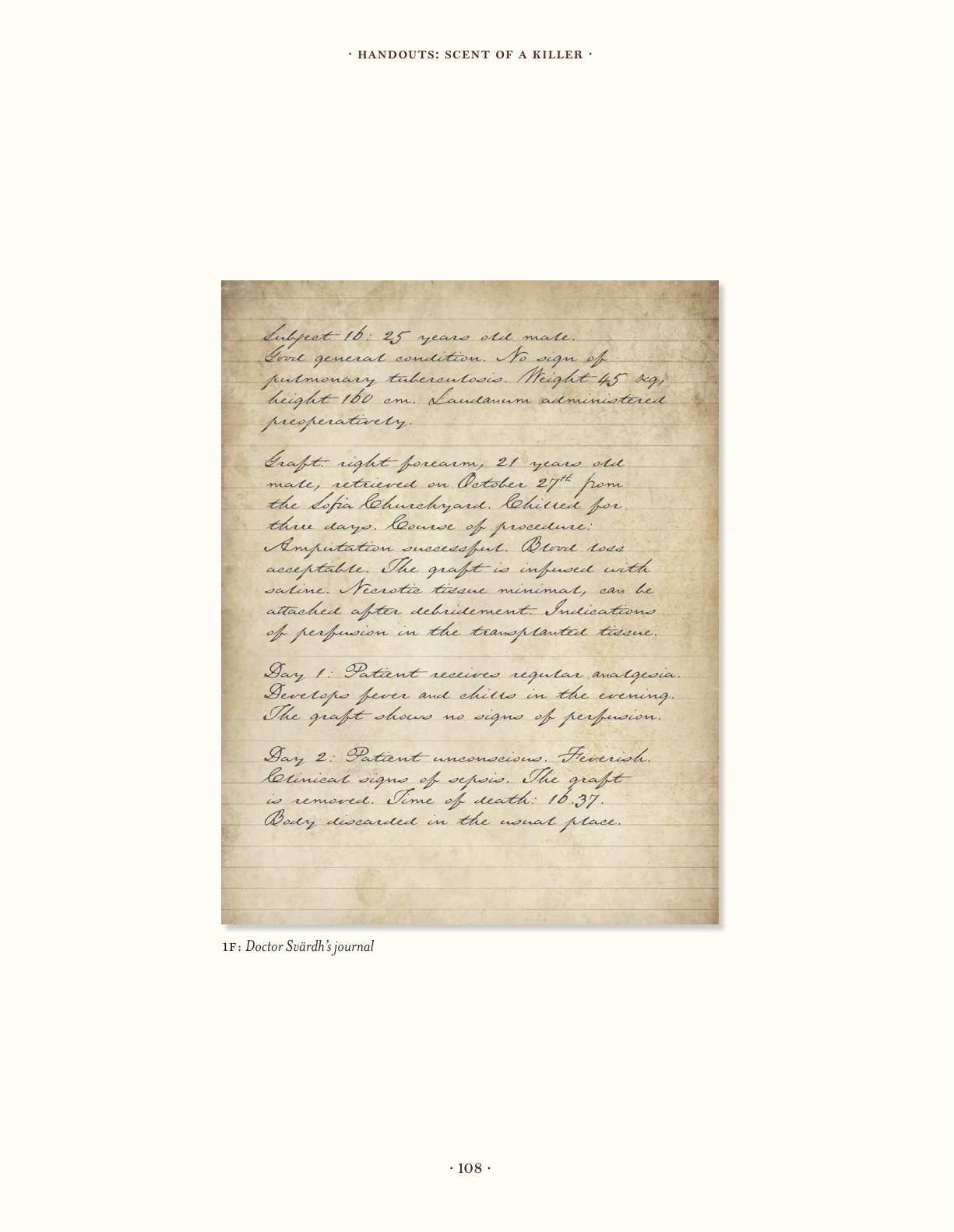
- The Notebook: The black leather satchel contains surgical instruments and a black notebook. The book is marked “Dr. Jens Svärdh” and the cover page reads: “Transplantation of Extremities From Cadavers – Experimental Series 3A”. The pages are filled with notes in neat handwriting describing how the patients responded to the procedure and how well the “graft” was accepted by the host. Present the players with handout 1F on page 108, also available for download on the Free League website. This is a central clue – if the characters do not find the bag, a policeman will. He then shows it to the characters or hands it over to Utterson later.
- Testimony: The shocked Märta Svärdh can be questioned right away or later at the Seraphim Hospital. She tearfully describes how she and her husband were on their way home to their apartment on Merchants Street after an evening at the Golden Peace. Suddenly a dark figure appeared by the fountain and knocked her to the ground. As she regained her senses, she saw her husband’s blood-soaked body in the fountain. She saw nothing of the attacker but remembers a growl, like that of a big dog, and a pair of “terrible green eyes.” She knows nothing about her husband’s surgical experiments.
Doctor Svärdh’s Journal
Subject 16: 25 years old male. Good general condition. No sign of pulmonary tuberculosis. Weight 45 kg, height 160 cm. Laudanum administered preoperatively. Graft: right forearm, 21 years old male, retrieved on October 27th from the Sofia Churchyard. Chilled for three days. Course of procedure: Amputation successful. Blood loss acceptable. The graft is infused with saline. Necrotic tissue minimal, can be attached after debridement. Indications of perfusion in the transplanted tissue. Day 1: Patient receives regular analgesia. Develops fever and chills in the evening. The graft shows no signs of perfusion. Day 2: Patient unconscious. Feverish. Clinical signs of sepsis. The graft is removed. Time of death: 16.37. Body discarded
The Seraphim Hospital
The Seraphim Hospital is located near the Karlberg Canal on King’s Isle and surrounded by a lush park. Built in the 18th century, it is the nation’s first modern hospital. Between the buildings there are several patios where patients and nurses in white caps can be seen during the day.
The player characters can visit the hospital to ask about the disease in the slums, follow the trail of the body snatchers who are dropping off bodies here (page 28), or after step 2 of the Countdown (page 16) when Doctor Jens Svärdh is attacked by the werewolf and brought here in an ambulance carriage.
Challenges
- Doctor Gregorius: If the player characters tell the nurse at the front desk that they are working for Commissioner Utterson, they are allowed to see the mustachioed Doctor Tyko Gregorius, who can tell them about the “pauper’s disease” and give them access to the injured Jens Svärdh (after step 2 of the Countdown). See Clues.
- Doctor Svärdh: If the characters wish to see Doctor Svärdh before step 2 of the Countdown, they are told that he is unavailable. With a successful MANIPULATION roll, they find out that he has a private operating room in the hospital’s basement, but only Svärdh has access to it.
- Getting In: Characters who want to get into the operating room must sneak their way through the hospital (STEALTH) and pick the lock (STEALTH) or break down the door (FORCE).
- Cellar Door: If the characters follow the trail of the body snatchers in White Hills (page 28) and investigate the alley behind the hospital, an INVESTIGATION roll reveals wheel tracks leading to a basement door. The door is locked but can be picked with STEALTH or forced open with FORCE. Inside is Doctor Svärdh’s operating room.
- Operating Room: A gruesome sight awaits in the operating room – amputated arms and legs on half-melted blocks of ice, and large glass jars of formalin containing strange surgical experiments where various body parts from humans and animals have been joined together.
Clues
- The Disease: If the player characters ask Doctor Gregorius about the disease spreading through the slums, he has little information to offer. The hospital has been receiving feverish patients with amputated arms and legs. Most of them have been dead or too ill to speak, but even those in better condition have refused to explain what happened. Most have died and been taken to the police morgue. Luckily, one of the hospital’s top doctors is working on the case. “Doctor Svärdh is an example to us all – he goes to the White Hills every day to care for the sick.”
- Journals: If the characters examine the basement operating room, they find several journals and notebooks, all labeled “Dr. Jens Svärdh”. No one else in the hospital knows what Doctor Svärdh has been doing down here.
- Transformation: If the characters come here after the werewolf’s attack on Svärdh (step 2 of the Countdown) and want to see him, they are shown to the room on the second floor where he is being treated. His wife Märta is waiting outside. In the room they are met with a shocking sight – a nurse is lying on the floor in a large pool of blood, badly lacerated (Fear test against Fear value 1). The window has been smashed from the inside and the cold autumn wind flows into the room. The nurse’s life cannot be saved. Note that the above happens even if the characters arrive shortly after the attack on Svärdh – his transformation is very rapid. From this point on, Doctor Svärdh roams the streets as a werewolf (see step 3 of the Countdown).
- Trail of Blood: Doctor Gregorius cannot explain Svärdh’s disappearance as his injuries were very severe. Characters looking for clues can make an INVESTIGATION roll to find a trail of blood in the park outside the hospital. It leads towards the Town Between the Bridges.
Ester Volk’s Apartment
Coroner Ester Volk lives alone in an apartment on Charity Street. At the entrance to the building grows a small chestnut tree. Louise Stefansson, the housekeeper who cleans and cooks for Doctor Volk, lives on the ground floor as well. The player characters will probably have no reason to come here until the end of the adventure (see Confrontation below), but can visit the place earlier if they like.
Challenges
- The Housekeeper: If the characters arrive before step 3 of the Countdown, Mrs. Stefansson is suspicious and will not let them in. It takes a successful MANIPULATION roll to get her to talk (see Clues).
- Sneaking: Characters trying to enter unnoticed must pass a STEALTH roll to pick the lock and another one to sneak into Volk’s apartment. The latter is an opposed roll against Stefansson’s VIGILANCE (8 dice in total as she has excellent hearing). If discovered, they are brusquely kicked out by Mrs. Stefansson.
- Hidden Door: Volk’s simply furnished apartment consists of two rooms and a kitchen. There is nothing suspicious in here, but an observant character searching the room (INVESTIGATION roll) notices scrape marks in the shape of a quarter-circle at a bookcase in the living room. The bookcase can be pulled out to reveal a narrow staircase down to a basement vault.
- Laboratory: In the basement vault there is a small laboratory with Bunsen burners and glass flasks. Heavy chains with iron shackles are attached to the stone wall. On a worktable lies a revolver loaded with silver bullets. A basement window near the ceiling lets in a bit of sunshine or moonlight. The air is stale and smells of chemicals and fur.
- Volk: During the day, Ester Volk is at the police station. In the evening, she may be at home, in which case she lets characters in if it is not too late. However, she wants to keep the conversation short as she claims to be very tired. A successful OBSERVATION roll reveals that Volk is hiding something.
Clues
- Strange Sounds: If the characters get Mrs. Stefansson talking and ask her about Volk, she tells them that she has been hearing strange noises from Volk’s apartment, and that the coroner often works all night.
- Talking to Volk: If Volk herself welcomes the characters in her apartment, she can provide the same information as at the police station (page 18). She tries to end the conversation as quickly as possible.
Blood in the Alleys
In the lead-up to the Confrontation, it may be a good idea to have Svärdh commit additional murders (after step 3 of the Countdown) – the werewolf kills indiscriminately, spreading fear through the Town Between the Bridges. This is an effective way to put pressure on the players while they are trying to figure out who is behind it all. However, do not let the characters confront Svärdh before they have confronted Volk.
Cast
Coroner Ester Volk p.21
Ester Volk is woman of medium height with fair hair and piercing green eyes. She speaks Finnish-Swedish. Straight-backed and methodical, she moves around the morgue with calm composure. Her face is scarred from the war against the Tsar’s armies in the eastern province. You can read more about her past under Background on page 10. Werewolf: Ester Volk is a werewolf. In werewolf form she has stats as per page 160 of the rulebook.
Commissoner Gabriel Utterson p.22
“Man is a wolf to man.”
Gabriel Utterson is a 40-year-old man with sharp hazel eyes, strong features, and a stern look on his face. After many years on the streets, his eyes are constantly searching for signs of trouble or danger, his hand often fiddling with the handle of his truncheon or the hilt of his saber.
He was recently promoted to police commissioner, but as a proud member of the first generation of the new police force, he wears the official uniform of top hat and double-breasted longcoat. He takes very seriously the task of fighting crime in his district – the Town Between the Bridges.
With his promotion, Utterson was welcomed into the city’s elite circles, and for the past couple of years he has been a member of the same Masonic order as August T. Lysander. He does not share the Society’s belief in the supernatural and is convinced that the murderer is human. But now he is at his wits’ end and has reluctantly accepted Lysander’s offer of help.
Erik Johan Stagnelius p.23
“Putrefaction! Hasten, oh beloved bride! To ready
our lonely lover’s couch! By the world rejected, by God set aside. Thou art my only hope, I vouch.” The poet Erik Johan Stagnelius is renting a room at the Golden Peace for an indefinite period. He is highly educated and speaks quickly and excitedly on all sorts of topics. In the evenings he entertains the hotel guests by reciting poems he has written, gesticulating animatedly until he is so out of breath that he needs to sit down for a while. A recurring theme in Stagnelius’s poems is alienation, his dissatisfaction with life, and his longing for death. He writes about yearning for a love that is only realized in the imagination.
Stagnelius is a short man with blonde hair and a pointed nose. His head looks disproportionately heavy on his thin body and is always tilted to one side. He is prone to mood swings and can suddenly become introverted and melancholic. He is constantly plagued by his poor health.
Tavern Keeper Öhman p.24
Henrik Öhman runs the kitchen at the Golden Peace. He is loud and warm and known in Stockholm for his version of Potage Tortue, or turtle soup – a very fashionable dish at this time.
- The Soup: Tavern Keeper Öhman insists that his turtle soup is definitely not toxic. He confides that he has not used real turtle in the soup for years, so it could not possibly have been botulism. Someone must have poisoned Cronstedt’s soup.
- Cronstedt: Öhman can confirm that Sverker von Essen was here the night Cronstedt died, as was Stagnelius. But this is not unusual – the two drinking buddies spent most evenings at the tavern. The poet and the singer partied late into the night and their conversations often turned into arguments. On this particular night, Öhman bumped into von Essen in the tavern’s kitchen and quickly threw him out. Öhman assumed that the singer was looking for liquor.
- Lavender: When asked if von Essen smelled of anything in particular, Öhman says that the tenor often smelled strongly of lavender perfume, “probably to hide the alcohol fumes.”
Lysander’s Guards p.25
Field Surgeon Jens Svärdh p.28
Doctor Jens Svärdh has served many years as a field surgeon in the Swedish army. Inspired by the scientific advances of this time, he has had increasingly innovative ideas in recent years. One such idea, which has almost become an obsession for him, is the possibility of transplanting body parts such as arms and legs from dying, or recently deceased, patients. This would help the city’s factory owners keep experienced workers on the job even after work-related accidents, which are very common. Werewolf: After step 2 of the Countdown, Jens Svärdh turns into a werewolf. In werewolf form he has stats as per page 160 of the rulebook.
- The Hospital:If the body snatchers are defeated and questioned, they reveal that they were hired by a wealthy man in fancy clothes to pick up dead bodies from the slums and leave them in a cart at a location behind the Seraphim Hospital. If pressed (MANIPULATION), the body snatchers can take the characters there. They do not know the man’s name.
Bodysnatchers p.29
Rufus Holberg p.30
The young lyric tenor Rufus Holberg is tall and often dresses in velvet. He is intense and expressive, gesturing with his delicate hands as he speaks. His bright green eyes are framed by dark eyebrows and eyelashes, and his curly dark brown hair falls over his shoulders. He works at the Royal Opera as a singer but is also a frequent actor. When the player characters meet him at the opera, he is wearing his costume as Gustav III at the masked ball.
- Witnesses: If the characters ask others at the Opera (MANIPULATION), they can confirm Holberg’s alibi – he really was on stage that night and went to Bern’s Salons after the show. Witnesses can also corroborate the story of the argument between von Essen and Cronstedt.
Handouts (15)
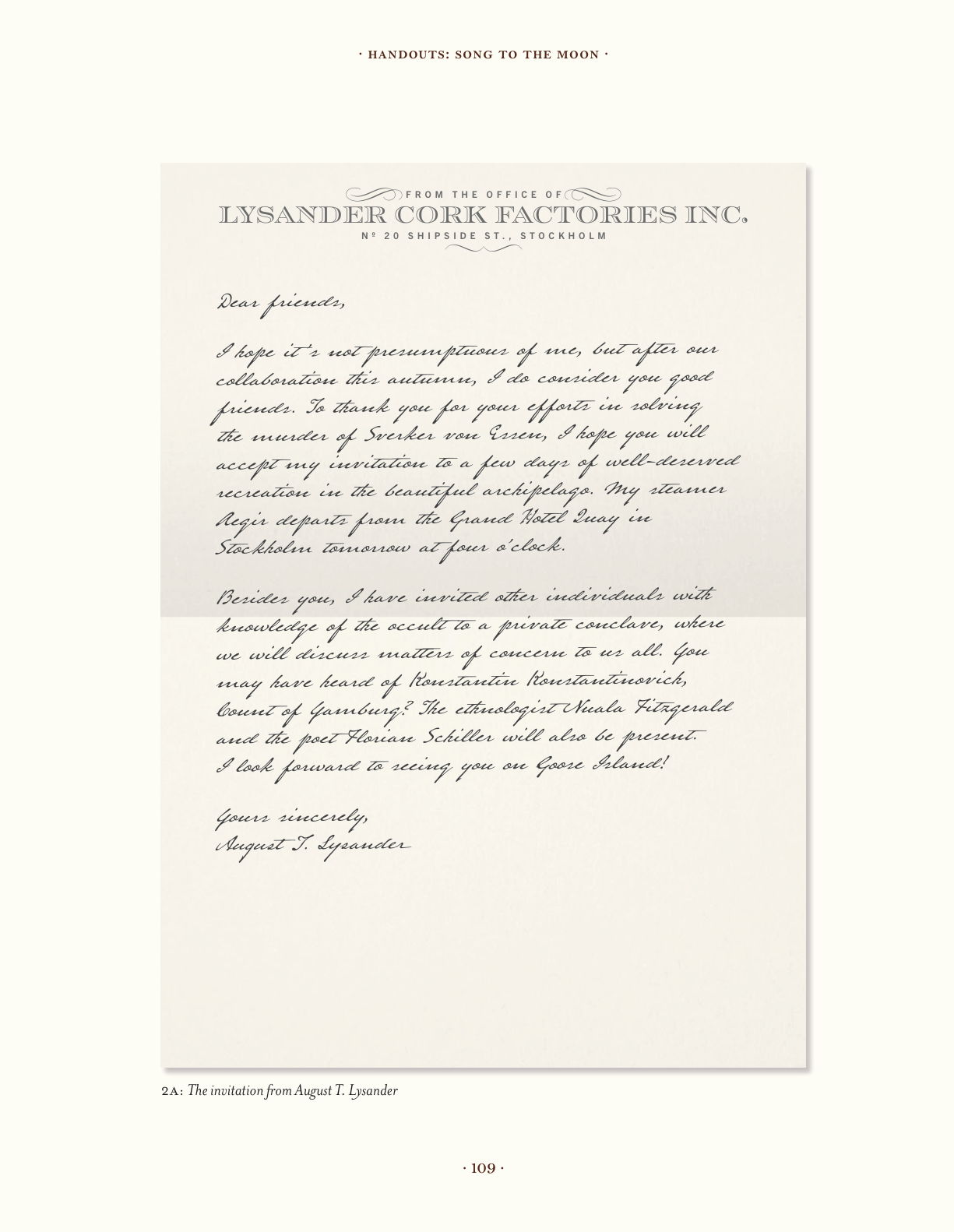
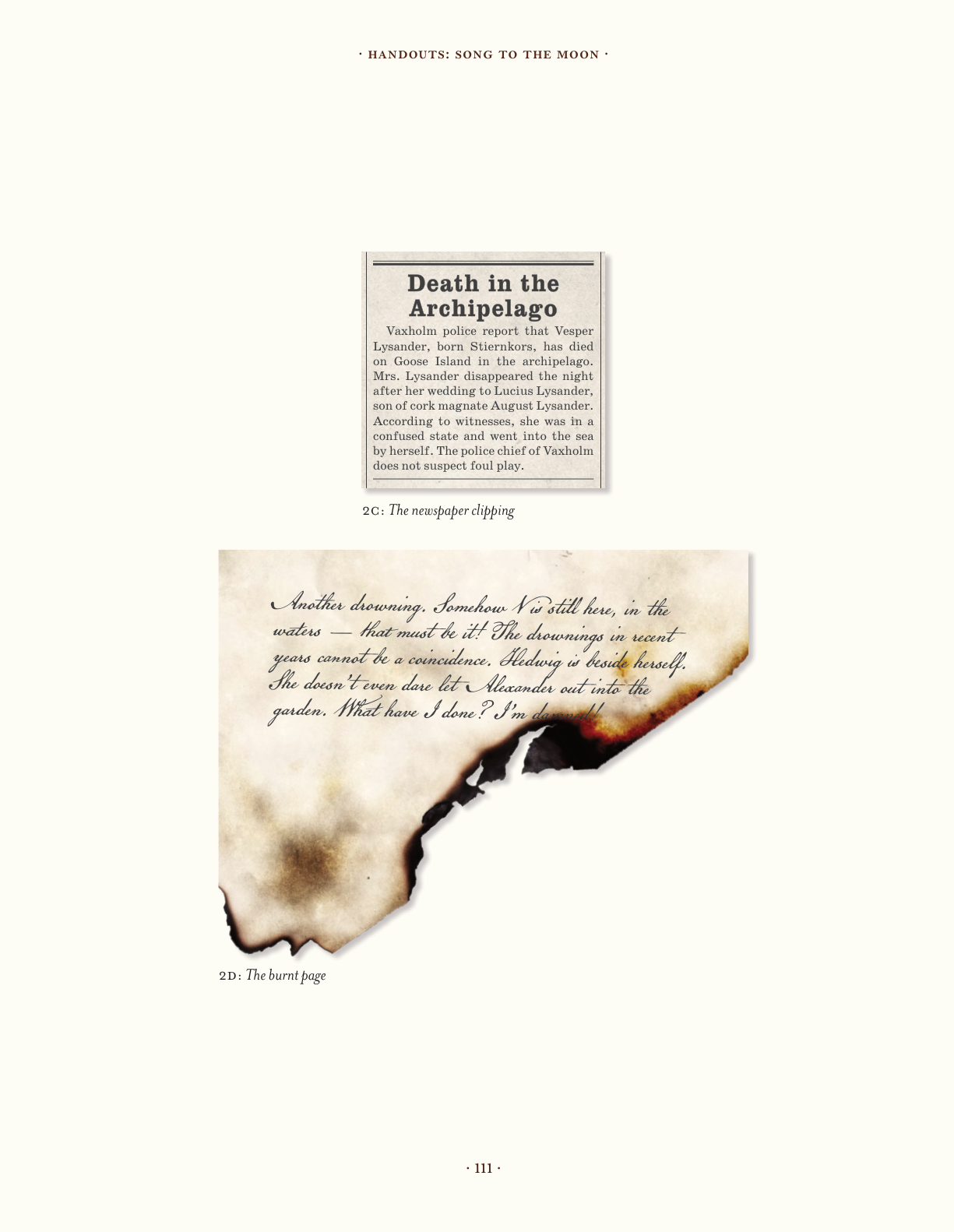
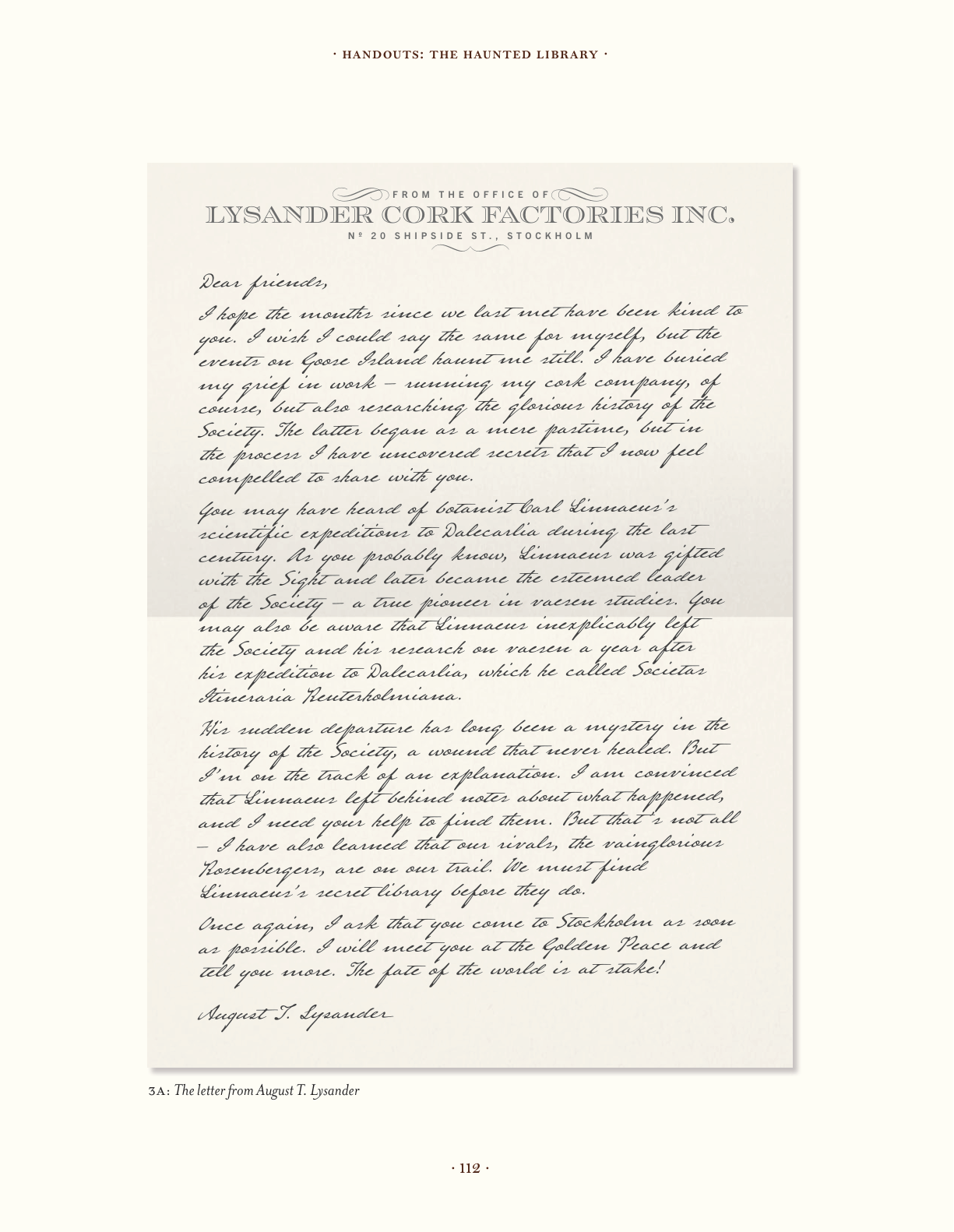
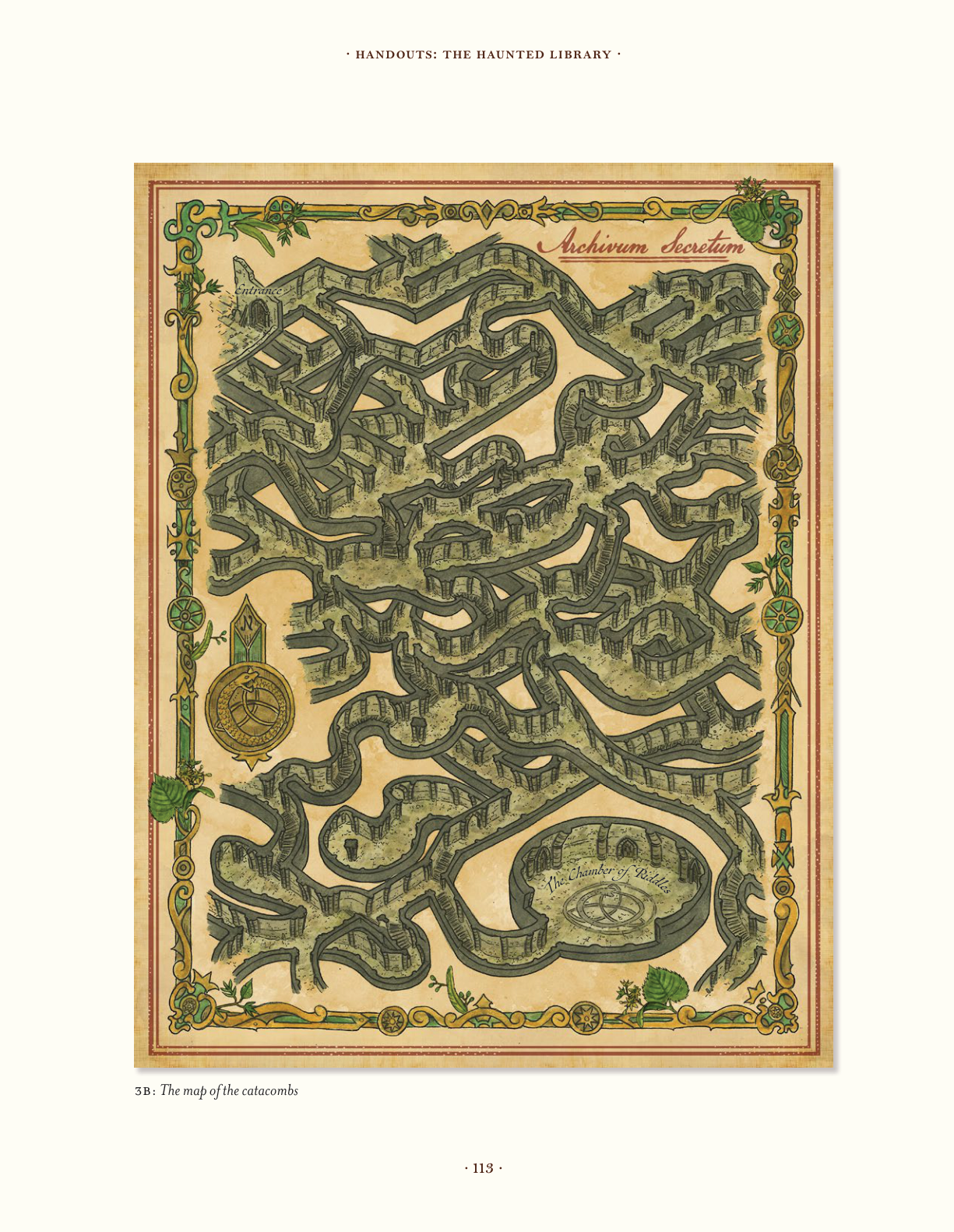
Handouts print at the back of VAE CMN covering all of its mysteries — click to reveal one to the players.





Confrontation
p.35The player characters’ investigation can play out in a variety of ways. A likely ending is described below, but what actually happens depends on the player characters’ actions and you may need to adjust the final confrontation accordingly.
Solving the Mystery
The player characters will likely realize fairly early on that they are dealing with a werewolf – but who is the werewolf? Shortly after step 2 of the Countdown, they also have a second werewolf on their hands. The key to the mystery is figuring out the identity of the original werewolf. Circumstantial evidence points to Ester Volk:
- All victims were murderers themselves. This suggests that someone in the justice system is responsible (which Utterson can also mention if the players need a nudge in the right direction).
- The initial victims all passed through Volk’s morgue (where her lycanthropic senses picked up the murderers’ scent).
- Volk is sensitive to strong smells, which is odd for a coroner. Sverker von Essen wore a strong perfume that smelled of lavender.
- Volk has green eyes, which is quite unusual – just like the beast that attacked Jens Svärdh, according to his wife (page 33).
- After the murder of the organist at Saint Gertrude’s Church, the characters can find a trail of blood. Volk in werewolf form cut herself on the church window on her way out, and the characters may notice a fresh wound on her forearm after this event (page 33). After step 3 of the Countdown, when Svärdh has turned into a werewolf, Volk concludes that her curse cannot be controlled and must be stopped at all costs. She chains herself in her basement vault and does not show up for work. The characters find out about Volk’s absence if they visit the police station. If you want to make it easier for the players, you can have Utterson come to the characters and tell them that Volk is missing. The obvious place to search for Volk is her home (page 35). The characters should come here at night, or at least after dark, when the streets are lit by a large full moon.
A Werewolf in Chains
If the player characters visit Volk’s apartment after step 3 of the Countdown, Mrs. Stefansson lets them in immediately. She is deeply concerned as Doctor Volk recently came home (shortly after step 3) and was very upset. She has not been seen since, and Stefansson has heard strange screams and cries from the apartment.
The housekeeper has not dared to enter the apartment, but she is happy that the characters are here and lets them in with her spare key. If they search the place, they must still pass an INVESTIGATION roll to find the secret door. On failure the characters hear a howling sound coming from the bookcase – do not make it too difficult to find the entrance.
In the basement, Doctor Volk has chained herself to the wall after realizing that she is the killer and is losing control of herself. The key is on the floor next to her. She explains that she has been trying to create an elixir to control her transformations, but it is not working. In great anguish, she asks the characters to kill her: “It’s the only way to stop the disease. There is no cure.”
Curing a Werewolf
Let the player characters discuss what they want to do. According to the information found in the National Archives (page 31) – and the Vaesen art book – there are three ways to break a werewolf’s curse:
- The werewolf is killed with a silver weapon.
- The werewolf rips out and eats the unborn child of a pregnant woman.
- Someone close to the werewolf calls it by its real name. However, this method only lifts the curse temporarily – the person transforms again at the next full moon. If the characters lack this knowledge, Volk can tell them herself. She refuses to consider option two above and she has no loved ones in her life (Utterson does not count). Volk therefore concludes that the characters must kill her with a silver weapon. If they do not have one of their own, there is a revolver with silver bullets on a table.
Utterson Shows Up
Before anything conclusive happens, Commissioner Utterson shows up. He too has become suspicious of Volk and wants to question her. He does not believe in werewolves and demands that the characters immediately release Volk and take her to the police station for questioning. If they refuse, he will do it himself.
The characters can MANIPULATE him into staying out of it – and even letting them kill Volk – but they must then win an opposed roll against Utterson as he is actively against the idea. He will then leave the basement and let the characters handle it.
The Second Werewolf
In the middle of the confrontation with Volk and/ or Utterson, the player characters hear thuds and screams coming from street level – Mrs. Stefansson shrieks in terror. If Utterson just left the basement, he too can be heard shouting from above.
If they rush upstairs, the characters encounter a terrible beast – Doctor Svärdh in the form of a shaggy werewolf. Stefansson (and Utterson if he is still there) are by the doorway, shocked but unharmed. All player characters must make a Fear test against Fear value 2 (1 if they have encountered a werewolf before). Combat: The werewolf immediately attacks, and the characters have a very tough fight ahead of them. For stats, see page 160 of the rulebook. Killing the werewolf requires silver weapons, otherwise it flees when Broken and will soon return to kill more victims on the streets. Mrs. Svärdh: A clever way to defeat Svärdh in werewolf form is to seek out his wife Märta at the couple’s apartment on Merchants Street. If she addresses him by his true name, Svärdh reverts to human form and becomes much easier to deal with. Werewolf Versus Werewolf: If Volk is still alive when Svärdh attacks, she begs the characters to release her so she can fight the other werewolf. If they do, she turns into a werewolf within one round and then engages Svärdh. The two werewolves have at each other in a brutal duel that spills out onto the street.
Finally, Volk rips Svärdh’s throat out with her fangs, killing him instantly. With inscrutable eyes and bloody jaws, Ester Volk glares at the player characters, hesitating for a moment before rushing off into the darkness. She then leaves Stockholm and flees into the countryside. If the characters try to stop her, her rage takes over and she fights to the death – or until she manages to escape.
Aftermath
p.37If the player characters kill or capture Jens Svärdh, they have prevented the Catastrophe and solved the mystery. They should also be awarded additional experience points if they:
- Found out who murdered the poor girls from the White Hills.
- Solved the poisoning of conductor Mortimer Cronstedt.
- Exposed Doctor Svärdh’s ghoulish experiments.
- Sent the money from the dying Johan Petterson in the White Hills to his family in Smolandia. The killings stop and calm settles over Stockholm – for now. The City of My Nightmares campaign continues in the next mystery, set a few months after this one. If Ester Volk is alive, she flees the capital and is never seen again – or maybe the player characters will meet her again at some point?
Lysander
August T. Lysander can visit the player characters during the aftermath of the mystery, before they leave Stockholm or when they are back in Upsala. He thanks them for their efforts (or expresses his sympathies if the Catastrophe occurred). He also offers to take care of Ester Volk’s work and ensure that her findings are preserved. Finally, Lysander bids them farewell with the assurance that they will soon meet again.
Scent of a Killer - Handouts
p.1061A: The letter from August T. Lysander
FROM THE OFFICE OF Lysander Cork Factories Inc.
Nº 20 Shipside St., Stockholm
Esteemed members of the Society,
The capital is in need of your expertise. Four weeks ago, there was a brutal murder at the Royal Opera and my friends in the police are at a loss. The tenor Sverker von Essen is dead! One of the nation’s most sublime voices has been silenced in a way that sends shivers down the spines of us opera lovers. So many evenings he carried us all to the heights of Elysium with his singing!
I cannot tell you any more about the murder in this letter, but I have reason to believe that the culprit is not human. Fear is spreading through the capital, and I do not want this murder to stir up further conflict in the city – the situation is tense enough as it is.
I am an old friend of the Society and know that some among you have abilities beyond those of the police. I have asked Police Commissioner John Gabriel Utterson to invite members of the Society as special advisers to the investigation and hope that you will accept this invitation. I have taken the liberty of purchasing train tickets, which are enclosed with this letter, and booked accommodation for you at the Golden Peace. I will of course cover all expenses, and the Society will be amply compensated for your work.
Yours sincerely,
August T. Lysander
1B: Train tickets
Five identical first-class Swedish State Railways ticket stubs for the line from Upsala to Stockholm, C., price 5/— each, numbered 067 through 071.
1D: Utterson’s list of previous murders
May 23rd – Mire Lake
June 22nd – Grain Harbor Square
July 21st – Shipside Street
August 19th – Ship’s Lock
September 18th – The Royal Opera
1E: Friedrich Baum’s drawing
[Full-page illustration; no accompanying printed text.]
1F: Doctor Svärdh’s journal
Subject 16: 25 years old male. Good general condition. No sign of pulmonary tuberculosis. Weight 45 kg, height 160 cm. Laudanum administered preoperatively.
Graft: right forearm, 21 years old male, retrieved on October 27th from the Sofia Churchyard. Chilled for three days. Course of procedure: Amputation successful. Blood loss acceptable. The graft is infused with saline. Necrotic tissue minimal, can be attached after debridement. Indications of perfusion in the transplanted tissue.
Day 1: Patient receives regular analgesia. Develops fever and chills in the evening. The graft shows no signs of perfusion.
Day 2: Patient unconscious. Feverish. Clinical signs of sepsis. The graft is removed. Time of death: 16.37. Body discarded in the usual place.