VAE CMN · City of My Nightmares
Content warning — Child Harm, Mind Control, Violence
Also in this campaign
Wherein the player characters journey through time and space in search of lost knowledge, with unexpected help from the other side.
“On reaching a small secret chamber in the left wing, he leaned up against a moon- beam to recover his breath, and began to try and realise his position. Never, in a brilliant and uninterrupted career of three hundred years, had he been so grossly insulted.”
– The Canterville Ghost by Oscar Wilde
Prelude
p.62This first section describes the background of the mystery and the conflicts on which it is based. This mystery has a slightly different setup, lacking the countdown and catastrophe found in most other mysteries. Instead, the focus is on exploration and the search for knowledge. But first we will look back at the events leading up to the mystery.
Background
Despite the tragic events on Goose Island (see the mystery Song to the Moon in this book), cork magnate August T. Lysander (page 6) has continued trying to free himself from the spertus’s curse. In the course of his research he has made an amazing discovery: the first owner of the spertus now in his possession was none other than the world-famous botanist Carl Linnaeus.
Less well known is the fact that Linnaeus possessed the Sight and for a time was the leader of the Order of Artemis – his time’s equivalent of the Society. During his expeditions in Sweden in the 18th century, first to Lapland and then to Dalecarlia, Linnaeus kept a secret journal of his encounters with supernatural vaesen and stories told about them. He called the journal Homo Ferus – you can read more about this on page 81 of the core rulebook.
A few years after his expedition to Dalecarlia on behalf of County Governor Nils Reuterholm, Linnaeus suddenly announced that he was leaving the Society, claiming that he no longer had the Sight. Shortly thereafter, the Society’s headquarters was devastated by a fire that was believed to have destroyed all records of the Dalecarlia expedition.
Lysander suspected that Linnaeus’s strange behavior could be explained by the spertus (which is only partly true – the whole truth will be revealed at the end of this mystery) but refused to believe that Linnaeus’s studies on vaesen were really gone. Perhaps the key to the spertus’s curse could be found in Linnaeus’s lost writings? It was just a matter of finding them.
His hopes were raised when he learned that Linnaeus had used an old cellar vault under Knights’ Isle in Stockholm as his private study and library. It turned out that this vault was now located under the beautiful, newly built National Archives. This could not be a coincidence, thought Lysander, who now believed the National Archives had been placed in this very spot to preserve Linnaeus’s secrets.
But Lysander made a disappointing discovery when he visited the National Archives in search of Linnaeus’s secret library. The catacombs beneath the National Archives were a maze, impossible to navigate. Lysander suspected that only someone with the Sight could find their way to the library. Someone like Linnaeus himself.
Lysander’s suspicions are correct, but what he does not know is that the National Archives is haunted by the ghost of none other than Carl Linnaeus himself. The ghost will cause a lot of trouble during the characters’ visit, and to open the way to Linnaeus’s secret library, they must seek answers in the specter’s memories…
Conflicts
This adventure does not follow the usual template for mysteries with primary and secondary conflicts. Instead, this mystery allows the player characters to explore hidden parts of the National Archives and complete three challenges to find Linnaeus’s secret library and recover lost knowledge from his expedition to Dalecarlia. Each of the challenges has a conflict that the characters must resolve.
Invitation
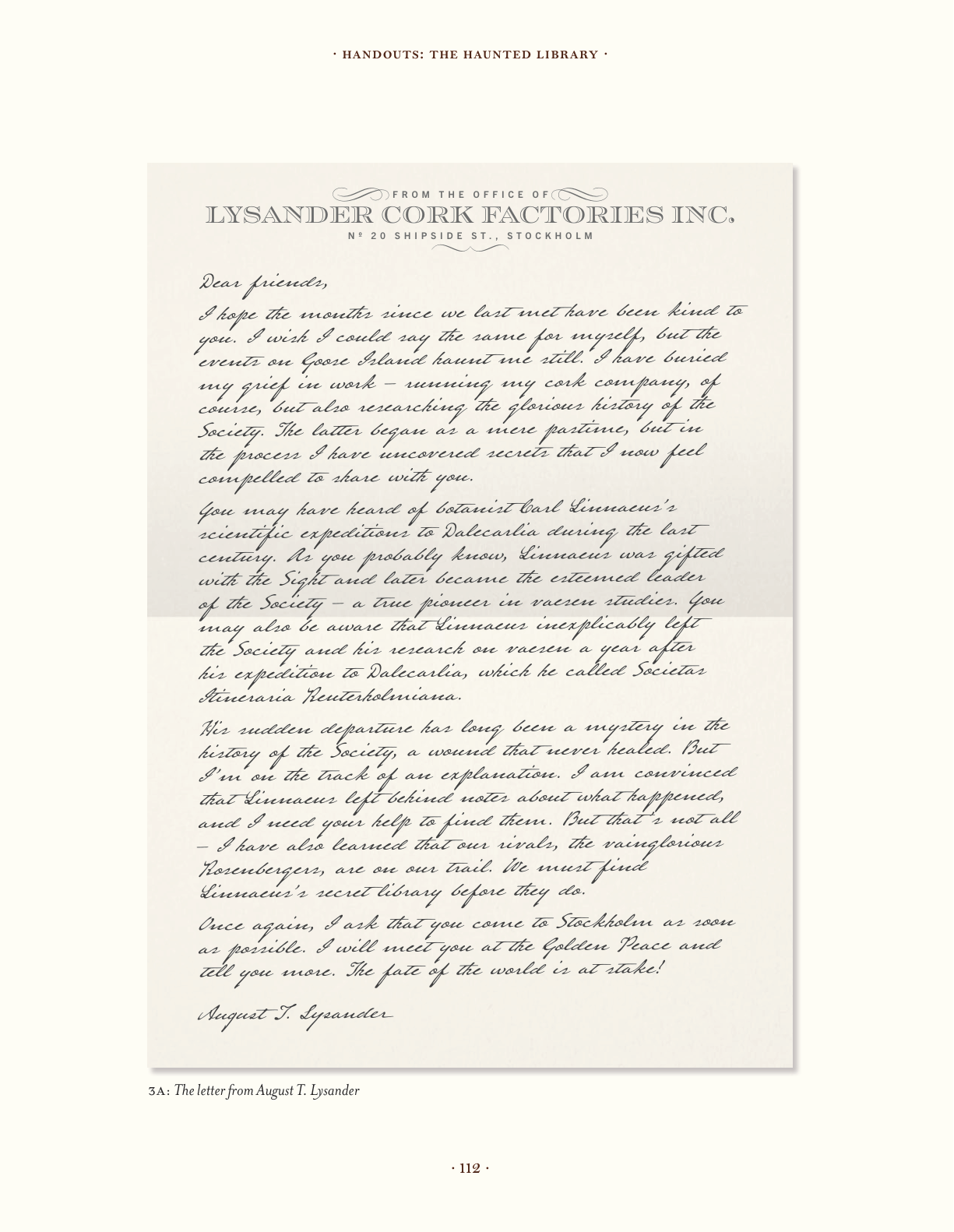
It is autumn and six months have passed since the dramatic events on Goose Island. The Society once again receives a letter from cork magnate August T. Lysander (handout 3A on page 112, also available for download on the Free League website): Dear friends, I hope the months since we last met have been kind to you. I wish I could say the same for myself, but the events on Goose Island haunt me still. I have buried my grief in work – running my cork company, of course, but also researching the glorious history of the Society. The latter began as a mere pastime, but in the process I have uncovered secrets that I now feel compelled to share with you.
You may have heard of botanist Carl Linnaeus’s scientific expeditions to Dalecarlia during the last century. As you probably know, Linnaeus was gifted with the Sight and later became the esteemed leader of the Society – a true pioneer in vaesen studies. You may also be aware that Linnaeus inexplicably left the Society and his research on vaesen a year after his expedition to Dalecarlia, which he called Societas Itineraria Reuterholmiana.
His sudden departure has long been a mystery in the history of the Society, a wound that never healed. But I’m on the track of an explanation. I am convinced that Linnaeus left behind notes about what happened, and I need your help to find them. But that’s not all – I have also learned that our rivals, the vainglorious Rosenbergers, are on our trail. We must find Linnaeus’s secret library before they do.
Once again, I ask that you come to Stockholm as soon as possible. I will meet you at the Golden Peace and tell you more. The fate of the world is at stake! August T. Lysander
Preparations
As usual, the player characters can prepare for the journey by purchasing equipment (page 73 of the core rulebook) or using Upgrades at Castle Gyllencreutz (page 89 of the core rulebook). They can research Linnaeus, and with a successful LEARNING test they find information about his public life and work (see the sidebar below).
If the player characters contact Linnea Elfeklint, she can tell them about Linnaeus’s tenure as head of the Society and his sudden resignation (page 81 of the core rulebook), as well as the schism with the Rosenbergers (page 82 in the core rulebook).
Carl Linnaeus
- Carl Linnaeus was a famous Swedish naturalist whose pioneering work in Systema Naturae laid the foundation for the systematic classification of plants, animals, and other organisms.
- Linnaeus was born in 1707 in Råshult in the parish of Stenbrohult in the Smolandia countryside. From an early age, Linnaeus showed an interest in plants, especially flowers. When Carl’s father was studying to become a priest, he adopted the name Linnaeus after a large linden tree that grew on his family’s farmstead when he was a boy.
- In the 1730s, Linnaeus made famous expeditions to Lapland and Dalecarlia to gather knowledge about flora and fauna.
The Journey
It is likely that the player characters will once again take the steam train from Upsala Central Station to Stockholm. As usual the characters can gain an Advantage during the journey (page 182 of the core rulebook).
Arrival
Once back in Stockholm, the player characters are free to go wherever they want, but sooner or later they will likely head to the Golden Peace in the Town Between the Bridges to meet with Lysander and possibly check into the hotel.
The tavern and hotel are described on page 22 in the first mystery of this book, Scent of a Killer. There the characters can be reunited with tavern keeper Henrik Öhman (page 24) and the poet Erik Johan Stagnelius, who is in a particularly melancholy mood and expressing it on the violin. Neither of them has a role to play in this mystery, but it might be fun seeing them again. Stagnelius will also return in the next mystery, so it might be good to remind the players of him. Feel free to show them his portrait again (page 23).
Lysander
At some appropriate time, Lysander appears and greets the player characters warmly, as if they were old friends. He then invites them to dinner at the restaurant. A fireplace and candles try to dispel the darkness and chill of autumn outside the windows.
Lysander says that he has spent the last six months researching the Society’s history, as a kind of therapy after the tragic events on Goose Island. He is convinced that the explanation for Carl Linnaeus’s sudden departure from the Society lies in his lost writings – particularly in Homo Ferus, Linnaeus’s secret journal of encounters with supernatural vaesen during his famous expeditions to Lapland and Dalecarlia in the 1730s.
Lysander has reason to believe that Homo Ferus is hidden in a secret library in a cellar vault beneath the newly constructed National Archives building on Knights’ Isle.
Unfortunately, this hidden chamber is impossible to find without the Sight, presumably to prevent unauthorized access to its texts. Lysander needs the Society’s help, and there is no time to waste – he has heard that the Rosenbergers, the Society’s rivals (page 82 of the core rulebook), are also looking for Linnaeus’s secret library. It would be disastrous if they found it first.
Truths and Lies
Lysander’s story is a mixture of truth and lies. His real reason for seeking Linnaeus’s secret library and Homo Ferus is that he believes the journal may contain a solution to the spertus’s curse. The idea that the Rosenbergers are looking for the library is a complete lie, invented by Lysander to create a sense of urgency and motivate the player characters.
What Has Transpired
IN THE CAPITAL?
The player characters may wonder what has happened in the nation’s capital since their last visit. If so, the following information can be provided by any of the adventure’s NPCs:
- The grisly murders of last autumn have stopped. Coroner Ester Volk has not been seen since (if she survived Scent of a Killer).
- Protests against the royal family have continued. Workers at the steam-powered Fire Mill have organized several demonstrations.
Countdown
This mystery does not follow the usual template and there is no disaster for the player characters to avert. However, there is a countdown of escalating events that may occur, caused by Linnaeus’s ghost that haunts the National Archives.
The specter can take several forms – a headless monk, a terrifying skeleton, or a ghostly apparition of Linnaeus himself in an 18th-century wig and old-fashioned clothes (see image on page 77). You are free to choose which of the following events occur, and in what order, or create your own ghosts to inflict on the characters.
- An icy wind suddenly sweeps through the room.
- The characters hear strange sighs and the rattling of heavy chains.
- Old portraits on the walls seem to be watching the characters.
- Their lanterns inexplicably go out.
- A headless figure in a monk’s cowl is seen reading a book or examining an inscription. If approached, the figure vanishes into smoke and the characters must pass a Fear test against Fear 1.
- The characters can see a ghost walking in front of them in a dark hallway. Suddenly it turns toward them, revealing its grimacing skull and letting out a terrible scream. The characters must pass a Fear test against Fear 2. Linnaeus’s ghost can appear in its true form once the player characters have passed through one or more doors in the Chamber of Riddles – see page 77 for more information. Practical Effects: You can use practical effects to make the haunting even spookier. For example, you can temporarily turn off the lights in the room if the player characters’ lantern goes out. Feel free to experiment to make the ghost’s presence more tangible.
Locations (8)
This mystery takes place at the National Archives on Knights’ Isle in Stockholm (see the map below), in tunnels and vaults beneath the building, and in hidden chambers that supernaturally allow the player characters to relive scenes from the life of Carl Linnaeus and his expedition to Dalecarlia more than a century earlier.
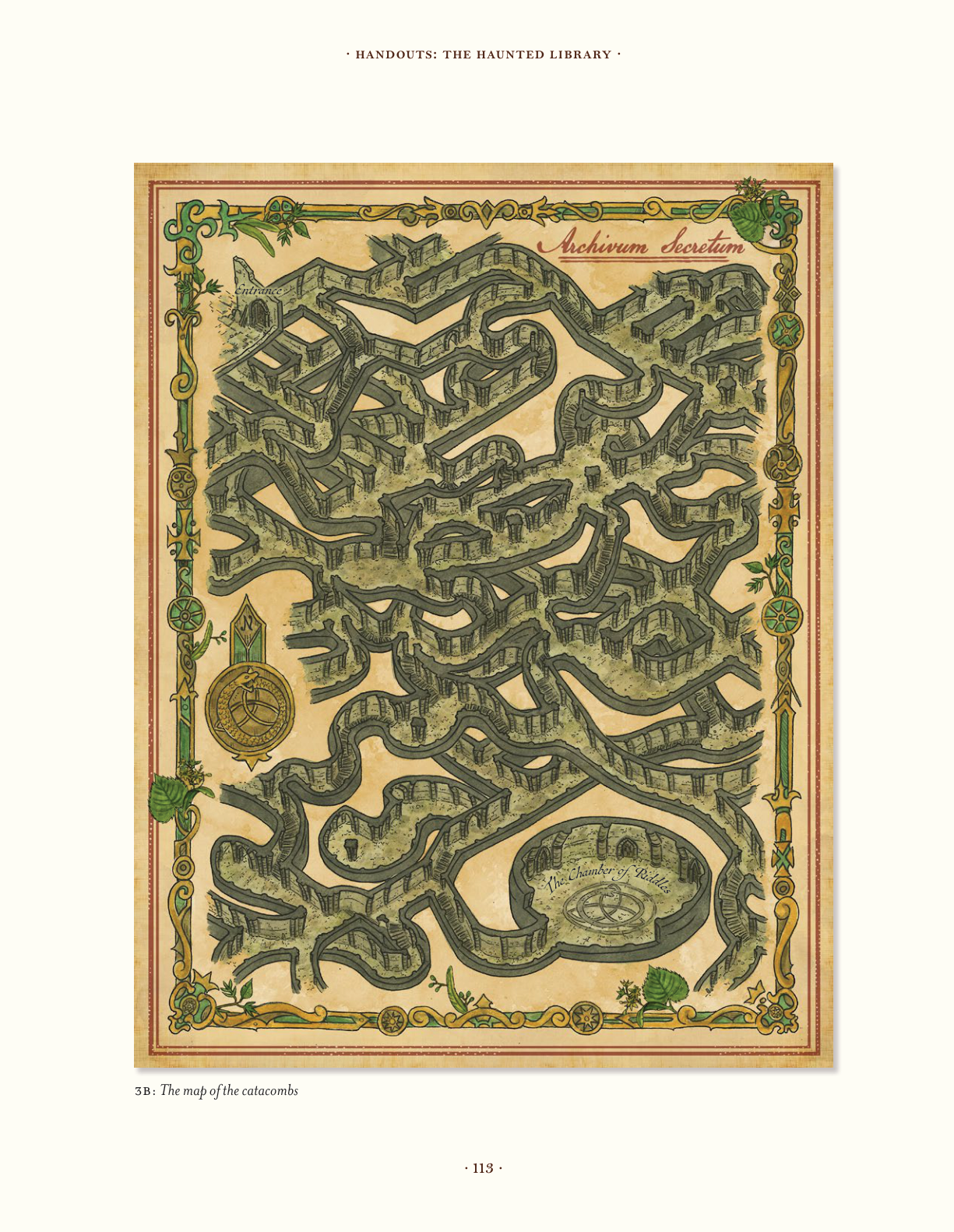
A map of the catacombs beneath the National Archives and the path to the secret library can be found on page 68. The characters can find this map in the Esoteric Section (next page).
Maps (3)


Entrance Hall
The National Archives has been collecting records, documents, books, and other items of particular importance to the realm for hundreds of years. It is one of Sweden’s oldest government agencies, dating back to the 13th century.
The impressive stone building on Knights’ Isle is newly constructed and built on a cast-iron frame to reduce the risk of fire. It will be familiar to characters who visited the archives in the first mystery of this campaign, Scent of a Killer. A wide stone staircase leads up to the first floor and the front desk.
The floors rest on iron beams and are supported by slender cast iron columns. A spiral book chute runs through the entire the stairwell. Light shines in through beautiful leaded windows. The bookcases are also made of iron and the doors of sheet metal. The National Archives is not open to the public.
Challenges
- The Archivist: Sitting behind the front desk is archivist Sigrid Holgersdotter, an ancient woman with round glasses and a stern face. Her gray hair is pulled back in a tight bun. Her behavior toward the characters depends on whether they have met before and, if so, how that meeting went. Unless the characters are already on very good terms with Sigrid, it takes a MANIPULATION test or a “donation to the organization” (cost level 2) for them to be granted access to the collections.
- Basement Vaults: If the characters ask Sigrid about vaults underneath the building, she admits that they exist and glances at an inconspicuous little door in the stairwell, visible from the front desk. She says that she cannot possibly let the characters walk around down there. Persuading her is difficult and takes another MANIPULATION test, this time a Challenging one (two successes required). If they fail, the characters must find a way to trick or sneak past Sigrid, or break into the National Archives at night or hide until it closes for the night. Do not make it too difficult for them.
Clues
- The City Archives: If the characters ask for information about the National Archives and the building itself, Sigrid refers them to the records and collections of the City Archives on the first floor.
- The Esoteric Section: If the characters are looking for works on vaesen and the like, Sigrid recommends the Esoteric Section on the second floor. If they ask specifically about ghosts, the archivist impishly mentions a manuscript entitled The Ghost of the National Archives that should be of interest to them.
The City Archives
The City Archives are located on the ground floor. Here the player characters can find documents about Stockholm and maps of the city’s districts and buildings.
Challenges
- Searching For Information: In the City Archives, the characters can find useful information about the history of the National Archives and Knights’ Isle. Each character searching for information can make a LEARNING test and gain a clue (see below) for each six rolled. If at least one character succeeds, they also find an old map of the labyrinthine passages beneath the National Archives, tucked between the ancient scrolls.
Clues
- The Greyfriars Monastery: The basement of the new National Archives is connected to old cellar vaults that originated from the medieval Greyfriars Monastery, one of the first buildings erected on Knights’ Isle. Back then the island was called Greyfriars Islet.
- The tunnels were expanded over centuries and connected many of the buildings on Knights’ Isle. It is said that in the 17th and 18th centuries, the cellar vaults were used as meeting places for secret societies.
- The Map: The old map of the passageways beneath the National Archives is shown on page 68 (handout 3B on page 113, also available for download on the Free League website).
The Esoteric Section
The Esoteric Section is located on the second floor. There are reading areas with leather armchairs, large potted plants on pedestals, and statues among the bookcases. The Esoteric Section contains not only writings, but also historical artifacts and large display cases with stuffed animals and dried plants collected during various expeditions.
Challenges
- Searching For Information: A player character seeking information about vaesen in the Esoteric section can make a LEARNING test to find useful knowledge (see chapter 8 of the core rulebook). If the gaming group has access to the Vaesen art book, the players may consult it freely as well.
- The Ghost of the National Archives: If a LEARNING test is made here, whether it succeeds or not, the player characters spot an interesting tome among a large number of leather-bound volumes on spirits and ghosts. It is an unpublished manuscript entitled The Ghost of the National Archives, written by archivist Sigrid Holgersdotter herself.
Clues
- The Ghost of the National Archives manuscript is a collection of humorous but bloodcurdling ghost stories, all set at the National Archives, where hapless visitors are scared out of their wits. It also includes drawings of the various specters.
- The Symbol: Several of the drawings show the symbol of an ouroboros in a triquetra (see illustration below). The player characters recognize it as the original symbol of the Society, used for centuries by their predecessors. Entrance Archivum Secretum Chamber of R e idd Th le s
- Sigrid: If the player characters ask Sigrid about the manuscript, she is noticeably flattered and says the stories are based on her own sightings of ghosts at the National Archives. After this it becomes easier for the characters to persuade her to let them into the cellar vaults (a normal skill test instead of a Challenging one). If the characters ask Sigrid about the symbol in the manuscript, she explains that it is found in several places in the library and in the stairwell leading down to the cellar vaults. She herself has never ventured very deep into the vaults. “It’s like a maze down there.”
The Cellar Vaults
Behind a low wooden door on the ground floor of the National Archives, an ancient stone staircase spirals down into the deep vaults beneath the building. It is pitch black and the player characters will need a light source. Sigrid has a lantern, but is reluctant to lend it to them unless she has already given them permission to enter the tunnels.
Challenges
The cellar vaults are dark and cold with water dripping from the walls. The player characters’ lantern only lets them see a few meters ahead. The map found in the Esoteric Section provides an overview of the tunnels, and the GM version of the map (previous page) shows a possible route through the maze. There are several ways for the characters to find the correct path to the Chamber of Riddles.
- The Map: The characters can use the map from the Esoteric Section.
- The Symbols: At each intersection, a small ouroboros in a triquetra – the Society’s own symbol – is carved into the wall at the correct entrance. These can be discovered with an INVESTIGATION test if the characters examine the walls of the vaults. Once they have found a symbol, they can easily notice more of them and find the correct path.
- Trial and Error: The player characters can wander aimlessly through the maze until they stumble upon the correct path. However, note that there are several tunnels leading out of the map. If the characters follow one of them, after a long walk through narrow passageways, they will suddenly emerge through a door in the Knights’ Isle Church or in an alley in the Town Between the Bridges.
- Hauntings: The characters should experience one or more hauntings (see Countdown on page 65) on their way through the vaults.
The Chamber of Riddles
If the player characters find the correct path through the labyrinthine passages beneath the National Archives, they eventually reach a large circular chamber with a high, vaulted stone ceiling. On the walls are gilded candelabras with candles. If the characters light the candles, they see the room in all its splendor.
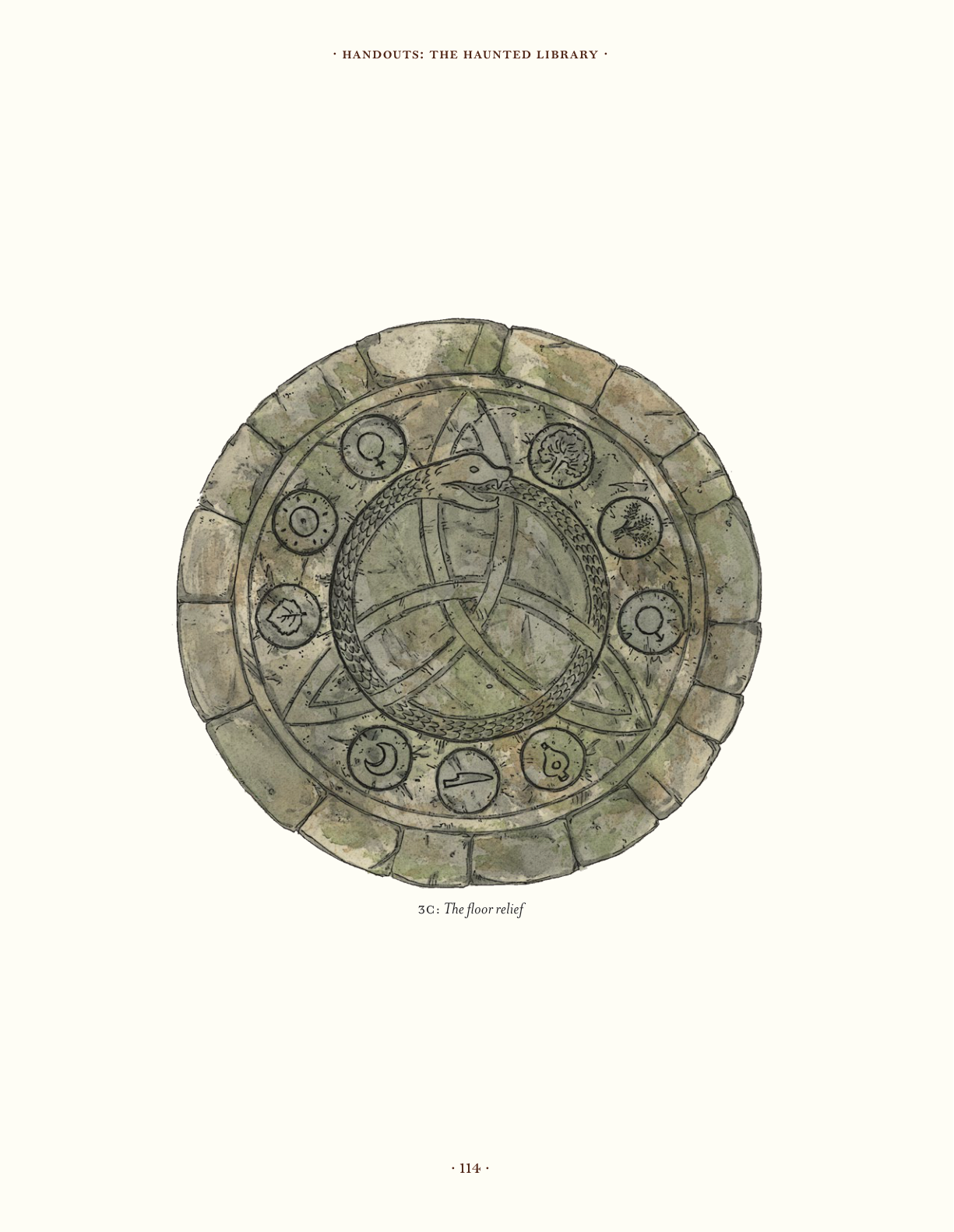
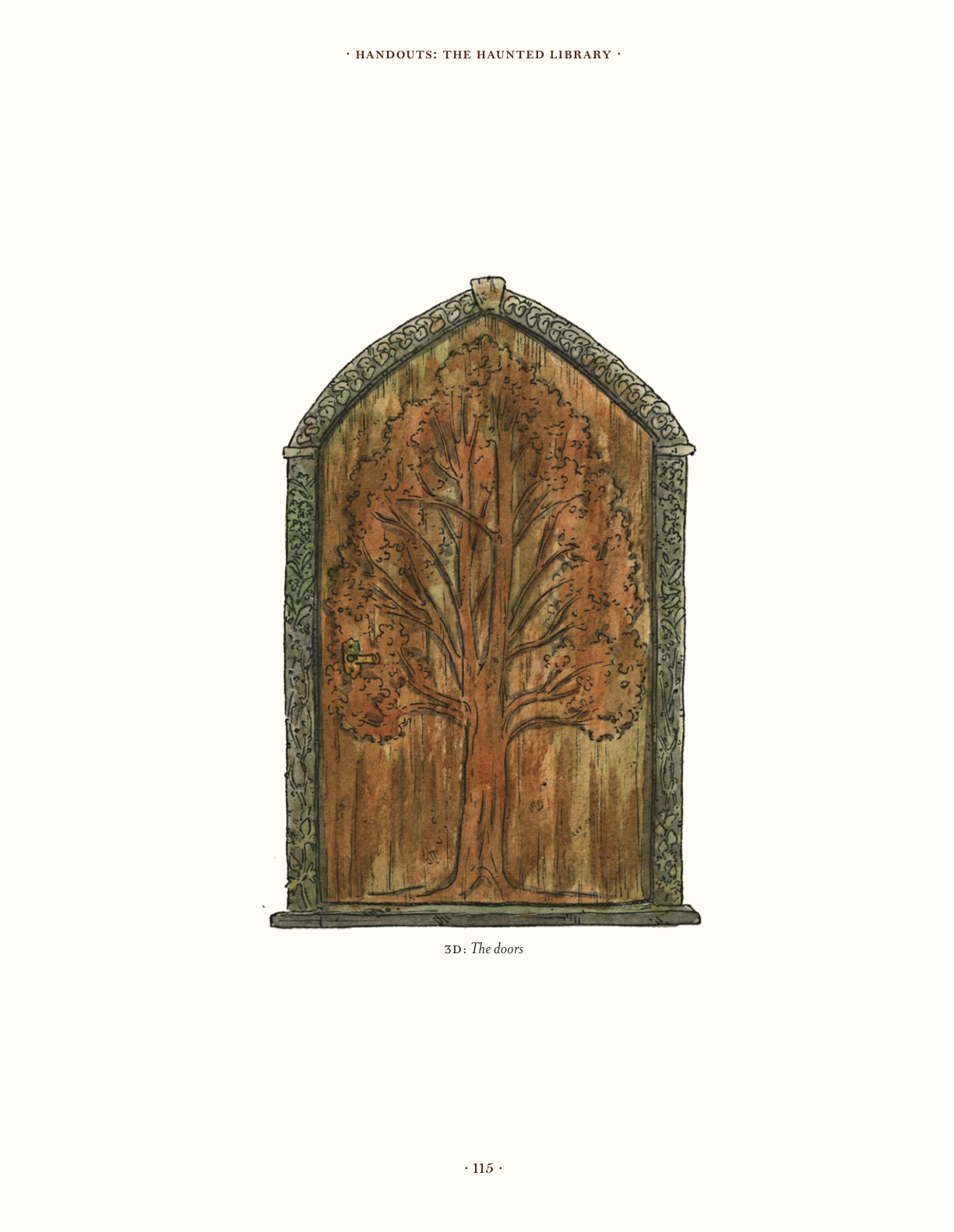
The ceiling is engraved with Latin words in gold lettering, and on the floor is a large ouroboros in a triquetra carved in a circle – once again the Society’s own symbol, but now surrounded by nine smaller symbols. Finally, the room has three identical arched doors leading in different directions, each decorated with a woodcarving of a beautiful tree.
Challenges
- The text on the ceiling reads “Nomina si nescis, perit et cognitio rerum.” A character who passes a LEARNING test knows that it means “Who knows not the names, knows not the subject” and that the quote is attributed to Carl Linnaeus.
- The floor relief is illustrated on this page (also available as handout 3C on page 114 and for download on the Free League website). Anyone who examines it realizes that the nine smaller symbols surrounding the Society’s symbol can be pressed down. A successful INVESTIGATION test reveals that the ouroboros in the symbol – the snake biting its own tail – is a separate round slab with a small gap between it and the rest of the floor. A character who passes a STEALTH test notices that there seems to be a hidden mechanism that could open a large hatch in the floor. The slab with the ouroboros is actually the door to Linnaeus’s secret library and the endpoint of the mystery (page 79).
- The Secret Passage: If the three correct symbols in the floor relief – and only those symbols – are pressed simultaneously, there is a loud rumble as the slab sinks about a meter into the floor, revealing a dark, narrow staircase that leads to the secret library. The symbols that must be pressed to open the secret passage are the sheaf, the bellows, and the knife. If the wrong three symbols are pressed at the same time, the mechanism is locked for an hour and the symbols cannot be pressed at all. Then the players will likely realize that they must pass through the three doors in the room to figure out the solution. If not, Linnaeus’s ghost can point this out to them (see the sidebar on page 77).
- Each door in the room is made of light wood and has a beautiful woodcarving of a large tree in the center. The door frame is carved into a wreath of seeds, sprouts, flowers, and leaves. See the image on page 69 (handout 3D on page 115, also available for download on the Free League website). A character who passes a LEARNING test realizes that the carvings represent a linden tree and its phases of growth. A successful FORCE test reveals that the doors themselves are also made of this light softwood. The doors – facing east, west, and north – have brass handles and open easily. On the other side it is dark and damp, and a cold wind sweeps into the room. See the sidebar on the next page for more information about the doors and where they lead. Door 1:
The Doors to Linnaeus’s Memories
The three linden wood doors in the Chamber of Riddles are part of an ancient locking mechanism created by Linnaeus and his disciple Hedda von der Burg, who had deep esoteric knowledge, to preserve the secrets of vaesen he discovered during his expeditions to Lapland and Dalecarlia.
For an ordinary person, the doors lead to empty stone chambers. But for a person with the Sight, they lead into Linnaeus’s memories. Each door leads to a specific memory and a challenge, which in turn provides a clue to one of the three symbols that must be pressed in the Chamber of Riddles to open the passage to the secret library.
As they pass through the doors, the player characters’ age, appearance, and equipment change and adapt to the environment in the memory on the other side. Each challenge involves a confrontation with a vaesen. The challenges can be solved through cunning or violence.
Let each character decide whether to enter a door, and if so, which one. A person who enters a door disappears from sight (including any light source) and does not respond if called. The player is temporarily out of the game until all characters have entered a door (or chosen not to).
No matter which door the characters choose, the first leads to Linnaeus’s childhood home (this page), the second to Reuterholm’s residence (page 74), and the third to the Dance of Death (page 77). If the characters enter different doors, play each challenge in the order above with the characters that are present.
Once the characters have passed through a door, it disappears behind them and they cannot return to the Chamber of Riddles until the challenge is completed, one way or the other.
Linnaeus’s Childhood Home
When the player characters pass through the door, they are swallowed by darkness. As their eyes adjust, they realize they are standing under a large linden tree at the edge of a garden next to a small, thatched cottage. It is evening and quiet. The moon illuminates the garden beds of flowers and vegetables. Tall birch trees with wiry branches cast long shadows across the yard.
The characters realize that they are child versions of themselves, perhaps eight or nine years old. They are wearing simple, old-fashioned peasant clothing and carry no equipment. Their stats are intact except for their Physique, which is temporarily halved (rounded up). Let the characters react to all this and think about where they are.
Before they can do anything else, they see a small shadow moving across the yard from the stable. It is a boy of the same age as them, dressed in similar clothes. He stops, takes a small wooden box out of his pocket, and seems to be talking to it.
Challenges
- The Boy: If the player characters make themselves known, the boy puts the box away. He speaks in a Smolandian dialect that sounds strangely archaic. He says his name is Carl Nilsson Linnaeus and that this is his family’s house in Råshult in the parish of Stenbrohult in Smolandia. Carl is eight years old and interested in all things in nature. If they ask him what year it is, he is puzzled. “The year of our Lord 1715 of course, don’t you know?” His parents are not at home – only he and his little sister Anna Maria are here.
- The Cottage: If the characters gain young Linnaeus’s trust with an INSPIRATION test, he lets them into the cottage and asks them for help. The cottage consists of a vestibule, a main room with a fireplace, a kitchen area, and narrow beds for the adults, and an inner room where the children sleep. Inside, sheaves of barley are hanging from the rafters to dry after the autumn harvest.
- The Box: If the characters pass a VIGILANCE test, they see Linnaeus spit into his box before entering the cottage.
- The Sister: Carl’s sister Anna Maria, who is in the cottage, has been having nightmares for the past few weeks and wakes up screaming every night. She says it feels like she is suffocating. Carl adds that he has seen an eerie black smoke creeping in through a knothole at night. He is determined to save his sister. If Carl has not let the characters into the cottage, they will instead hear Anna Maria screaming in terror later that night.
- Research: If the players have access to the Vaesen art book or the Codex Occultum booklet (included in the game’s starter set), they can figure out for themselves that they are likely dealing with a mare and get tips on how to banish it. Otherwise, you can have them make a LEARNING test to recall clues (see below). The knowledgeable young Carl can also make suggestions – he has heard stories about mares.
- The Ride of the Mare: Anna Maria eventually falls asleep in the children’s bedroom, and each player character must pass an OBSERVATION test not to do the same. Later that night, the mare (page 142 of the core rulebook) attacks. A dark mist sweeps toward the cottage like oily black smoke and enters the children’s bedroom through a knothole. The smoke gathers around Anna and forms a hideous female figure on her chest. If the characters show up or are already there, the figure turns to them, baring its sharp teeth before launching a furious attack. Sleeping characters miss the first round of combat.
- Banishing the Mare: The Mare can be banished by force or cunning (see Clues below). It takes damage from physical attacks, but remember that the characters’ Physique scores are halved and that they have no weapons with them. However, they can find an axe, a knife, and several chairs in the cottage that can be used as weapons. If all player characters are Broken, Carl eventually manages to drive the Mara away. Once it has been banished, the illusion of Linnaeus’s memory fades and the characters find themselves in a cold stone chamber with a door back to the Chamber of Riddles.
Clues
- Mare’s Brooms: The birch trees around the house are full of mare’s brooms – twigs growing in dense, sheaf-like clusters. A mare’s broom can be used to lure a mare (fast action). The mare must then make a MIGHT test – on failure, the mare must stop what it is doing and attack the character holding the mare’s broom on its next turn.
- Mare Cross: Drawing a mare cross – a five- or six-pointed star – on someone’s forehead protects that person from the mare’s attack. Doing so during combat counts as a slow action for both the drawer and the person being drawn on. If everyone around mare has a mare’s cross on their forehead, the creature flees, howling with rage.
- Counting Grains: The mare suffers from obsessive thoughts, which can be used to trick it – if someone throws grains or seeds in front of it (long action), the mare must pass a MIGHT test to resist counting them all, which consumes its next turn in combat. Sacks of grain and jars of flaxseed can be found in the kitchen.
- The Worm: If the player characters ask Carl about his box, he reveals that it contains his lucky worm. He has always wanted to know more about nature but had difficulty learning to read. One day two years ago, he fished the worm out of a stream, and he has done well in school ever since. He takes care of it because it brings him luck. The worm is of course a spertus (page 154 of the core rulebook), which clever players may realize. Under no circumstances will Carl let anyone take the box from him, not even for a moment.
- Barley Sheaves: Sheaves of barley are hanging from the rafters to dry after the autumn harvest. This, along with the sheaf-like mare’s brooms, will hopefully be enough for the players to realize that the sheaf is one of the three symbols to be pressed in the floor relief in the Chamber of Riddles. Door 2:
Reuterholm’s Residence
When the player characters pass through this door, they are enveloped in darkness, just like the first time. The door behind them is gone, but soon they hear a murmur of voices, music, and clinking glasses. They are in a dark room, a large linen closet, with a door – the voices and music are coming from the other side, and a sliver of light shines through the cracks.
Opening the door, the characters find themselves in an ornate hall with candelabras and mirrors. The decor is almost palatial in its grandeur. Outside there is a beautiful park with impressive flower urns, low hedges, and lavender bushes. A short distance away is a small chapel and a hill with a huge old tree stump. It is dusk, and a thin mist has settled over the lawn.
The characters now realize that they are wearing 18th century clothing, with white wigs, silk waistcoats, and ruffled shirts or extravagant dresses and powdered hairstyles. They are adults and have their usual stats, but lack weapons and equipment. They are in Linnaeus’s memory of his dinner with Governor Nils Reuterholm at his residence in Falun, just before the famous expedition in Dalecarlia in 1734.
A servant in a ruffled shirt, livery, and a white wig enters the room and offers them a glass of wine from a silver tray: “Welcome! Governor Reuterholm is waiting for you in the dining room – dinner will be served shortly. Your professor is already there.”
The dining room is beautifully set for dinner, with wines in crystal glasses. A large fireplace spreads light and warmth throughout the room. Among the gathered are Linnaeus himself, his student Hedda von der Burg, who is also the goddaughter of Governor Reuterholm, as well as the governor and his wife. Show their portraits to the players. “Welcome, apostles, you are just in time for dinner,” Linnaeus exclaims, and Reuterholm invites them to sit down.
Linnaeus (and everyone else) perceives the characters as members of his expedition and is completely oblivious to talk of strange doors and riddles. They are very excited about the upcoming expedition, and the characters are welcome to join the conversation. See Challenges for more information.
What no one in the group knows is that Reuterholm’s residence is built on land that contains an old fairy mound. The great linden tree that once grew on the mound was cut down and its wood was used to make the beautiful door that now adorns the entrance to the house. This angered the fairies, who caused all kinds of trouble during the construction. Now they seek revenge by trying to abduct Reuterholm’s goddaughter, Hedda von der Burg.
Challenges
- Linnaeus spends much of the dinner talking about his plans for the expedition, which he has named after Reuterholm. He looks forward to cataloging both the worldly and occult flora and fauna of Dalecarlia, and is excited about all the knowledge this expedition might bring. “Think of all the medical discoveries! All the knowledge of the seen and unseen!” As he speaks, his hand unconsciously reaches for his vest pocket.
- Reuterholm has different ideas than Linnaeus about the purpose of the expedition. He is superstitious and loyal to the crown. He believes the artifacts and knowledge from the expedition should go primarily to the king, to combat the threat of supernatural forces.
Clues
- The Bellows: A pair of bellows can be used as a weapon against fairies (damage 2, range 0, bonus to RANGED COMBAT). There is a copper bellows by the stove in the dining room, but only one. The significance of the bellows is hopefully enough for the players to realize that it is one of the three symbols to be pressed in the floor relief in the Chamber of Riddles.
- Holy Water: Splashing holy water (slow action) at the fairies can temporarily disperse them. They must make a MIGHT test, and if they fail, they lose their next turn. There is some holy water in a baptismal font at the chapel in the manor’s park. Door 3:
The Ghost Appears
If the player characters have passed through two of the doors and visited two of Linnaeus’s memories but not yet figured out how to use the floor relief and solve the puzzle, the ghost can reveal itself and help them along.
A shimmering figure appears to the characters. It is an older man wearing 18th century clothes and wig. See the adjacent image of Linnaeus’s ghost. The sight of him provokes a Fear test against Fear 1 (lower than normal as the ghost is not trying to scare them). He apologizes for startling them, saying that he is only trying to keep the curious away, but that they have shown good intentions.
“To prove yourselves worthy to enter my secret library, you must pass through the three doors and face the challenges that await within. Each challenge provides a clue to a symbol in the circle on the floor in front of you. Three symbols must be pressed simultaneously to open the passage; one for each challenge.”
The ghost of Linnaeus can also appear and admonish characters who are trying to figure out the right combination without going through all three doors – after all, once they have two symbols, there are only seven left to choose from. Note that the mechanism locks if they press the wrong combination of symbols, and stays locked for an hour.
The Dance of Death
When the player characters pass through this door, they are engulfed in darkness, as before, but soon find themselves treading through dense bushes. They arrive at a tall linden tree near a small village church and its cemetery, situated on a slope down to a dark river surrounded by deep woods.
The characters are in the same guise as in the previous memory, but much more practically dressed. They carry simple camping gear but no weapons, except for the character with the highest CLOSE COMBAT, who has a knife. Linnaeus himself is standing a bit ahead of them. Crouching behind some bushes, he once again greets the characters as his apostles. Hedda von der Burg is here as well.
It is night, and the intense sound of violins echoes in the darkness. Down by the riverbank is a clearing where people are dancing in pairs, swirling around four musicians in the moonlight. Several graves in the cemetery appear to have been vandalized. The earth has been dug up and the tombstones overturned.
Linnaeus signals for the characters to move closer to the crowd down by the river. As they approach, they see that the faces of the dancers are contorted with terror and pain. The ground beneath them is completely trampled, their feet bleeding or broken at unnatural angles.
A man swings around a woman hanging limply in his arms, seemingly lifeless. Farther away, they see the rotting corpse of a man leading a terrified, bridal-clad woman in dance. Two small skeletons of children in decaying clothes are standing in front of the musicians, listening to the melody as if entranced.
The faces of three of the musicians are filled with fear. They play the stirring polka with bleeding fingers on their violins. Behind them, closest to the river, stands a tall, dark-haired man with piercing eyes and a hat on his head. He smiles enigmatically and carries a beautifully carved lyre.
“My apostles, we must save these poor souls, but be careful,” warns Linnaeus.
Challenge
- The music is irresistibly catchy. Each round in the vicinity of the three bewitched musicians (i.e. in the same zone), the characters must pass an OBSERVATION test to avoid being drawn into the dance and losing their turn in the round. A new attempt may be made each round. The music continues until all three violinists are Broken (they do not defend themselves), the strings of their instruments have been cut (requires a successful CLOSE COMBAT test with a knife), the violins have been taken from them (requires an opposed FORCE test), or the Neck has been banished.
- The Neck: If the players have access to the Vaesen art book or the Codex Occultum booklet (included in the game’s starter set), it can help them figure out that the man with the lyre is the Neck (page 148 of the core rulebook) and provide tips on how to banish him. Otherwise, you can let them make LEARNING tests to gain clues (see below) or simply have Linnaeus help them. The Neck attacks any character who tries to stop the music and defends himself if attacked.
- A Familiar Face: A character who passes a VIGILANCE test finds the Neck’s face strangely familiar but cannot figure out why (this will be revealed in the next mystery).
- The dancers desperately seek the characters’ gaze with a silent plea for help – they cannot stop dancing. Their eyes are wide with fear. If the enchanting music is stopped, the exhausted dancers collapse to the ground and the walking dead revert to lifeless bones. But the Neck himself continues to fight until he is banished.
- The Lyre: When banished, the Neck turns into a toad that jumps into the river and disappears, leaving behind his lyre. It is beautifully carved and looks very old, decorated with symbols that the characters (with a successful LEARNING test) recognize as ancient Greek letters. Linnaeus picks up the lyre and notes that it is a very valuable and potentially dangerous artifact that must be protected and preserved. Then the illusion fades and the characters find themselves in a cold stone chamber with a door back to the Chamber of Riddles.
Clues
- Beeswax: If the player characters put beeswax in their ears (long action), they get to OBSERVATION to resist the music’s enchantment and the Neck’s Trollcraft spell DANCE. Linnaeus has beeswax in his pack and can recommend that they use it.
- Knife: If a knife that has cut the strings of a violin (e.g. one of the musicians’ instruments) is stuck into the ground in the same zone as the Neck (long action), he cannot cast Enchantments and Curses in that zone or against anyone in it. The significance of the knife is hopefully enough for the players to realize that it is one of the three symbols to be pressed in the floor relief in the Chamber of Riddles.
- Christian Symbols: The Neck is also sensitive to crosses and other Christian symbols. If anyone in the same zone shows him such a symbol (long action), he must pass a MIGHT test (not an action) or be forced to leave the zone on his next turn. If the Neck is completely surrounded by Christian symbols, he is immediately Broken and banished.
Cast
Carl Linnaeus p.75
In 1734, Linnaeus is 27 years old. He is excited about his expedition, but also a bit worried that Reuterholm will claim any discoveries he makes about vaesen in the name of the King. Linnaeus favors more casual attire during expeditions, but for the evening he wears a ruffled shirt, an embroidered silk waistcoat, and white wig. In one pocket he carries a gilded snuff box containing the spertus. Linnaeus’ eyes darken when the subject comes up. Let the player characters join the discussion if they wish. With good role-playing, and successful MANIPULATION or INSPIRATION tests, they can mediate between Linnaeus and Reuterholm.
Hedda Von Der Burg p.75
One of Linnaeus’s students and Reuterholm’s goddaughter. She wears a white wig and a silver brocaded silk dress with side hoops. A botanist, orientalist, and cook, Hedda was active in scientific circles from an early age, and at the age of 25 she wrote her dissertation De Acetariis on the subject of salad plants. She is convinced of their beneficial effects on the body. She has made several trips to India and the Middle East and published a cookbook on vegetarian diets and the medicinal properties of herbs. She is happy to discuss this at length and also gives tips on salad plants to eat.
Hedda von der Burg has the Sight and a special interest in Chinese puzzle boxes, which comes in handy when she later builds the magic lock for Linnaeus’ secret library (page 5) together with him.
- Hedda von der Burg speaks passionately about the importance of naming plants, animals, and other creatures for the advancement of human knowledge. Reuterholm believes this information must first and foremost benefit the nation. Linnaeus waves enthusiastically at the player characters and asks for their opinions. He then ends the conversation by saying “ ‘Nomina si nescis, perit et cognitio rerum.’ ‘Who knows not the names, knows not the subject.’ Remember this, my apostles.” After this, Hedda von der Burg excuses herself and leaves the table for a while. She goes out into the park to get some air, walking past the chapel and over to the mound with the tree stump. The characters can follow her if they wish.
- The Snuff Box: With a successful VIGILANCE test, the characters see Linnaeus fidgeting with a gilded snuff box with his monogram “CL” on it. When asked about it, he smiles secretively and calls the box his “little lucky charm” but will not say more about it. Astute players may recall that the snuff box resembles the one they may have seen August T. Lysander carry in previous mysteries (page 25 and 43). If the players want to know if it is the same box, you should say that it could be but that it is impossible to say for sure. Linnaeus will not open or part with the box under any circumstances.
- The Attack of the Fairies: Shortly afterwards, a scream is heard from the garden. Hedda von der Burg is standing in a ring of mushrooms growing around the stump of an old linden tree – a so-called fairy ring. She appears to be under attack by a swarm of insects. With a successful VIGILANCE test, the characters can see small winged fairies tearing at her clothes and trying to drag her to a hole in the ground at the roots of the tree stump. “Hurry, my apostles! It looks like our skills are needed,” shouts Linnaeus. If any player characters are with Hedda von der Burg on the mound, they are attacked as well.
- Banishing the Fairies: The fairies will attack anyone who enters the fairy ring. For more on fairies and how to combat them, see page 164 of the core rulebook. Note that they get to MAGIC because it is dusk. Fairies can be dealt with by cunning or violence. If the players have access to the Vaesen art book or the Codex Occultum booklet (included in the game’s starter set), the texts can provide useful tips on how to banish them. Otherwise, you can let them make LEARNING tests to gain clues (see below), or simply have Linnaeus help them.
- Reuterholm: When the interlude is over, Governor Nils Reuterholm storms out into the yard, red with rage. “Fairies, in my own garden! Linnaeus, I told you these creatures you’re so passionate about are a danger to the public. They must be controlled – fought in the name of the king!” Then the illusion of Linnaeus’s memory fades and the characters find themselves in a cold stone chamber with a door back to the Chamber of Riddles.
Musicians p.78
Fake Rosenberger p.80
by Lysander, but the player characters have no way of learning that now.
The fake Rosenbergers, including Karl-Axel Trygg, are as many as they are. If the characters refuse to hand over the book, it will likely result in combat. Clever maneuvers and diplomacy on the characters’ part should be rewarded, but the Rosenbergers are not easily fooled.
If there is a fight, the Rosenbergers will flee if half of them are Broken or when Linnaeus’s ghost appears (below). If possible, they will try to take the book Homo Ferus with them. Lysander’s hands are tied and he does not take part in the fight.
Handouts (15)
Handouts print at the back of VAE CMN covering all of its mysteries — click to reveal one to the players.
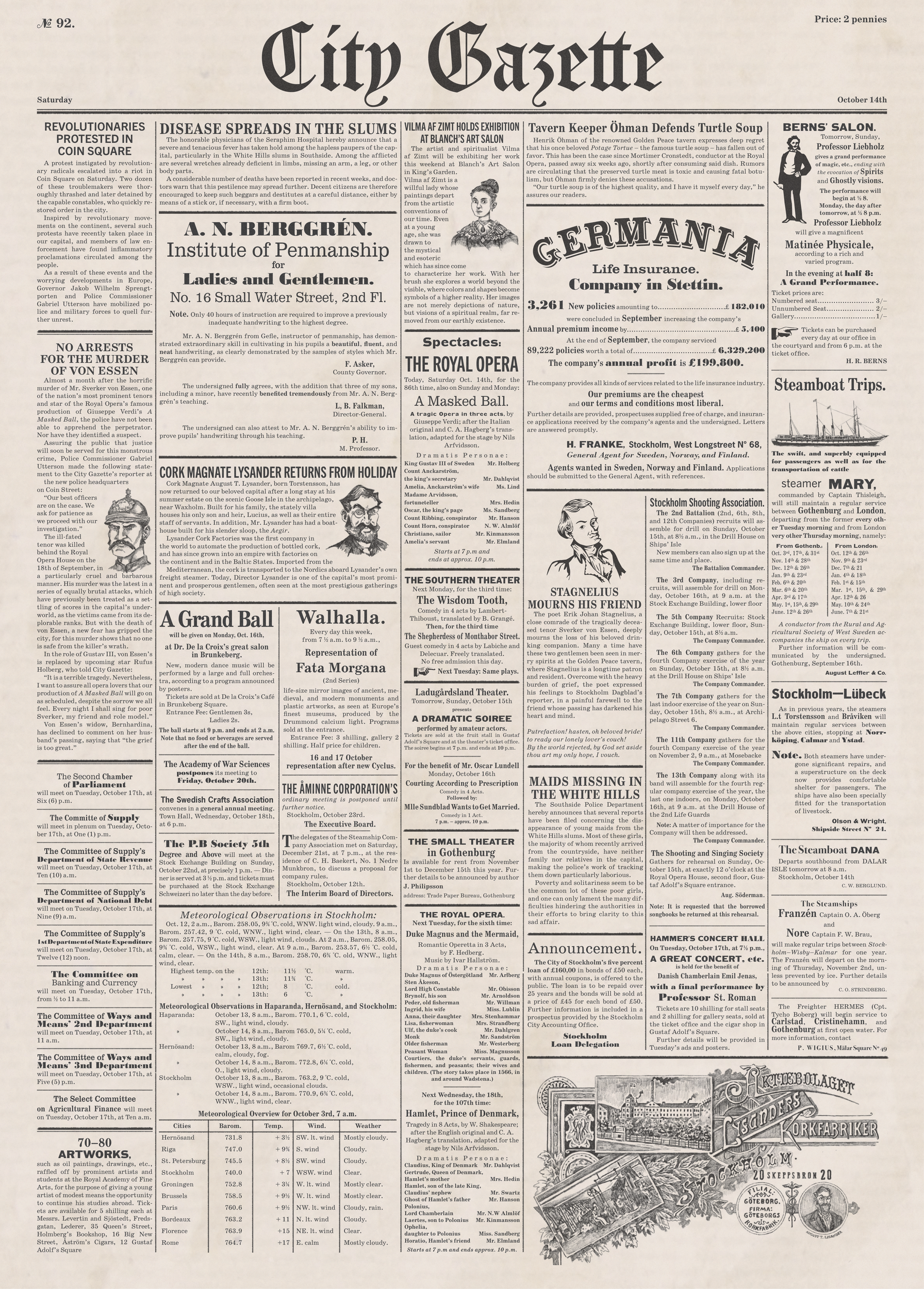
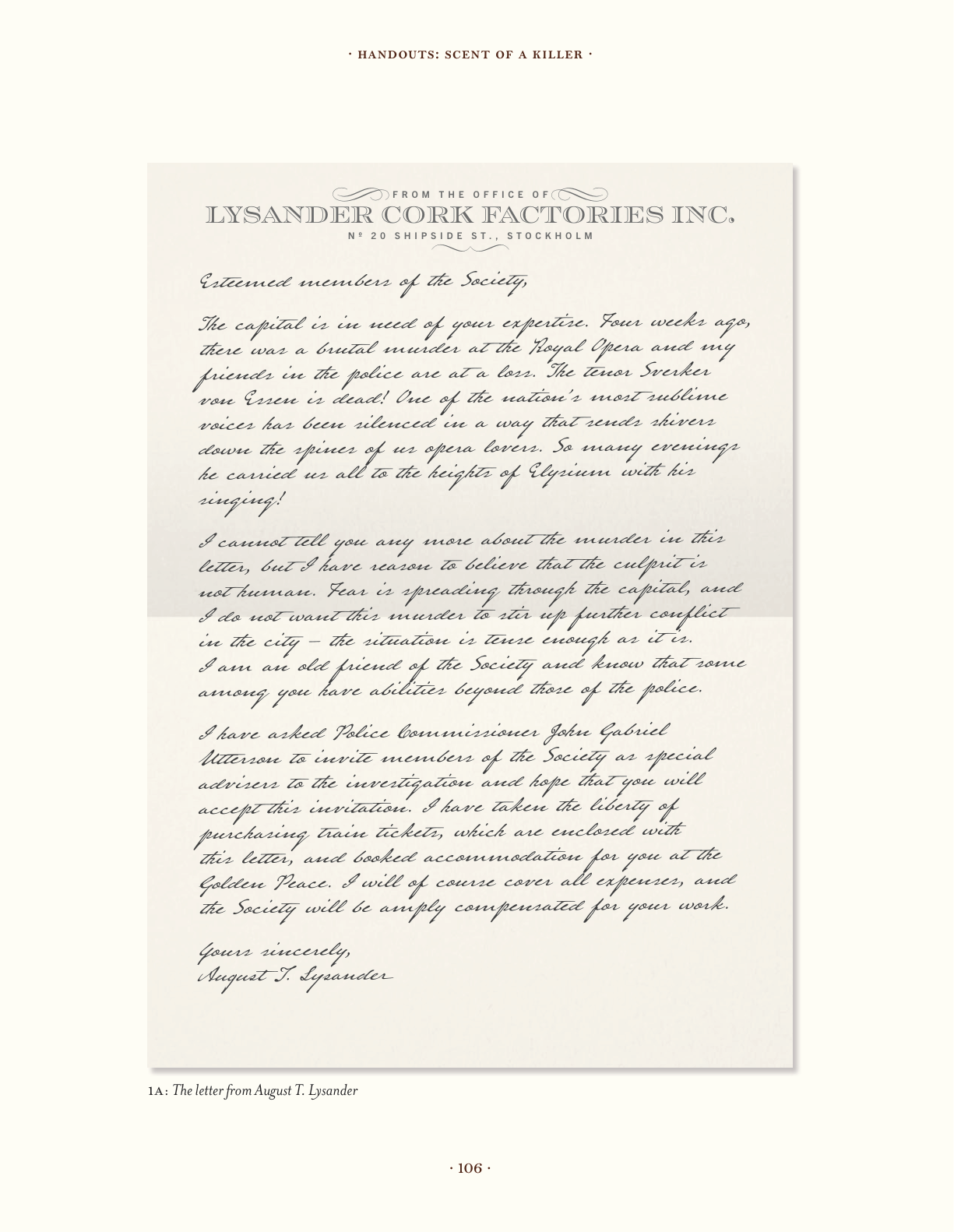
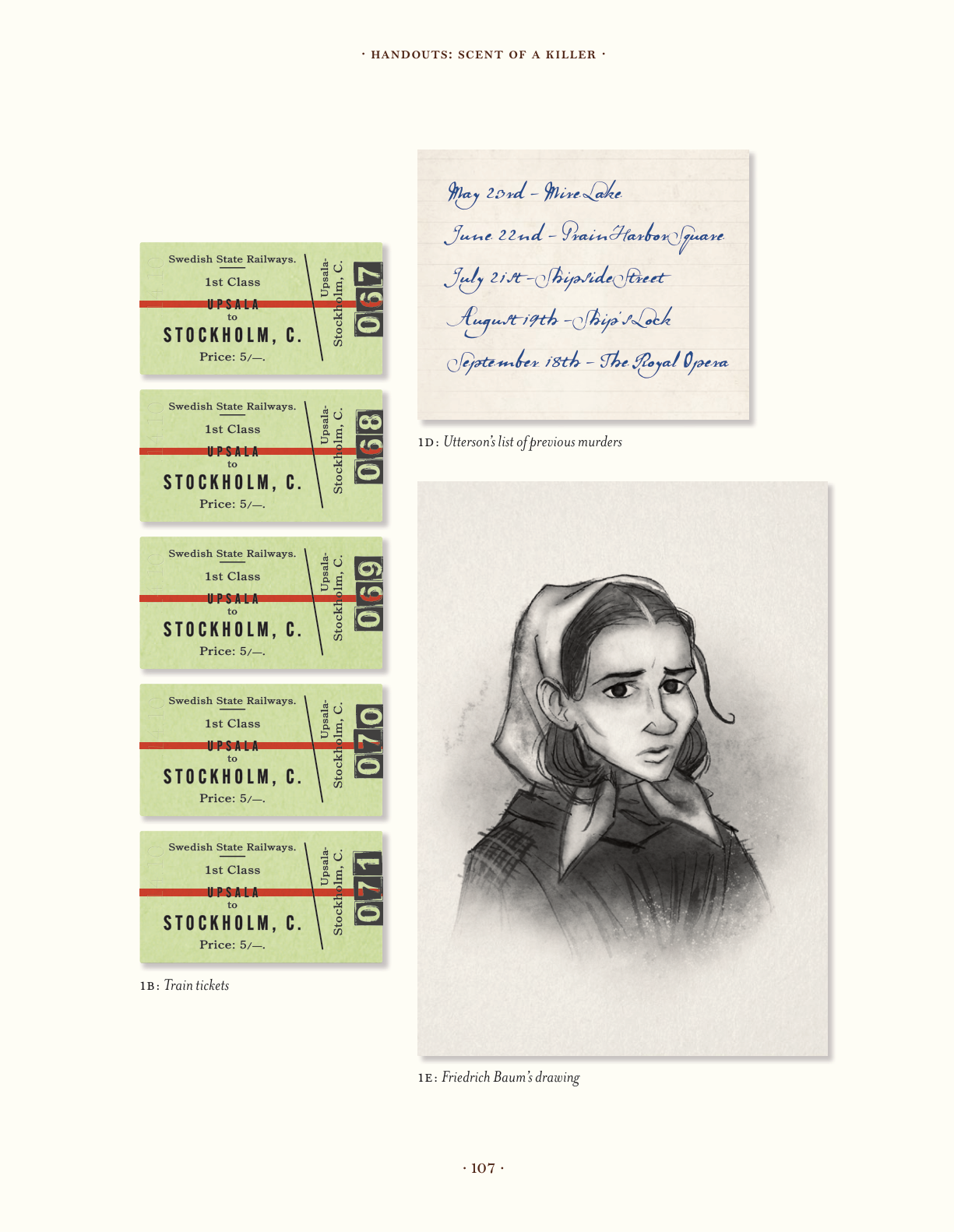
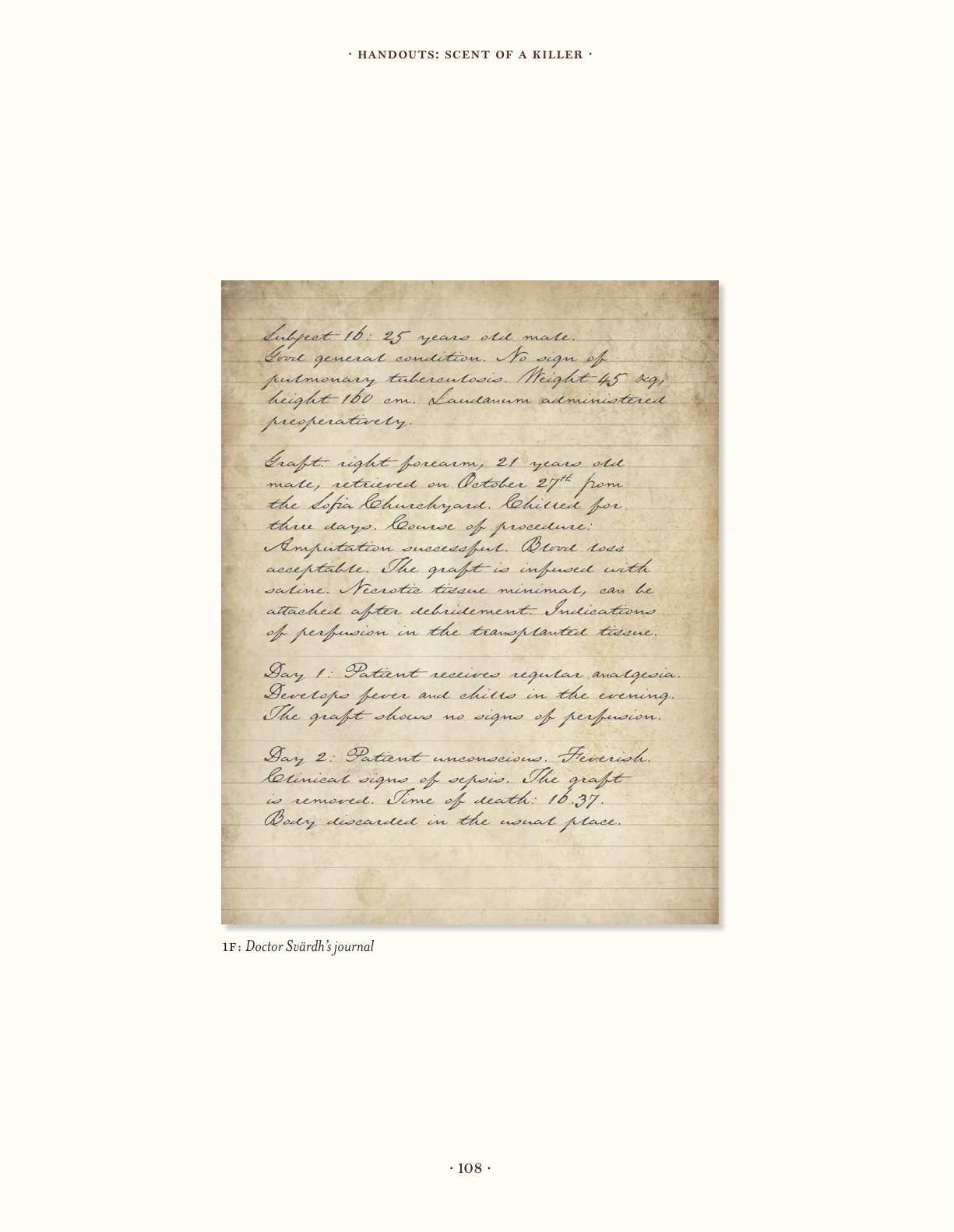
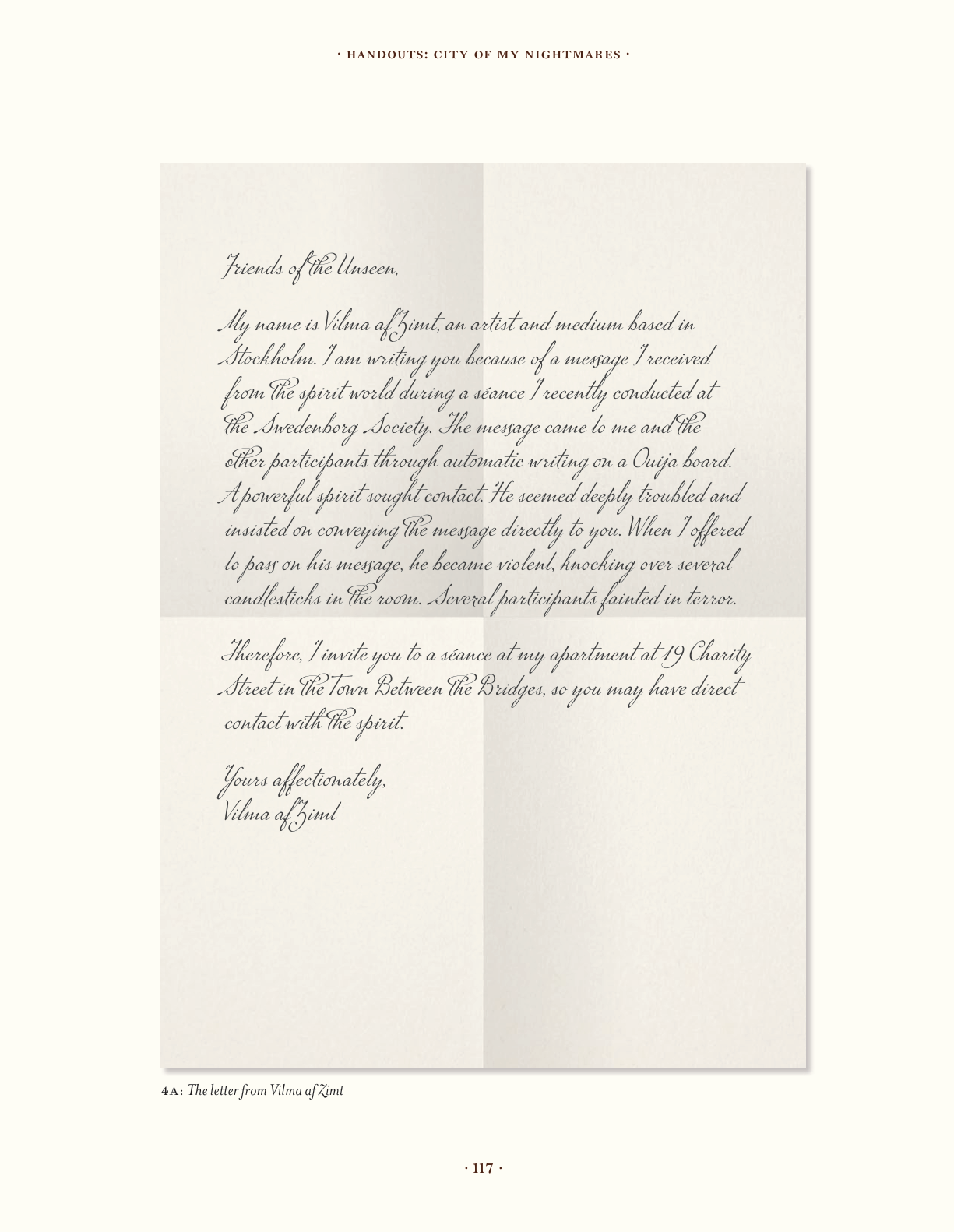
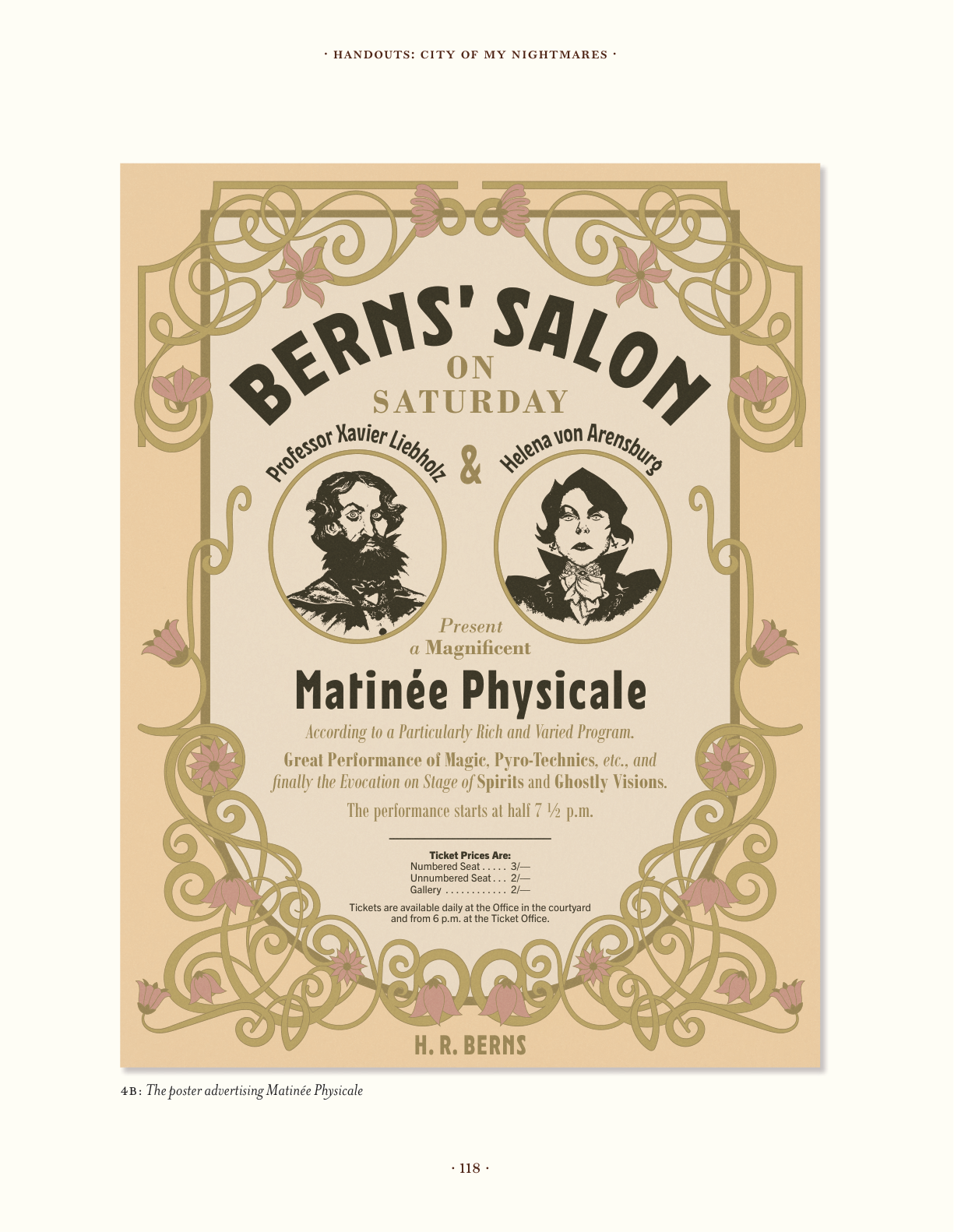

Confrontation
p.79If the three correct symbols in the floor relief are pressed at the same time, there is a loud rumble as the inner slab sinks about a meter into the floor, revealing a dark, narrow staircase that leads to the secret library. The player characters can take a gilded candelabra with them if they have no other light source.
The stairs lead to a small, dusty stone chamber lined with bookshelves containing hundreds of old writings and notes. On one of the walls hangs a painting of Linnaeus on his Lapland expedition (see adjacent image). The letters “CL” are carved into the floor, and a thick book of handwritten pages lies open on a lectern. This is Linnaeus’s secret library, and the book is Homo Ferus.
Linnaeus Appears
If the ghost of Linnaeus has not previously appeared to the player characters in his true form (see sidebar on page 77), he does so now, before they start examining the room and the book. A shimmering figure appears before them. It is an older man wearing 18th century clothes and wig – see the image of Linnaeus’s ghost on page 77. The sight of him provokes a Fear test against Fear 1 (lower than normal as the ghost is not trying to scare them). If the characters have seen the ghost before (see sidebar on page 77), they do not need to roll this time.
“Friends of the Unseen, welcome! You have proven yourselves more than worthy of my writings!”
Let the characters react and talk to Linnaeus’s ghost. However, he does not have time to provide any useful answers before the next phase of the drama occurs.
Trouble in the Library
Suddenly, the player characters hear footsteps coming down the stairs. August T. Lysander enters the library with an enigmatic expression on his face and his hands behind his back. His pained look is soon explained as Lysander’s valet Karl-Axel Trygg walks behind him with a drawn revolver, followed by some burly men with guns. If Linnaeus’s ghost is here, he fades away.
“I’m so sorry,” says Lysander bitterly, hands tied behind his back. “They made me follow you here. I had no idea there was a snake in my midst.”
“Shut it, swine,” replies Karl-Axel Trygg. “I’m claiming the book for the Rosenbergers. Give it to me, or this day will be your last.”
Karl-Axel pulls up his coat sleeve and shows a tattoo of a howling werewolf head – the Rosenberger symbol. Let the player characters react. Of course, these “Rosenbergers” are fake and the attack staged
Karl-axel Trygg
Karl-Axel Trygg is described in more detail on page 53. His stats are repeated here.
Linnaeus Again
If combat breaks out in the library, Linnaeus’s ghost becomes very agitated. At the appropriate moment during the fight, the room suddenly turns freezing cold as the ghost reappears, hovering near the ceiling. His eyes glow red, and he wears heavy chains around his wrists and ankles. The ghost rattles his chains, sighing loudly: “Not again! When will the treachery end?”
The ghost cannot be reasoned with. The player characters must make a Fear test against Fear 1 (even though they have already encountered the ghost). Lysander and the Rosenbergers, who have not seen the ghost before, are struck by panic – Lysander freezes in terror and Karl-Axel Trygg flees if possible. After this, Linnaeus’s ghost vanishes until he reappears in the next mystery.
The Traitor
Lysander pretends to be shaken and swears that he had no idea of Karl-Axel’s connections to the Rosenbergers. The captured Rosenbergers (if any) refuse to answer questions, but Lysander promises to turn them over to the police. If the players want to know more about this organization, you can tell them what is written on page 82 of the core rulebook.
Aftermath
p.81After the showdown in Linnaeus’s secret library, this mystery is over. Lysander promises to look after the library and let the player characters visit it whenever they want. However, he is against taking any books from there. Linnaeus’s collection of writings technically functions as the Occult Library Upgrade at the Society’s headquarters (page 92 of the core rulebook), except that it requires a visit to Stockholm. If the Society already has an Occult Library, they get both effects.
Homo Ferus
Anyone who consults Linnaeus’s journal Homo Ferus gains to LEARNING tests concerning vaesen. A character who studies the book for a few weeks and spends 5 XP gets this bonus permanently and no longer has to flip through the book. It effectively becomes a new talent.
The Truth About Linnaeus
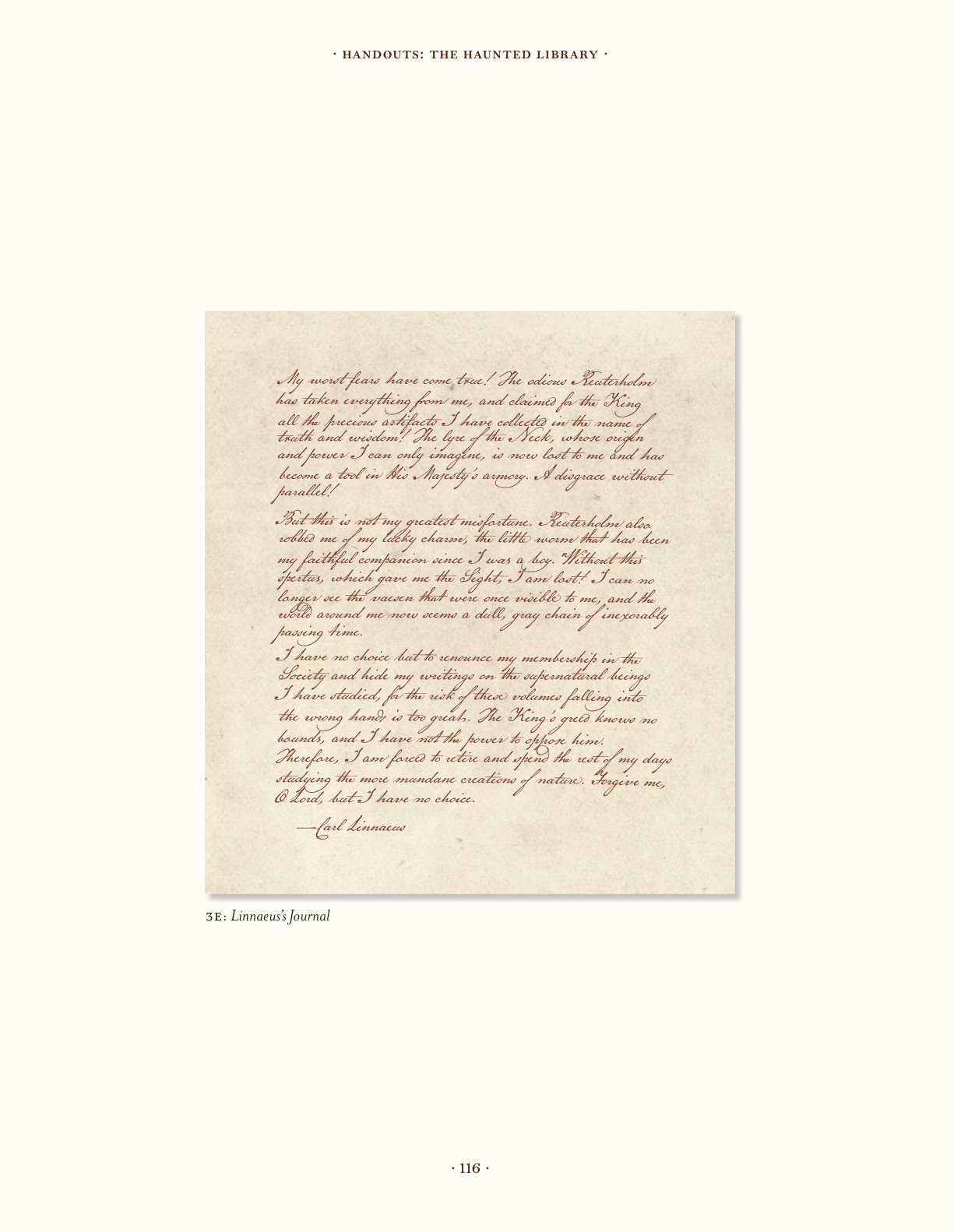
An entry at the end of Homo Ferus reveals what happened after the expedition to Dalecarlia and why Linnaeus left the Society. The entry in the adjacent sidebar is also available as handout 3E on page 116 and for download on the Free League website. There is nothing the player characters can do with this information at this time, but it will be useful in the next mystery.
Linnaeus’s Journal
My worst fears have come true! The odious Reuterholm has taken everything from me, and claimed for the King all the precious artifacts I have collected in the name of truth and wisdom! The lyre of the Neck, whose origin and power I can only imagine, is now lost to me and has become a tool in His Majesty’s armory. A disgrace without parallel!
But this is not my greatest misfortune. Reuterholm also robbed me of my lucky charm, the little worm that has been my faithful companion since I was a boy. Without this spertus, which gave me the Sight, I am lost! I can no longer see the vaesen that were once visible to me, and the world around me now seems a dull, gray chain of inexorably passing time.
I have no choice but to renounce my membership in the Society and hide my writings on the supernatural beings I have studied, for the risk of these volumes falling into the wrong hands is too great. The King’s greed knows no bounds, and I have not the power to oppose him.
Therefore, I am forced to retire and spend the rest of my days studying the more mundane creations of nature. Forgive me, O Lord, but I have no choice.
—Carl Linnaeus
The Haunted Library - Handouts
p.1123A: The letter from August T. Lysander
FROM THE OFFICE OF Lysander Cork Factories Inc.
Nº 20 Shipside St., Stockholm
Dear friends,
I hope the months since we last met have been kind to you. I wish I could say the same for myself, but the events on Goose Island haunt me still. I have buried my grief in work – running my cork company, of course, but also researching the glorious history of the Society. The latter began as a mere pastime, but in the process I have uncovered secrets that I now feel compelled to share with you.
You may have heard of botanist Carl Linnaeus’s scientific expeditions to Dalecarlia during the last century. As you probably know, Linnaeus was gifted with the Sight and later became the esteemed leader of the Society – a true pioneer in vaesen studies. You may also be aware that Linnaeus inexplicably left the Society and his research on vaesen a year after his expedition to Dalecarlia, which he called Societas Itineraria Reuterholmiana.
His sudden departure has long been a mystery in the history of the Society, a wound that never healed. But I’m on the track of an explanation. I am convinced that Linnaeus left behind notes about what happened, and I need your help to find them. But that’s not all – I have also learned that our rivals, the vainglorious Rosenbergers, are on our trail. We must find Linnaeus’s secret library before they do.
Once again, I ask that you come to Stockholm as soon as possible. I will meet you at the Golden Peace and tell you more. The fate of the world is at stake!
August T. Lysander
3B: The map of the catacombs
[Full-page map illustration; legible labels: “Entrance,” “Archivum Secretum,” and “The Chamber of Riddles” (the latter lettered along a curved path). No other printed text.]
3C: The floor relief
[Full-page illustration; no accompanying printed text.]
3D: The doors
[Full-page illustration; no accompanying printed text.]
3E: Linnaeus’s Journal
My worst fears have come true! The odious Reuterholm has taken everything from me, and claimed for the King all the precious artifacts I have collected in the name of truth and wisdom! The lyre of the Neck, whose origin and power I can only imagine, is now lost to me and has become a tool in His Majesty’s armory. A disgrace without parallel! But this is not my greatest misfortune. Reuterholm also robbed me of my lucky charm, the little worm that has been my faithful companion since I was a boy. Without this spertus, which gave me the Sight, I am lost! I can no longer see the vaesen that were once visible to me, and the world around me now seems a dull, gray chain of inexorably passing time. I have no choice but to renounce my membership in the Society and hide my writings on the supernatural beings I have studied, for the risk of these volumes falling into the wrong hands is too great. The King’s greed knows no bounds, and I have not the power to oppose him. Therefore, I am forced to retire and spend the rest of my days studying the more mundane creations of nature. Forgive me, O Lord, but I have no choice.
— Carl Linnaeus